
The EUR Rome District is a unique area in Rome, a place that not many tourists ever get to visit. I must admit I don’t often go there, but any time I go I enjoy the tranquility and the uniqueness.
I visited again on my most recent trip – there’s a popular sports and concerts venue – and while there I decided to explore a bit further and discovered some other fun places that you should also consider visiting.
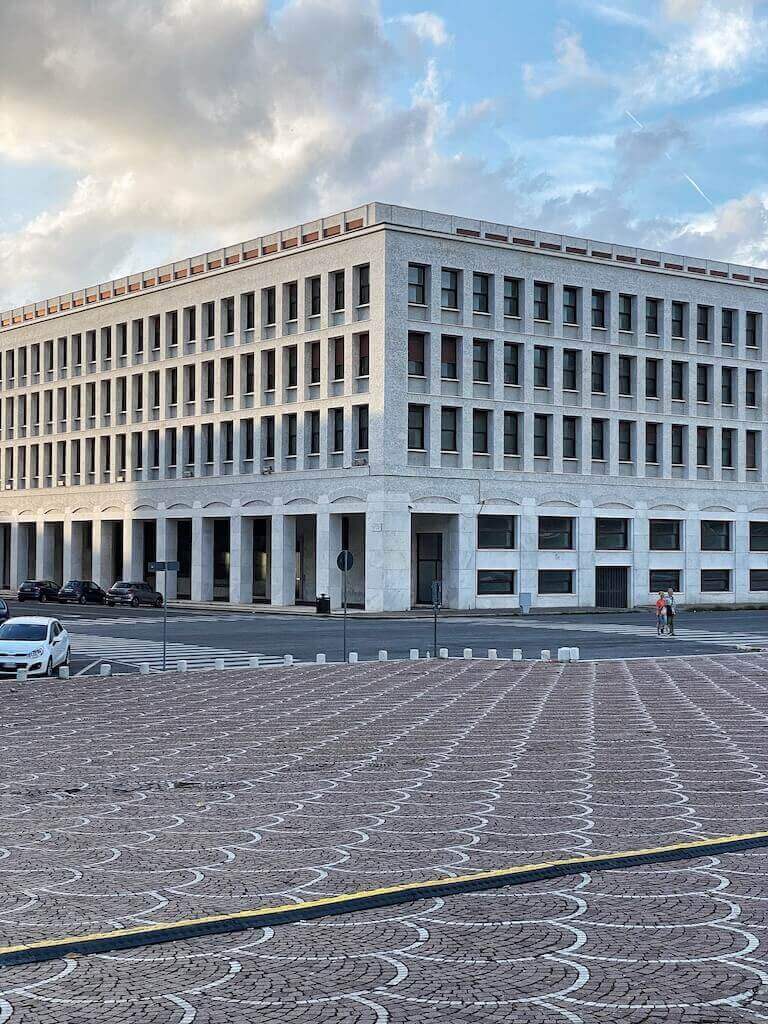
The EUR looks completely different from the rest of Rome. Think large boulevards, modern essential buildings, many of them in the rationalist architectural style that was typical of the final years of the Fascist era.
You will love exploring the EUR district if you are into architecture and design. To give you an idea of this part of the city that tourists often completely ignore, I thought I’d write a short guide and share its history, the main attractions and some practical tips to plan your visit.
My post The Best Hidden Gems In Rome will guide you to more secret spots in the city.

The History Of EUR Rome
As I have said before, if you have an interest in Fascist-era architecture, the EUR District in Rome is a must-visit.
In recent years, this district has gained international recognition for its distinctive design, providing a cinematic backdrop for films, including those in the James Bond series. While I firmly oppose Fascism, I find the architecture of this period fascinating: a visit to EUR a compelling experience.
Let’s discover how this district came about.
A unique historical development
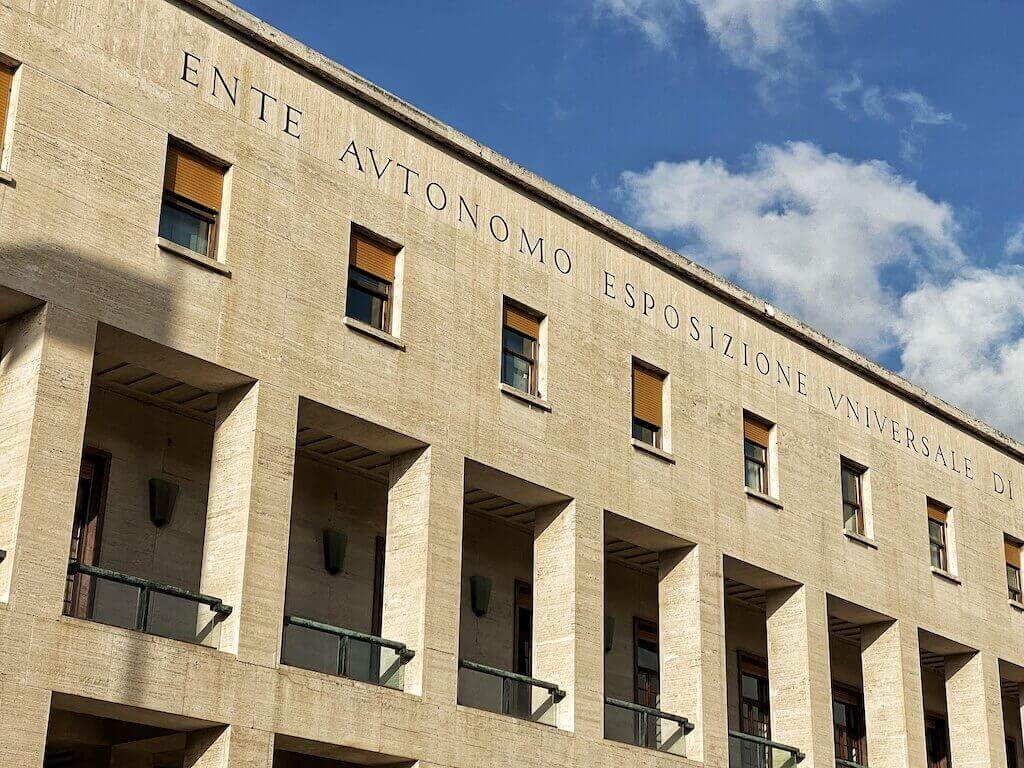
Unlike many areas of Rome that trace their origins to antiquity, EUR is a modern creation, shaped by the Italian political landscape of the early 20th century.
The district was conceived in 1935 when Giuseppe Bottai proposed that Rome should host the 1942 World Exposition. His goal was to showcase Italy’s cultural and industrial achievements to the world. Benito Mussolini embraced the idea enthusiastically.
Planners initially struggled to select a location for the event. After much debate, they chose a site south of Rome’s historic center, from the Baths of Caracalla toward the sea. This new district was intended to symbolize a “new Rome,” linked to the old city via the Via dei Fori Imperiali.
On April 26, 1937, construction plans officially began under the name E42 – and manholes in the area still show that inscription.
The event was designed to commemorate 20 years of Fascist rule. In 1939, the name was changed to Esposizione Universale Roma (EUR). Mussolini himself ceremonially planted an umbrella pine to mark the district’s significance, setting the stage for an ambitious project.
An architectural experiment
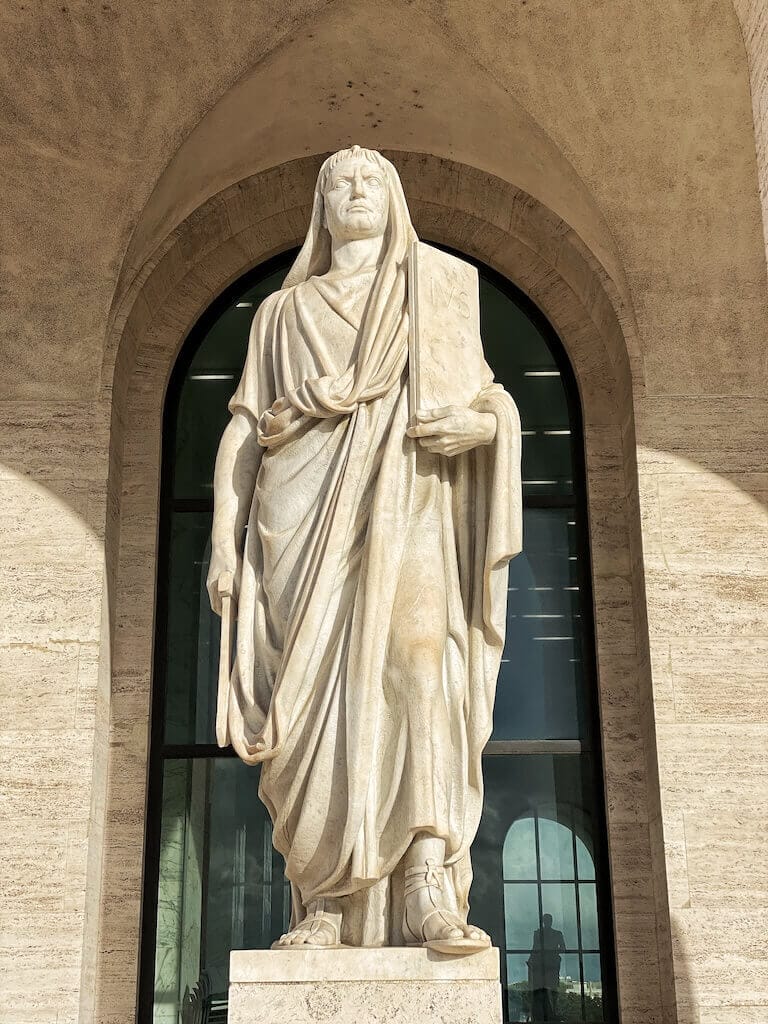
The EUR district was envisioned as a unified architectural masterpiece, though the architectural style to follow was initially undecided. Many architects contributed to its design, making it an experimental hub for modernist interpretations of classical forms.
The resulting style merged elements of rationalism, monumentalism, brutalism, and art deco.
Historians describe it as both modern and grand, echoing imperial Rome through a contemporary lens. The use of arches, large squares, and massive geometric structures was meant to convey power and order.
However, with the onset of World War II, construction ceased in 1942. The exposition never took place, leaving the EUR in an unfinished state. After the war, the district’s future remained uncertain.
Post-War reinvention
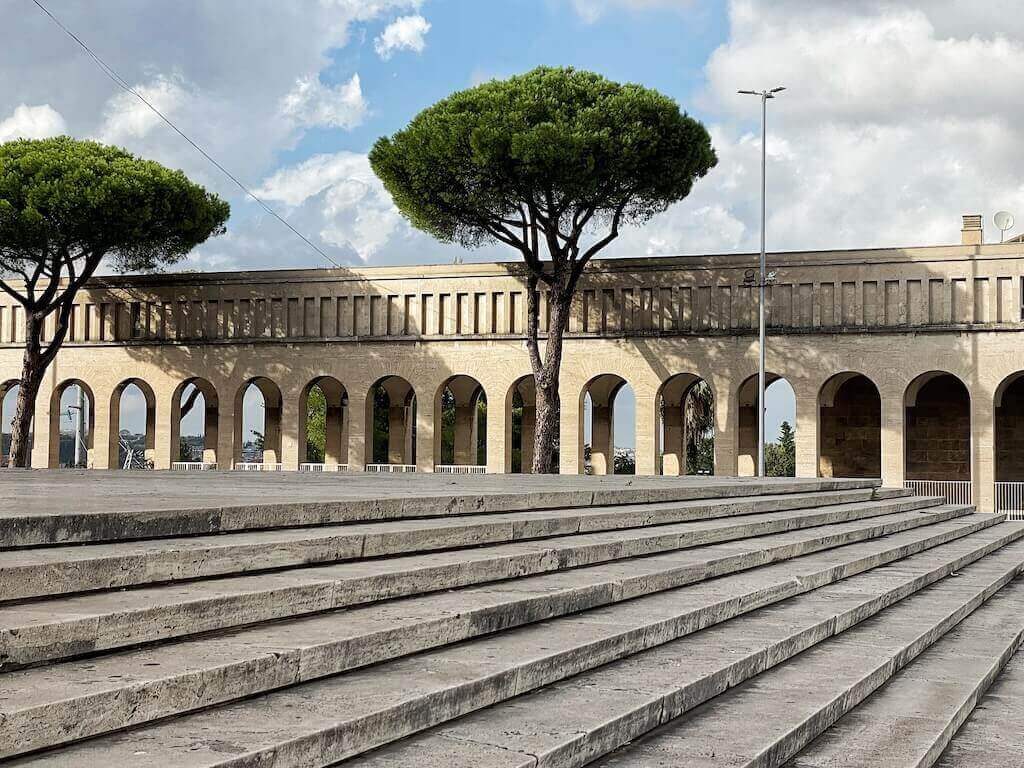
By the 1950s, a decision was made to repurpose EUR as a business district. The unfinished buildings were completed, war-damaged structures were restored, and modern office buildings were added. Infrastructure improvements helped integrate the area into the broader city.
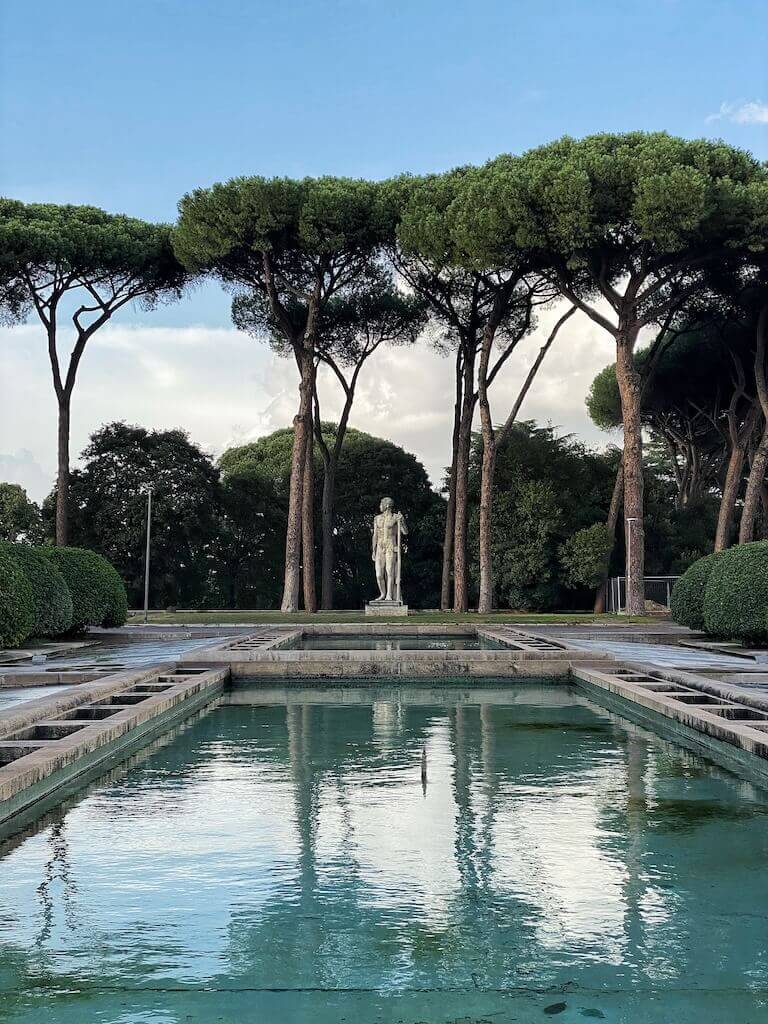
Though EUR never hosted the 1942 World Expo, it became a key venue for the 1960 Rome Olympics. New facilities were constructed, including the Piscina delle Rose (as a swimmer, this pool in the Parco Centrale del Lago – Lake Central Park – is one of my favorites in Rome), a large velodrome, and the Palazzo dello Sport, which remains central to the district today.
A district of contradictions
EUR continued to expand throughout the late 20th century, with new developments reinforcing its role as a business and governmental hub. However, as time passed, debates emerged regarding the ethics of preserving a district so closely associated with Mussolini’s regime.
Today, EUR stands as yet another striking example of Rome’s layered history—both a reminder of a dark past and a testament to the evolution of urban planning. Its architecture remains a subject of both admiration and debate, making it one of the city’s most intriguing areas to explore.

Best Things To Do In EUR Rome
You will find many interesting landmarks in the EUR Rome district. Here are my favorite things to do whenever I visit, but I can promise you there’s more!
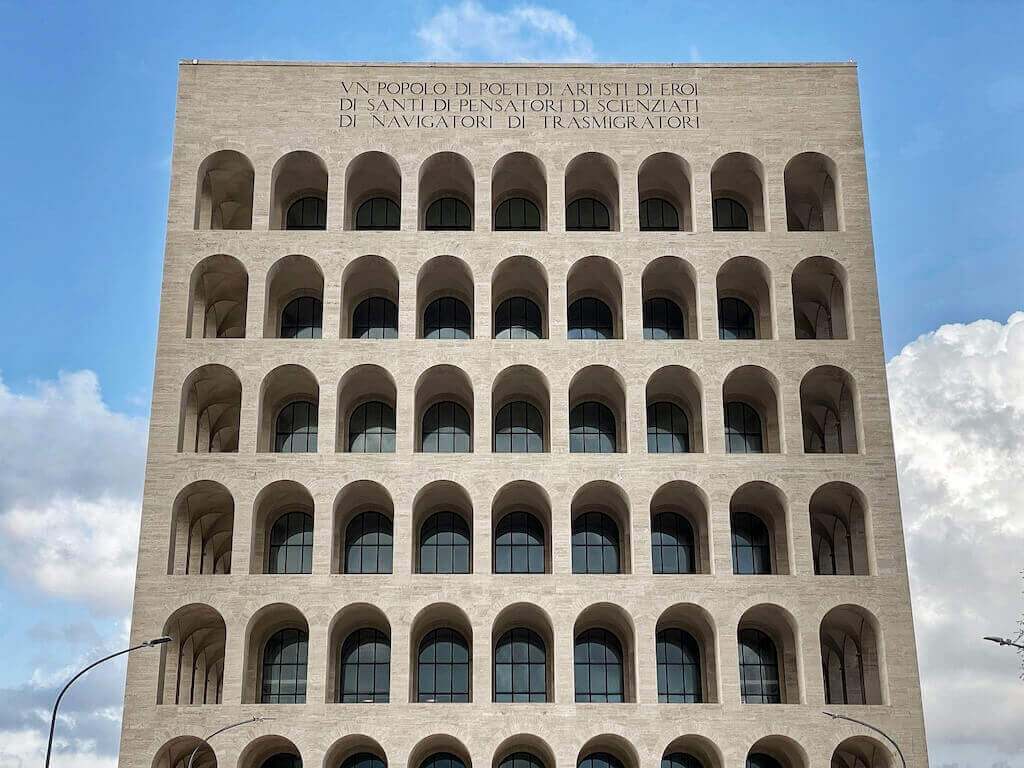
See the Palazzo della Civiltà Italiana
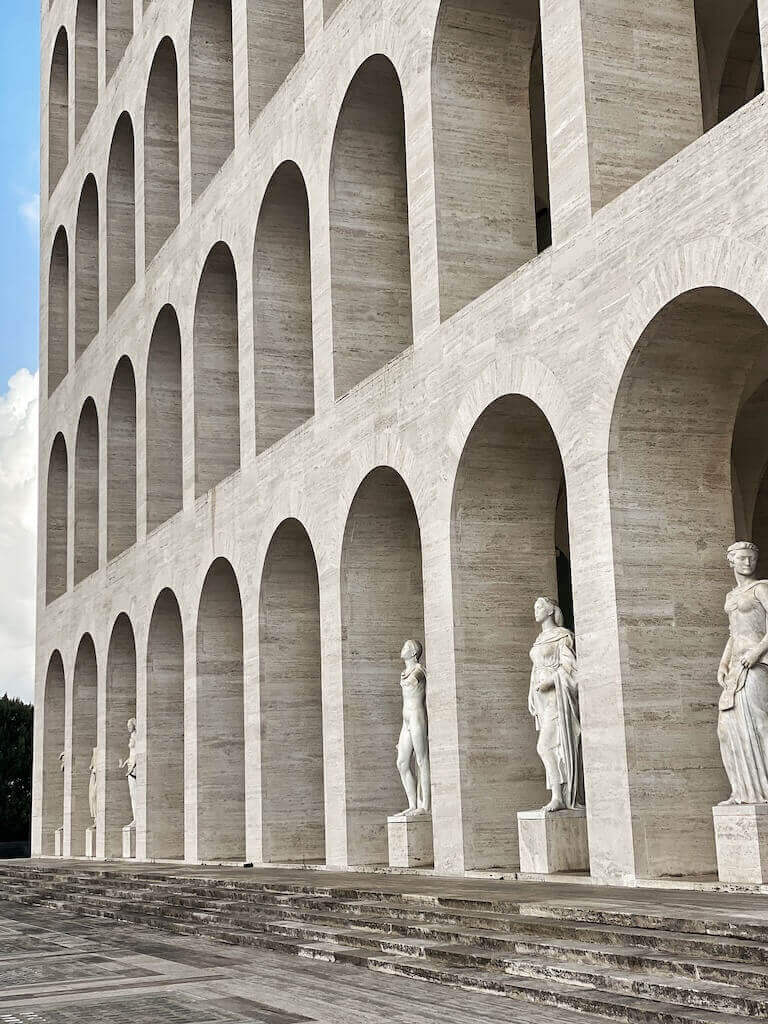
One of the most iconic buildings in the EUR district, the Palazzo della Civiltà Italiana is a symbol of EUR architectural identity and its most famous landmark. You easily see if from the car if you take a taxi from either Ciampino or Fiumicino Airport to Rome.
Built between 1937 and 1953, the structure was designed by architects Mario Romano, Giovanni Guerrini, and Ernesto Lapadula.
Their design was influenced by the metaphysical school of art, a movement that emerged in 1910, characterized by dreamlike compositions set against stark backdrops, dramatic contrasts of light and shadow, and futuristic details.
Nicknamed Colosseo Quadrato (Square Colosseum), historian and art professor Giorgio Muratore described it as “the most important work constructed in Rome in the last 100 years.”
It is a great example of Italian Rationalism blended with Neoclassical design, which went on to characterize Fascist architecture. This approach is rooted in “Romanità,” a philosophy that seeks to unify past, present, and future elements in a single structure.
The Palazzo della Civiltà Italiana was envisioned as a landmark that would signal a new chapter in Italian history. The repeated arches are a clear reference to the Colosseum.
It was meant to house the museum of Italian civilization, which never opened here. In 2022, Italian fashion house Fendi signed a contract to rent the building for 15 years – so now many locals refer to it as Palazzo Fendi. It hosts contemporary art exhibits and Fendi offices.
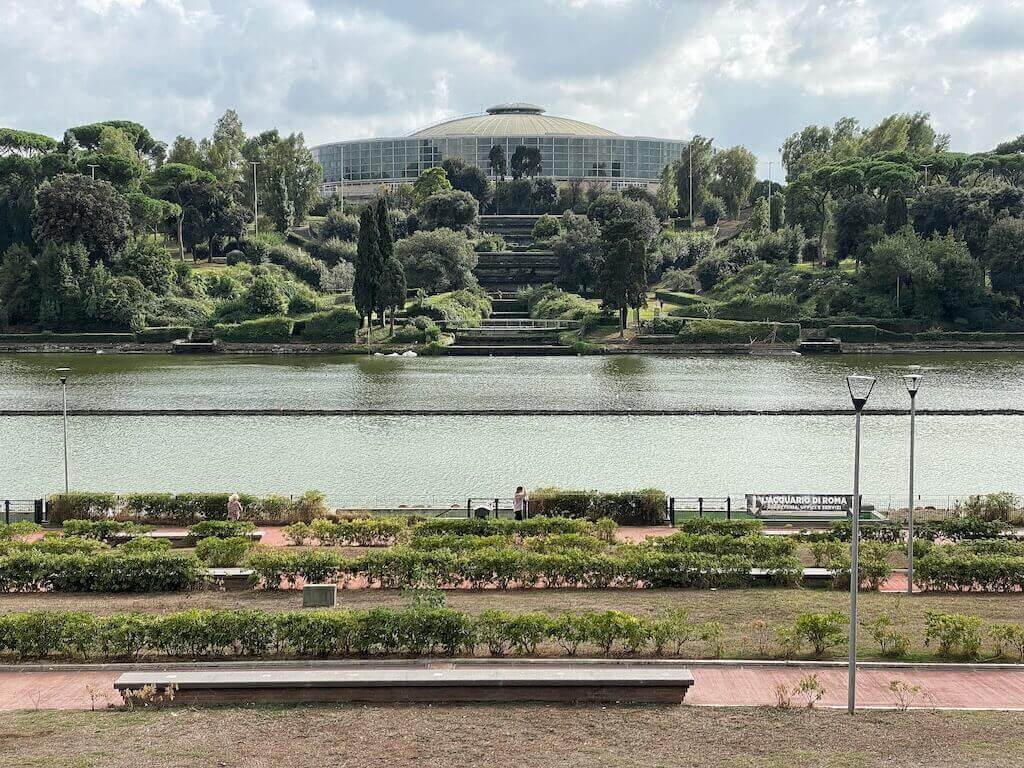
Go for a walk in the Parco Centrale del Lago
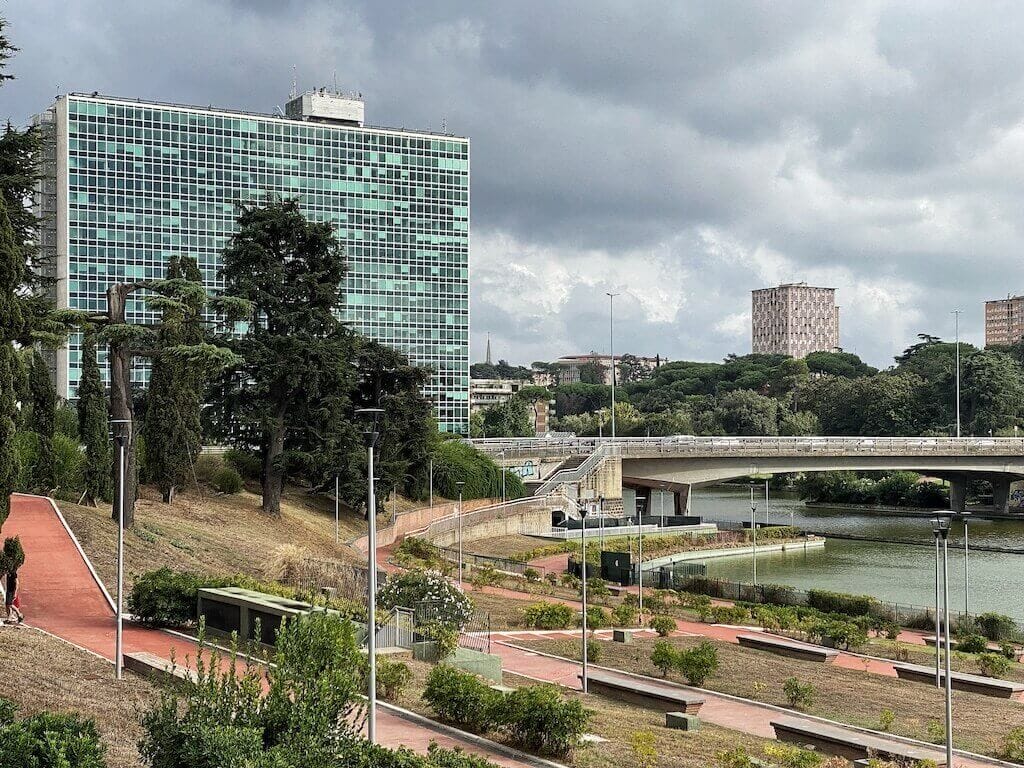
The Parco Centrale del Lago is one of my favorite places in EUR, the ideal spot for a peaceful walk and a picnic on a sunny day.
The idea for this artificial lake dates back to 1936, when it was included in the initial designs for EUR, then known as E42, and was envisioned by architect Marcello Piacentini as part of the planned 1942 Universal Exposition. However, its actual construction was only completed in time for the 1960 Rome Olympics.
The lake stretches for 1 km (about 0.6 miles) and depending on the spot it can be up to 4 meters (a bit over 13 feet) deep. Planted in the park there are all sorts of trees, including oaks, poplars, magnolias, olive trees, and maples, alongside rare specimens of cherry laurel, ligustrum, pittosporum, and various conifers.
In 1959, Japanese Prime Minister Nobusuke Kishi visited the park and gifted Italy 2,500 Japanese cherry trees. Many of these trees were planted along what we now know as the the Passeggiata del Giappone (Japan Promenade), designed by Raffaele de Vico.
Each year, from late March to early April, you can see the cherry blossoms and celebrate sakura, following the Japanese tradition. Some visitors even go there dressed in kimonos.
Check out the Waterfall Gardens
Located within the Parco Centrale del Lago you’ll find the Giardino delle Cascate (Waterfall Garden), another masterpiece designed by de Vico and inaugurated on June 29, 1961.
While the waterfalls are human made, the stone formations are natural and the lush greenery, making it one of the most picturesque urban parks in Rome.
Here you’ll also find the Hashi pedestrian bridge, which features glass flooring. It connects different sections of the park and integrates the garden seamlessly with the lake and surrounding walkways.
The Giardino delle Cascate went through extensive renovation works and was reopened to the public in May 2017. It’s a lovely spot to visit for the entire family.
Go to EurPark
One of the best things to do in EUR is visiting the EurPark, a dynamic outdoor recreational area that offers a mix of adventure, nature, and family-friendly activities. It’s a very popular spot among locals – tourists are few, so make sure to check it out for a bit of adventure within the city.
You will find obstacle courses, rope bridges, zip lines, and climbing structures for different levels of difficulty, so both children and adults can have a good time.
EurPark is set within a lush green space, which makes it a refreshing escape from city life. There are walking trails, picnic areas, and shaded spots perfect for relaxing.
Spot the obelisk
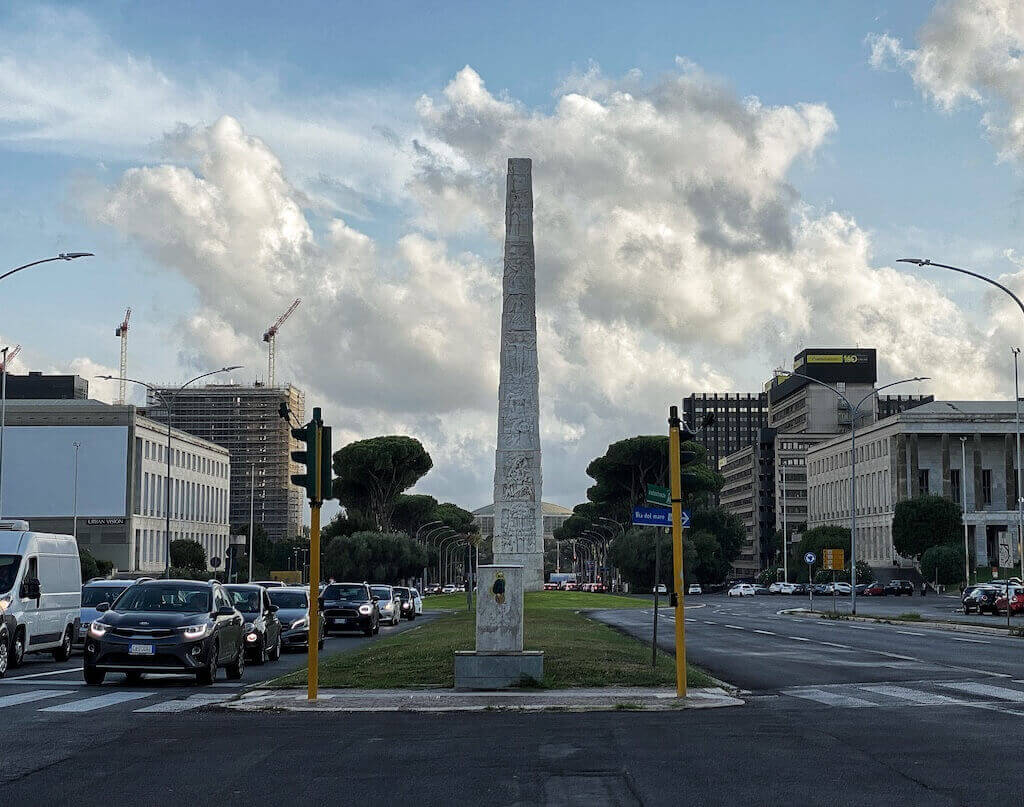
There are many obelisks in Rome, but not all of them date back to ancient time. The one in the EUR district is a modern-era one.
The Marconi Obelisk in the EUR District is dedicated to Guglielmo Marconi, inventor of the radio and Nobel Prize winner. It was commissioned by the Ministry of Popular Culture in 1939 (Marconi had died in 1937) to sculptor Arturo Dazzi.
Much like the rest of the district, the construction of the obelisk was interrupted during WWII, but works resumed in 1951 and it was finally completed in 1959. It measures 45 meters (almost 148 feet) and covered in 92 bas-reliefs slabs of Carrara Marble that depict Marconi’s achievements.
It’s easy to spot during your EUR itinerary as it is close to the Palazzo della Civiltà Italiana and other important landmarks, though keep in mind the spot where it is located (between Piazza Guglielmo Marconi and Viale Asia) is quite trafficked.

Visit the Rome Convention Center
The Rome Convention Center, commonly referred to as La Nuvola, is among the newest buildings in the EUR district. This modern, earthquake-proof building costed hundreds of millions of euros to build and while modern it’s similar in style to other rationalist buildings found in the area.
It was designed by Massimiliano Fuksas and completed in 2016; and it stands out for its futuristic glass-and-steel exterior and the massive, cloud-like structure (“La Nuvola”) suspended inside (hence its nickname).
It’s a state-of-the-art venue that hosts international conferences, exhibitions, and events, making it a key business hub in Rome.
Have fun at the Balloon Museum
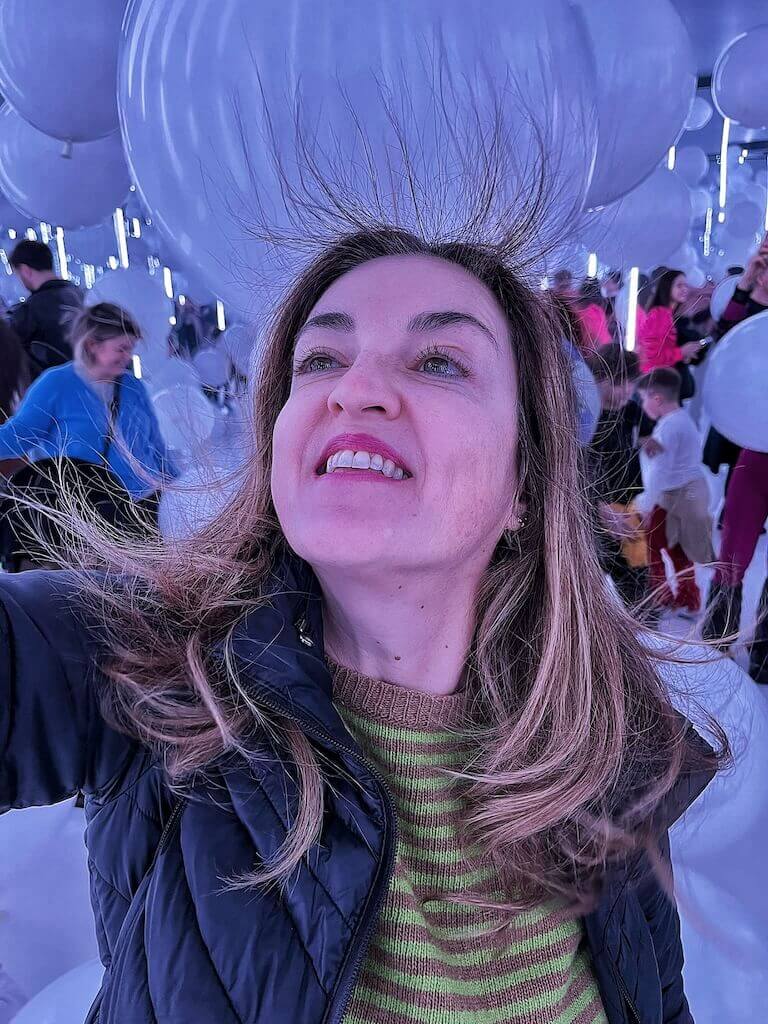
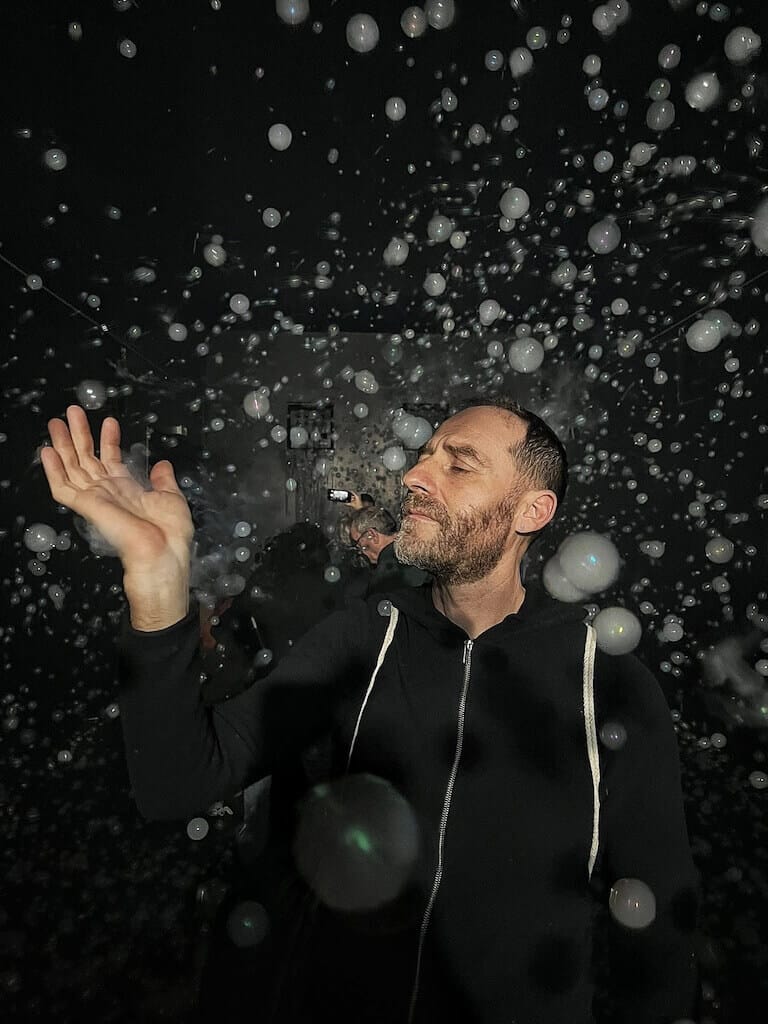
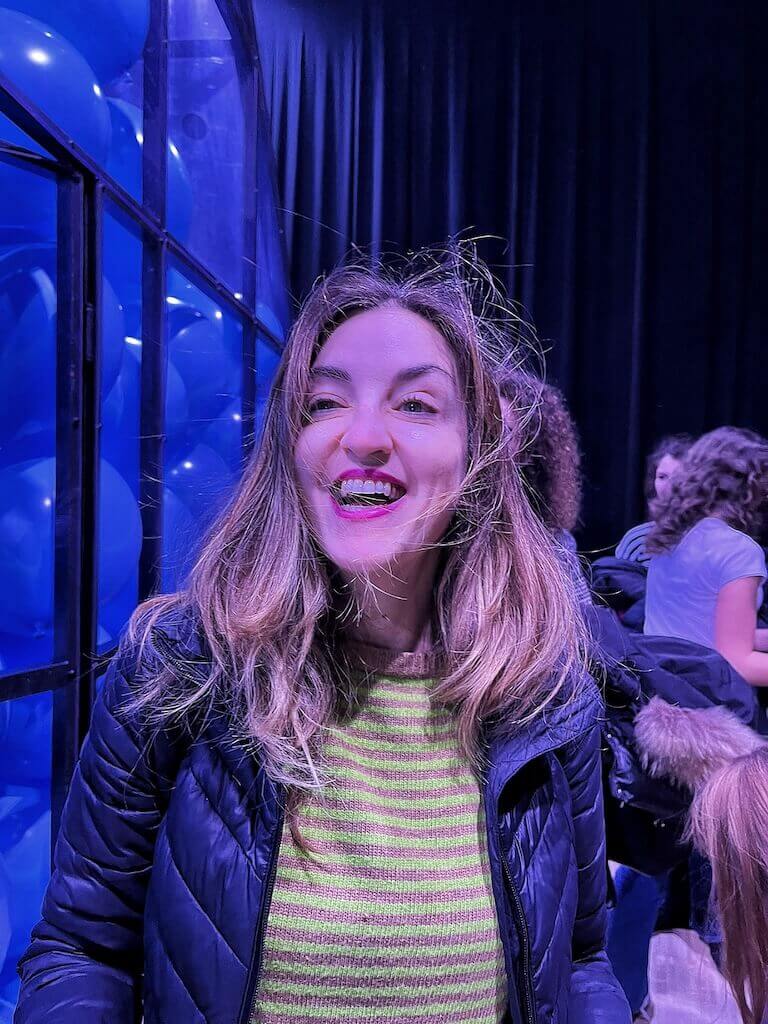
The Balloon Museum is one of the newest additions to the EUR District. I must admit I was really reluctant to visit, but my sister insisted we’d go before we went to a concert nearby and I decided to tag along and had a great time.
The Balloon Museum is currently hosting the exhibition Euphoяia – Art is in the Air at La Nuvola (which I have just mentioned above). It features more than twenty monumental and interactive inflatable artworks by renowned international artists.
It’s a fun place to spend a few hours for visitors of all ages – we saw lots of families with children, and adults exploring the various exhibit. My personal favorite was the pool – we had to jump into a pool filled with small red balls and standing was impossible.
Visit the Basilica dei Santi Pietro e Paolo
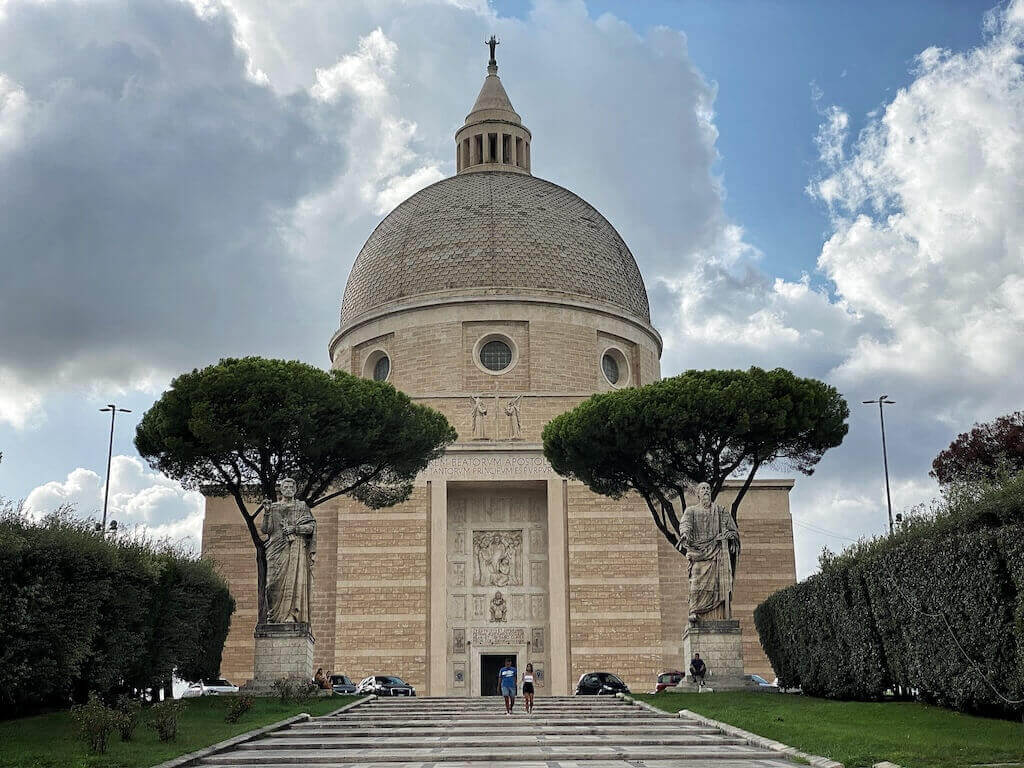
The Basilica dei Santi Pietro e Paolo dominates EUR’s skyline with its massive dome—one of the largest in Rome.
The church was built between 1939 and 1955. Much like the rest of the district, it was meant to be a monumental church for the E42 World’s Fair, but construction works came to a halt during the war.
Its design, by Arnaldo Foschini, once again reflects the district’s Rationalist architecture, with clean lines and a grand, imposing structure. The church – which is meant to be a smaller and minimalist version of St. Peter’s Basilica in the Vatican – was meant to become Mussolini’s mausoleum, but of course this never happened. It became a basilica in 1967.
From the square where the church is located, you can enjoy great views of the rest of the district. Inside, there’s a gigantic bronze statue of St. Peter and St. Paul. There’s also a crypt where it is said that St. Peter’s remains were temporarily kept during the Nazi occupation.
Take a look at the Palazzo dello Sport
Once known as PalaLottomatica, then PalaEUR, the Palazzo dello Sport is in the very heart of the EUR district and the reason many people (including myself) visit this part of the city altogether.
The building was designed by architect Marcello Piacentini and Pier Luigi Nervi for the 1960 Rome Olympics and built between 1958 and 1960.
Topped by a reinforced concrete dome, the overall capacity of the Palazzetto dello Sport (as it is commonly referred to) can host up to 12,200 spectators and is used as a venue for sport events such as basketball, and of course concerts like the one we attended.
Spot the Fungo dell’EUR
Close to the Palazzo dello Sport there’s one of the most iconic landmarks in the area. The Fungo dell’EUR (literally EUR Mushroom).
Built in 1957, this 62-meter-tall (that’s 203.4 feet) water tower was originally constructed to supply water to the district. Over time, it was repurposed, and today, it houses the restaurant Il Fungo on it’s 14th floor (the upper level).
Needless to say, the panoramic views from the restaurant are breathtaking – on a clear day you can see all the way to the coast.

Visit the Museo delle Civiltà
One of Italy’s most important museums for anthropology and archaeology, it houses collections that were once spread across different institutions.
- Museo Preistorico Etnografico “Luigi Pigorini” – The exhibit includes prehistoric artifacts and ethnographic collections from around the world.
- Museo dell’Alto Medioevo – The exhibit shows objects from the Dark Ages, including Lombard and Byzantine relics.
- Museo delle Arti e Tradizioni Popolari – The museum focuses on folk art, traditional costumes, and crafts from different Italian regions.
- Museo d’Arte Orientale “Giuseppe Tucci” – It showcases a collection of Asian art, from Chinese ceramics to Tibetan artifacts.
It’s also worth mentioning the Museo della Civiltà Romana, a comprehensive museum on Ancient Rome, showcasing plaster casts of ancient Roman monuments – it’s currently closed for renovations but meant to reopen in June 2026.
Map Of EUR Rome District Attractions

Practical Guide To Visit EUR Rome District
Guided tours of the EUR District
Not many tourists ever venture to the EUR Rome district – this is a part of town only locals know, and occasionally visitors from other parts of Italy venture there for sport events and concerts (this was the case last time I was there, last weekend).
There honestly aren’t many tours that go to the EUR District, but this post and the map of all the attractions should be enough for you to explore independently.
For history and architecture geeks, however, it may be interesting to hire a guide to go around and learn about the history, culture, architecture and even all the politics that characterize this interesting area of Rome. There isn’t anything reasonably priced online, but when I visited I hired a guide and you may get in touch with him for a quite.
His name is Samuele Casarin and he works for Touriks, one of my favorite local tour companies. Samuele is passionate about this part of the city and its unique history, and you will surely enjoy exploring with him. You can email at [email protected].
How to get to the EUR district
The EUR district is far from the historic center of Rome – 12 km (7.5 miles), but well connected by public transport, with lots of buses and 3 metro stations along Metro Line B (the same that goes through Termini Station, Cavour and Colosseum): EUR Fermi, EUR Palasport and EUR Magliana. EUR Magliana is the most central stop.
A taxi from the center of Rome will cost between €20 and €30 depending on your starting poit and the time of day. Last week, we paid €25 to get there from Trastevere in the late afternoon, and around €28 to travel back around midnight.
Where to stay in EUR Rome
Not many foreign tourists ever stay in EUR during their trip to Rome. However, you may decide to stay in EUR if you are there for a sports’ event or a concert, for a conference, or if you simply want to stay in a more local part of town. I have stayed there a few times and it’s pleasant and very quiet.
These are some good places to stay in EUR Rome District:
- HOTEL DEI CONGRESSI – Rooms are on the small side but there’s everything you need.
- HOTEL AMERICAN PALACE EUR – This is where I stayed once when I visited. It’s a good hotel with spacious, clean rooms and very comfortable beds.
- EXCLUSIVE APARTMENT IN EUR LAKE – A large apartment perfect for a family. It’s fully equipped with everything you need for a comfortable stay.
So, Is EUR Rome Worth Visiting?
Are you still wondering if it’s worth going to the EUR District during your trip to Rome?
Here’s what I think. If it’s your first trip to the city, you probably should focus on the most classic attractions in the historic center (I have a post on the Unmissable Things To Do In Rome that shares the places you should visit) and perhaps hit a hidden gem or two in the historic center, such as Rome’s legendary Largo di Torre Argentina cat sanctuary.
However, if you have explored the city before and especially if you are visiting Rome with kids, this is a truly peculiar, unique part of town where you’ll find some fabulous attractions.
In general, the EUR District is worth visiting if you appreciate modernist architecture, history, and urban planning. Unlike Rome’s ancient ruins, EUR offers a striking contrast with its monumental, geometric buildings that reflect Fascist-era design.
While its origins are controversial, the district serves as a significant example of how history shapes urban landscapes. The district’s role in the 1960 Rome Olympics and its continued evolution as a business hub make it an area of both cultural and architectural significance.
Whether you’re interested in its design, its history, or its role in modern Rome, EUR provides a unique perspective on the city’s development beyond antiquity.
PIN IT!


Claudia Tavani
Claudia Tavani was born and raised in Sardinia, and after moving between the United States and the United Kingdom, she's now back living in her hometown, Cagliari. She's a travel blogger and certified travel designer who loves planning trips and publishing guides, travel tips, and packing lists so that you don't have to. Owner of Strictly Italy, cat mom to Minnie. Loves pizza, hiking, archeology, cities, beaches, swimming, and running. Hates peppers.