
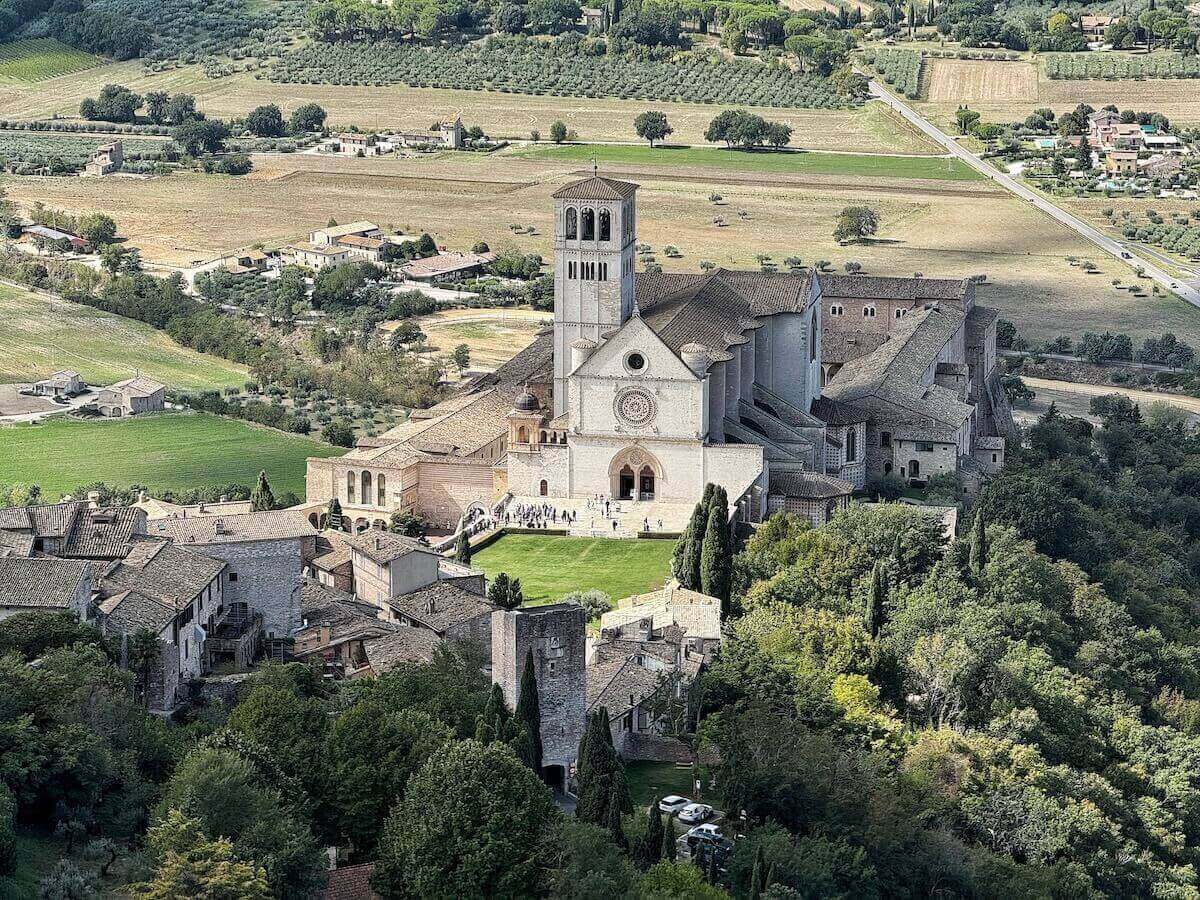
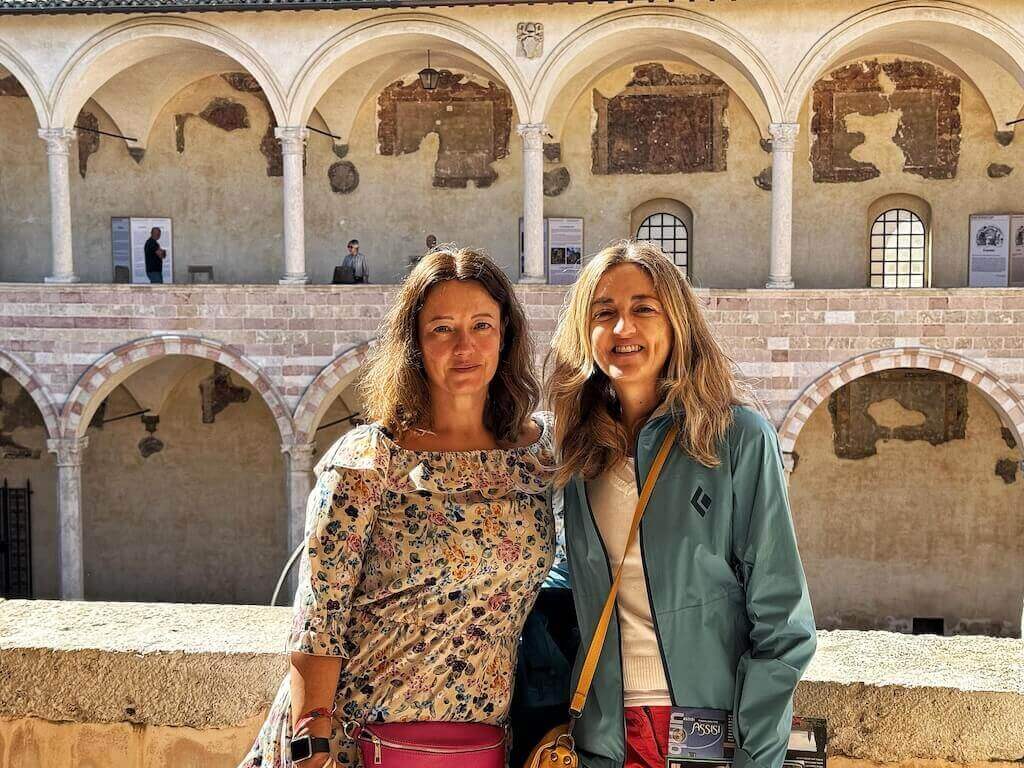
My sister and I visited Assisi on a recent trip to Umbria, and spent a couple of days exploring this lovely small town that is packed with history and significance. For this reason, I thought I’d share my insights on the best things to do in Assisi, and some guidance and tips that will help you plan your trip.
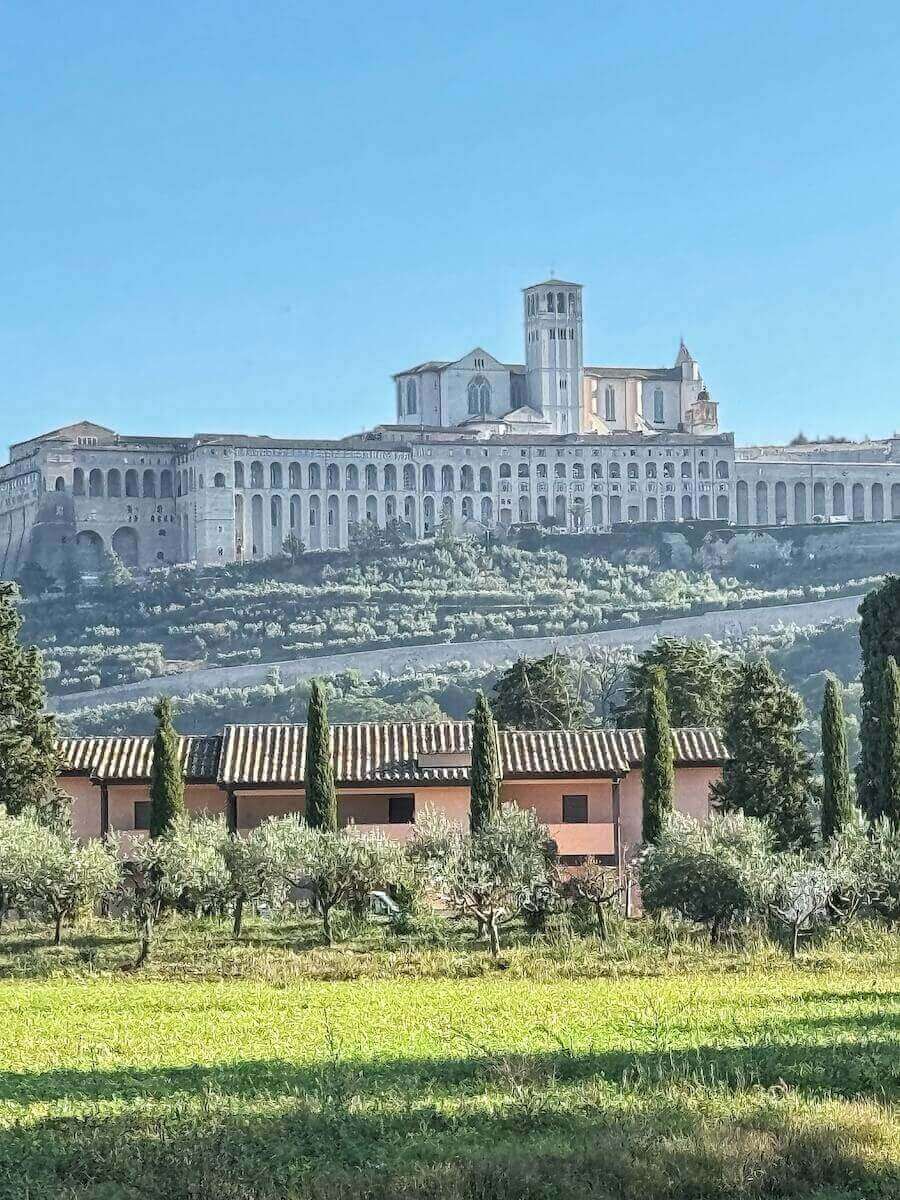
The town of Assisi is located on the slopes of Mount Subasio, in Umbria (one of the Regions of Central Italy), about 30 minutes by car from Perugia. The first thing that strikes you upon arriving is the sight of the majestic Basilica of St. Francis from a distance (we had to stop for photos, it was so pretty to see), and the feeling of peace, spirituality, and integration.
Assisi, in fact, is famous for being the birthplace of St. Francis and St. Clare, and it is a pilgrimage destination for many Christians. Within the imposing city walls, you will find a pretty city with many beautiful sights, churches, basilicas, and the impressive Rocca Maggiore.
In 2000, the historic center of Assisi was declared a UNESCO World Heritage site thanks to its medieval masterpieces such as the Basilica of St. Francis and the paintings by Cimabue and Giotto. Its artistic beauty is closely linked to the Franciscan movement and the universal message of peace and tolerance.
Now, let’s discover what to do in Assisi.
Can’t locate Umbria? Head over to my post Where Is Umbria? to discover why you should visit.
You can also read my post The Best Places To Visit In Umbria for more ideas on destinations for your trip, and if you are basing yourself in Perugia, my guide on What To Do In Perugia will provide more useful tips on activities.
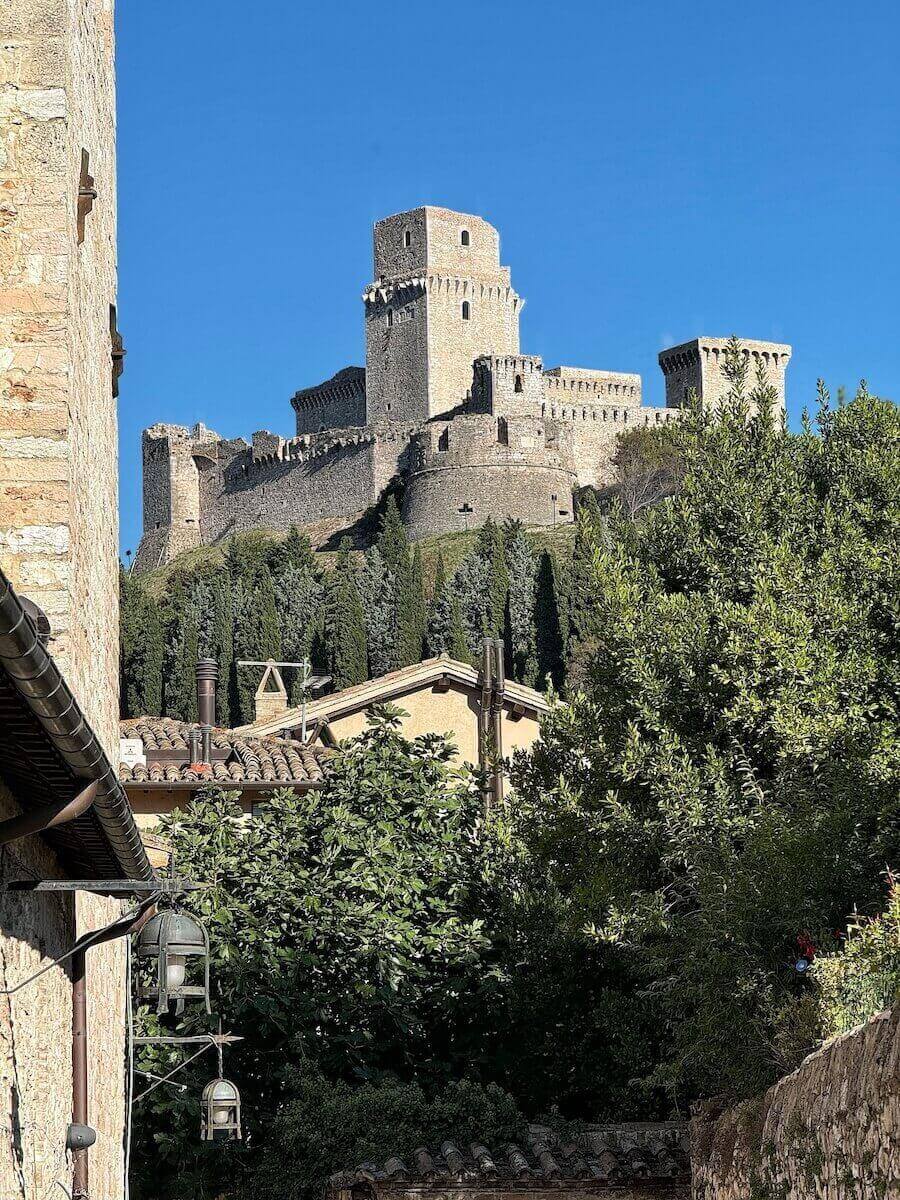
Overview of What To Do In Assisi
Here’s a quick overview of what to do in Assisi, and some quick tips for visiting.
Must-see in Assisi in one day:
- Basilica di San Francesco (Upper/Lower & Tomb)
- Santa Chiara
- San Rufino
- Piazza del Comune & Temple of Minerva
- Roman Forum & Museum below
- Rocca Maggiore for sunset
If you have an extra day:
- Eremo delle Carceri
- Santa Maria degli Angeli (Porziuncola)
Dress code in Assisi: shoulders/knees covered inside basilicas; observe no-photo rules inside St. Francis Basilica.
ZTL & Parking in Assisi: Use the car parks in Piazza Matteotti or the Porta Nuova/Saba car park; take elevators or escalators to get to the Old Town.
Best views of Assisi: Rocca Maggiore.

Best Things To Do In Assisi Italy
Useful Tip: Assisi is quite compact, but there are many places to visit in Assisi. I recommend joining a guided walking tour to get at least a good introduction to the city. For example, you could consider this walking tour that also includes a visit of St. Francis’ Basilica and San Rufino Cathedral, which lasts 2.5 hours and also stops at the Piazza del Comune, among other places.
Explore the Basilica of St. Francis
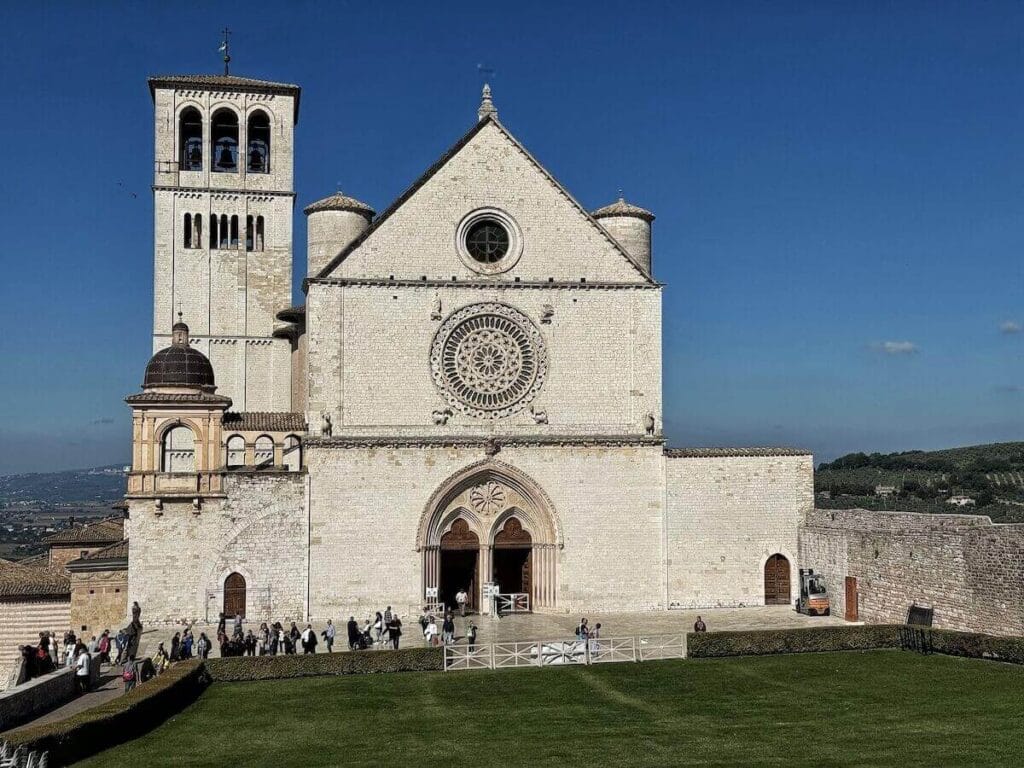
The Basilica of Saint Francis is one of the most important places to visit in Assisi. It’s a masterpiece that attracts more than 5 million visitors from around the world each year.
It is named after St. Francis, who was born in Assisi in 1182 and left his wealthy family to put himself at the service of God and to help disadvantaged people. He died in 1226, and his remains are preserved inside the crypt in the Basilica.
Construction of the basilica began two years after the saint’s death: the foundation stone was laid by Pope Gregory IX on July 17, 1228, the day after the canonization of St. Francis.
The Lower Basilica was opened on May 25, 1230; whereas the Upper one was consecrated in 1253. In the year 2000, the Basilica of St. Francis has been declared a UNESCO World Heritage site.
The Basilica consists of three overlapping layers: the crypt, the Lower Church and the Upper Church, together with a bell tower. Inside you can admire frescoes by some of the greatest artist of the time, such as Giotto, Cimabue, Simone Martini and Pietro Lorenzetti, just to mention a few.
The remains of St. Francis are preserved in the crypt, in a stone urn enclosed by bars in two iron grills, in which the Saint’s body was found. The sarcophagus is located on top of a small altar directly under the main altar of the Lower Church and, next to it, an oil lamp perpetually burns: the oil is offered each year from a different Italian region.
You will notice when you visit that the Lower Basilica is dimly lit (if not just dark!). That’s because it was dedicated to penance. The Upper Basilica, in Gothic style, is instead bright with huge stained-glass windows. Both are decorated with frescoes: some show the spiritual journey of St Francis, others episodes from the life of Mary painted by Giotto and Cimabue, among others.
In the Cloister, you can find the entrance to the Treasury Museum, a collection of sacred art that includes paintings, gold works and textile artifacts related to the history of the Basilica. Next to it, there is the Perkins Collection.
Admission to the Basilica is free, but I suggest to book a guided tour in order to fully appreciate the incredible art and architecture inside. For example, you could consider this one-hour guided tour of St. Francis’ Basilica during which you’ll see Giotto’s frescoes in both the lower and upper church and the tomb of St. Francis.
Remember that modest clothing is required to access this and other churches in Assisi, and that you can’t take photos of the interiors. For more information, visit the official website of the Basilica of Saint Francis.
Visit San Rufino Cathedral
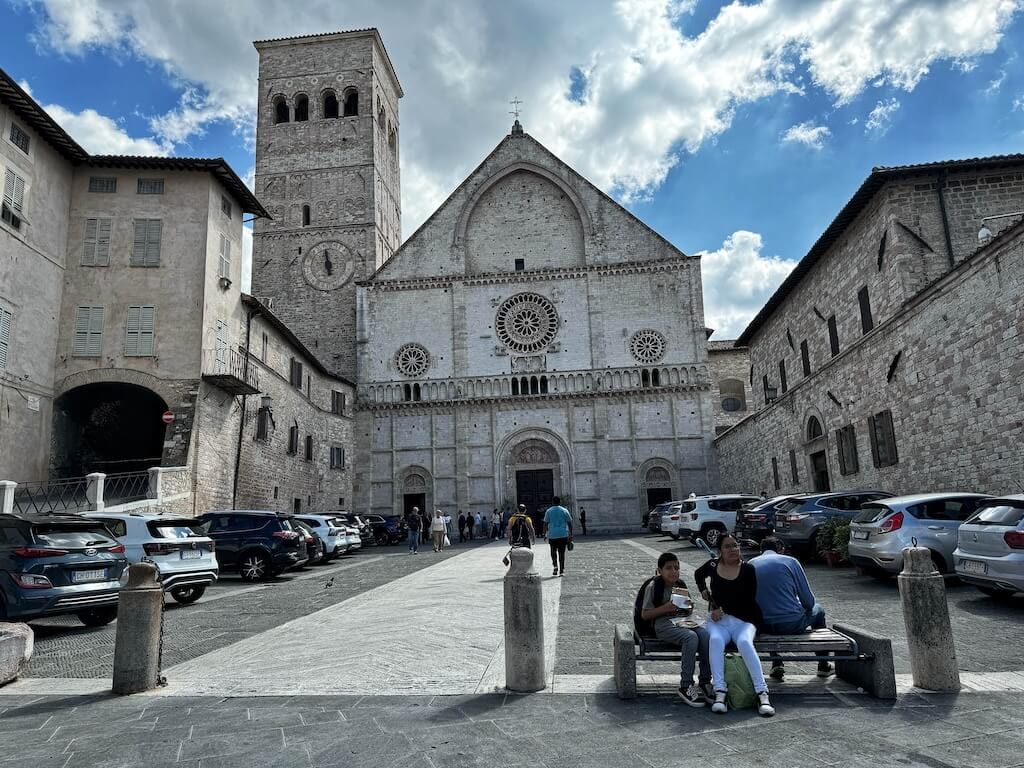
San Rufino Cathedral is the oldest church in Assisi, and it stands over a Roman terrace that once supported civic buildings. It’s here that St. Francis made his first preaching. Construction of the church started in 1029 – it became a Cathedral in 1036. It’s dedicated to St. Rufinus, a third-century bishop and martyr.
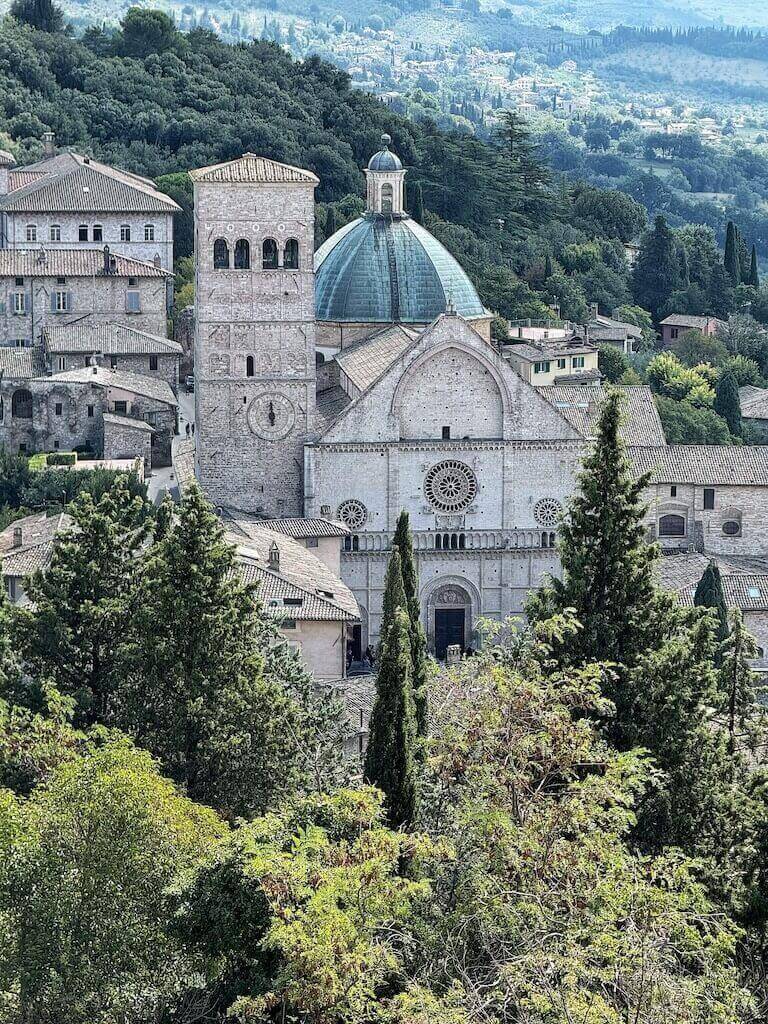
The Romanesque facade features three rose windows and three portals. In the lunette, there are Christ enthroned between the sun and the moon, the nursing Madonna, and St. Rufinus. The apse is enriched by the splendid carved wooden choir by Giovanni di Pier Giacomo da San Severino.
Once inside, make sure to spot the baptismal font in which St. Francis and St. Clare were baptized. The Chapel of the Sacrament has a rich Baroque decoration about the Eucharist, made by Giacomo Giorgetti. The Crypt has a small museum with artifacts found in Assisi and the sarcophagus where the body of St. Rufinus lies.
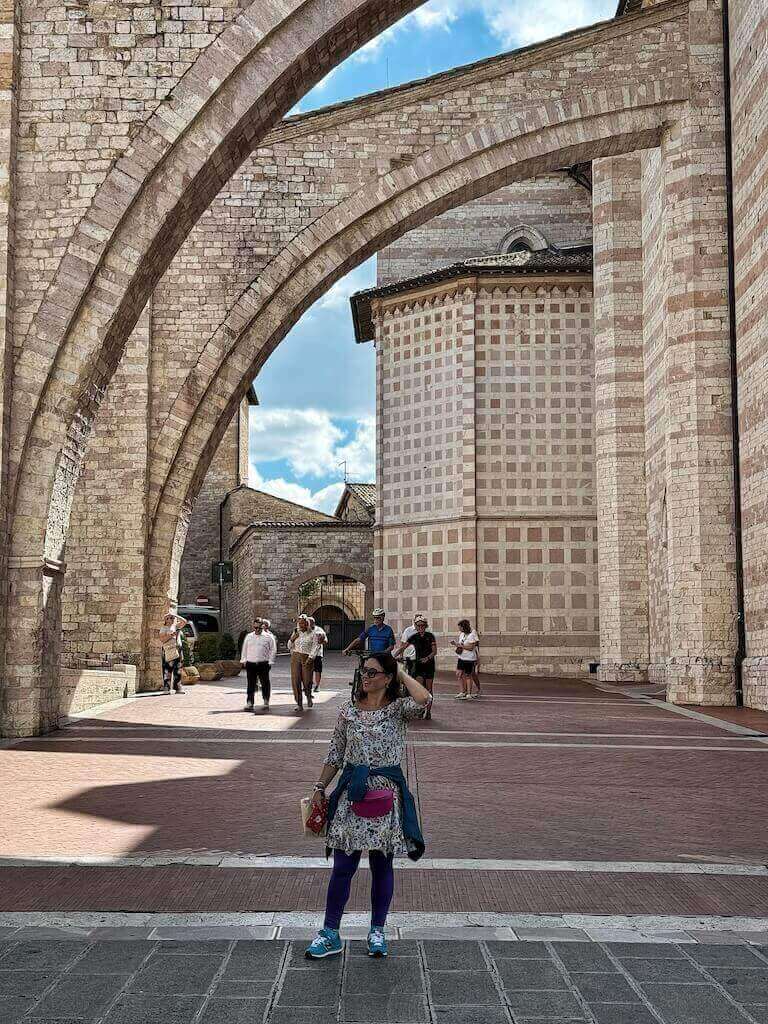
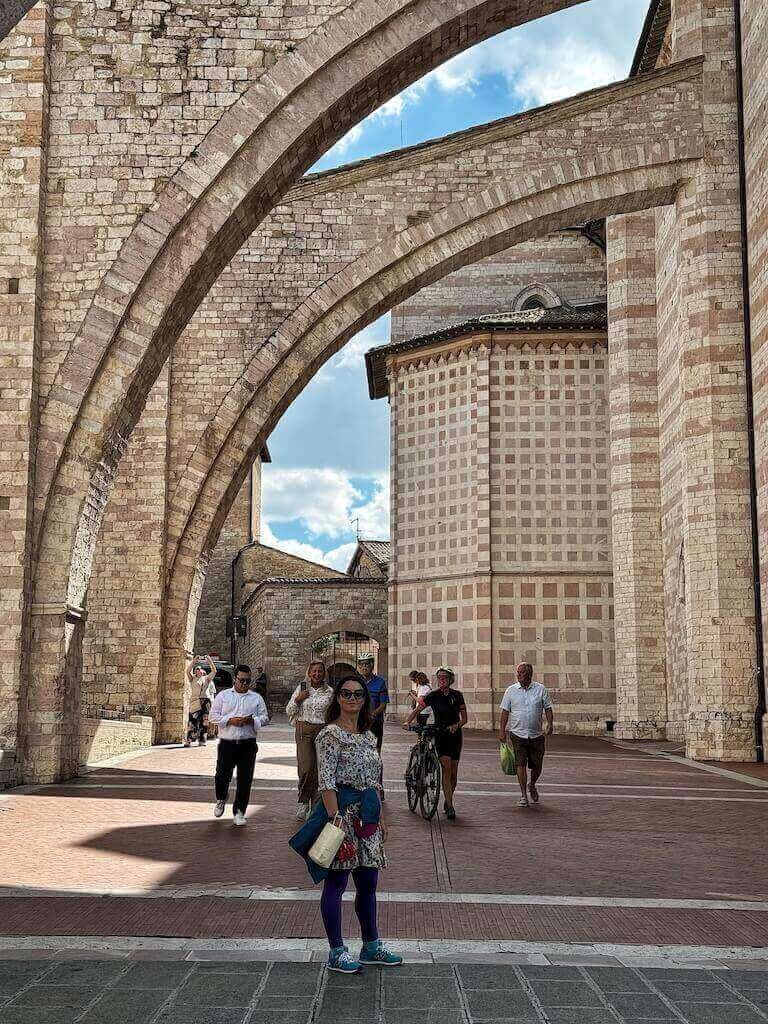
Go to the Basilica of Santa Chiara
St. Clare was a spiritual pupil of St. Francis and the founder of the Clares order. At the age of 18, she fled her wealthy family to join Francis at the small church of St. Mary of the Angels, called the Porziuncula.
The Basilica was built soon after her death. The area was occupied by the Church of St. George, which was incorporated into the new structure. The Church of St. George was, in fact, granted in 1255 by Pope Alexander IV to the Clares, who were looking for a place in the city where they could relocate their religious community.
The Church overlooks a large square with a fountain and a terrace from which you can enjoy a beautiful view of the valley. The façade is made of white and pink stone from Mount Subasio and has a large rose window in the center. The wide arches on the left side were added in the late 14th century.
Inside you will find a painted panel of St. Clare and eight stories from her life, a work of the so-called Master of St. Clare. The chapel of St. George houses the Crucifix of St. Damian, under which St. Francis was praying when he received the calling. The crypt shields the mortal remains of St. Clare.
And to the Basilica of Santa Maria degli Angeli di Porziuncola
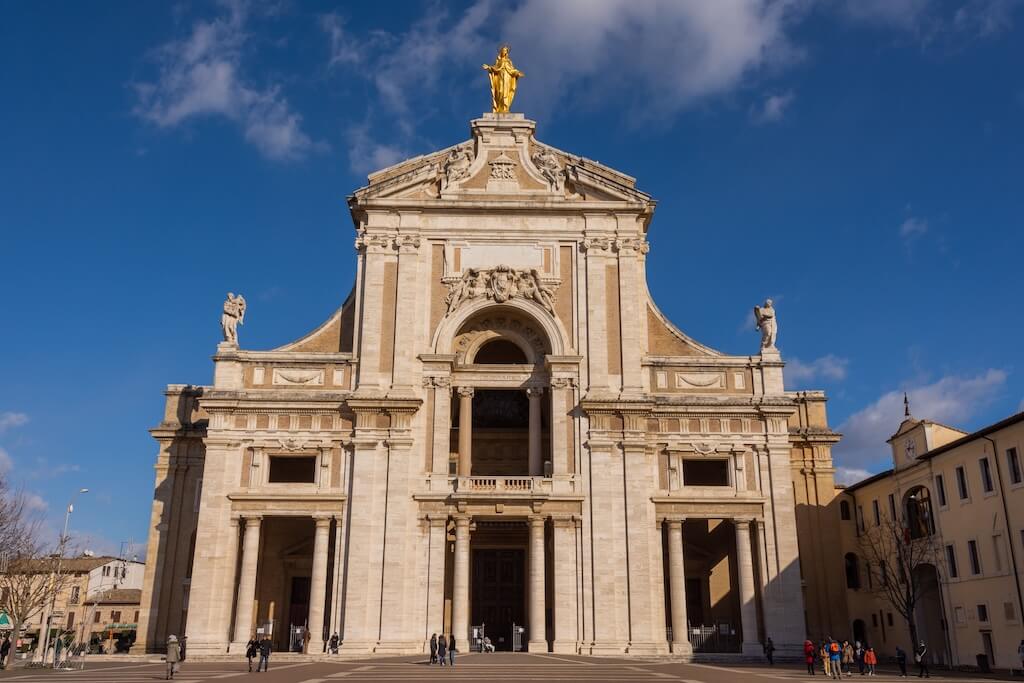
For more things to do in Assisi, head out of town to the hamlet of Porziuncola, where you’ll find the Basilica of St. Mary of the Angels, home of the Franciscan convent and the little Church where the Saint composed the Canticle of the Creatures.
The Basilica was built between 1569 and 1679 upon the wishes of Pope Pius V, who wanted to recognize the importance of the Franciscan order and welcome pilgrims during the Pardon of Assisi held at the beginning of August.
Here, St. Francis had a vision of Christ that conferred on him the “Indulgence of the Porziuncula”. He then asked the Pope for a plenary indulgence for those who visited the Chapel.
The church was designed by Galeazzo Alessi, who followed Franciscan ideals of simplicity. The Basilica was partly rebuilt after the damage caused by the 1832 earthquake. Later on, between 1925 and 1930, the facade was restored by Cesare Bazzano in order to give it a more monumental appearance. He placed the gilded bronze statue of the Madonna of the Angels by the sculptor Colasanti.
Close to the Porziuncola, you will find the Chapel of the Transit, the infirmary where St. Francis spent the last days of his life and died on October 3, 1226. Today, in a niche inside the Chapel, there is a terracotta statue of St. Francis by Andrea della Robbia.
The Rose Garden is part of the Basilica, too. Legend says that here St. Francis rolled among the roses to fight against doubt and temptation. But the roses, once in contact with the Saint’s body, lose their thorns, creating the Rosa Canina Assisiensis, which still continues to bloom only at the Porziuncola.
The adjacent museum houses a few panels portraying St. Francis by Cimabue, a Crucifix by Giunta Pisano, and the statue of Madonna del Latte by Andrea della Robbia. The Conventino, the cells where the friars lived, now houses an exhibition of contemporary sacred art.
Enjoy some time in Piazza del Comune
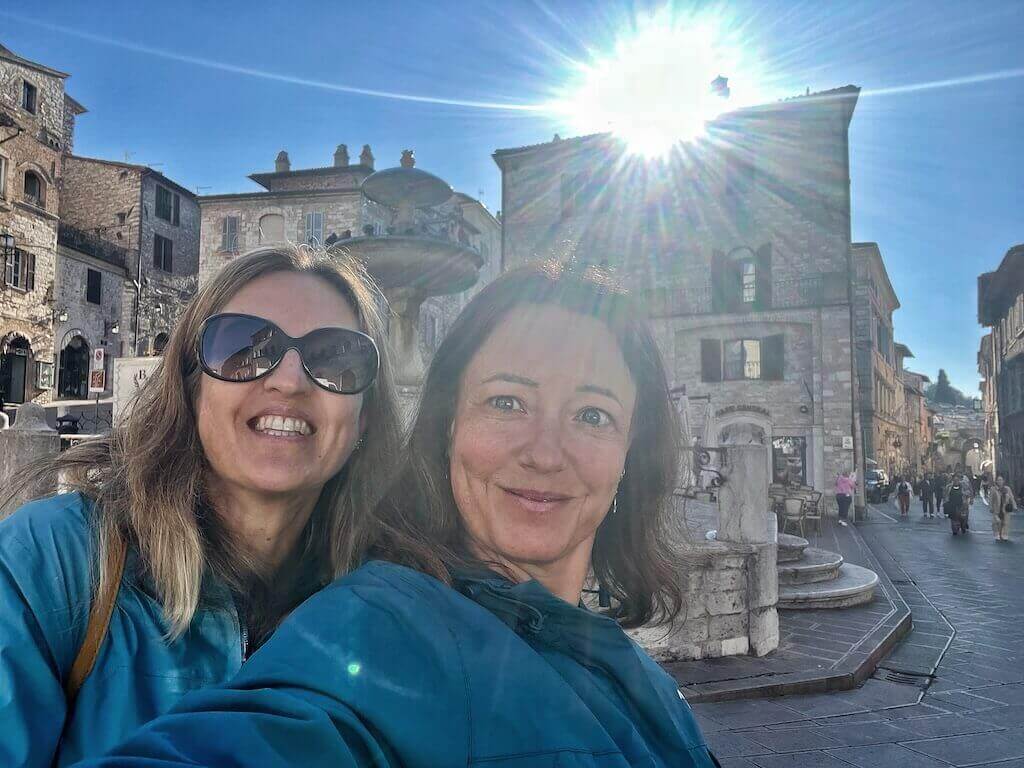
All the streets of Assisi starting from city gates converge to Piazza del Comune, which has always been considered the hub of Assisi’s social and cultural life.
You will eventually end up there in your wanderings around the city, if anything because surrounding the squares there are many cafés and restaurants, and because the tourist information center is located there – you can go there to grab a map of the city and buy the Assisi Card, which gives you access to many monuments in town.
It’s impossible not to be struck by the beauty of the monuments of pink and white stone, typical of Mount Subasio, that overlook the square. When we visited, we spent quite some time there as it’s just a fun place to be.
You will immediately spot Minerva Temple (more about it below), the first seat of Assisi’s municipality (later moved to Palazzo dei Priori), the Palazzo del Capitano del Popolo and the Torre del Popolo, the fountain and the Palazzo delle Poste, dating from 1926, which is the most recent building.
Explore Roman Assisi
Long before St. Francis, Assisi was a thriving Roman town—Asisium—perched strategically on Mount Subasio. You can still walk through the layers of its history and discover the town’s Roman past. Here is what to do in Assisi to learn more about its Roman heritage:
Visit the Piazza del Comune, the lively main square. The square may look medieval, but it is actually built over Assisi’s Roman forum.
Dominating the square, you’ll find the Temple of Minerva (which dates from the 1st century BC) (more about this below).
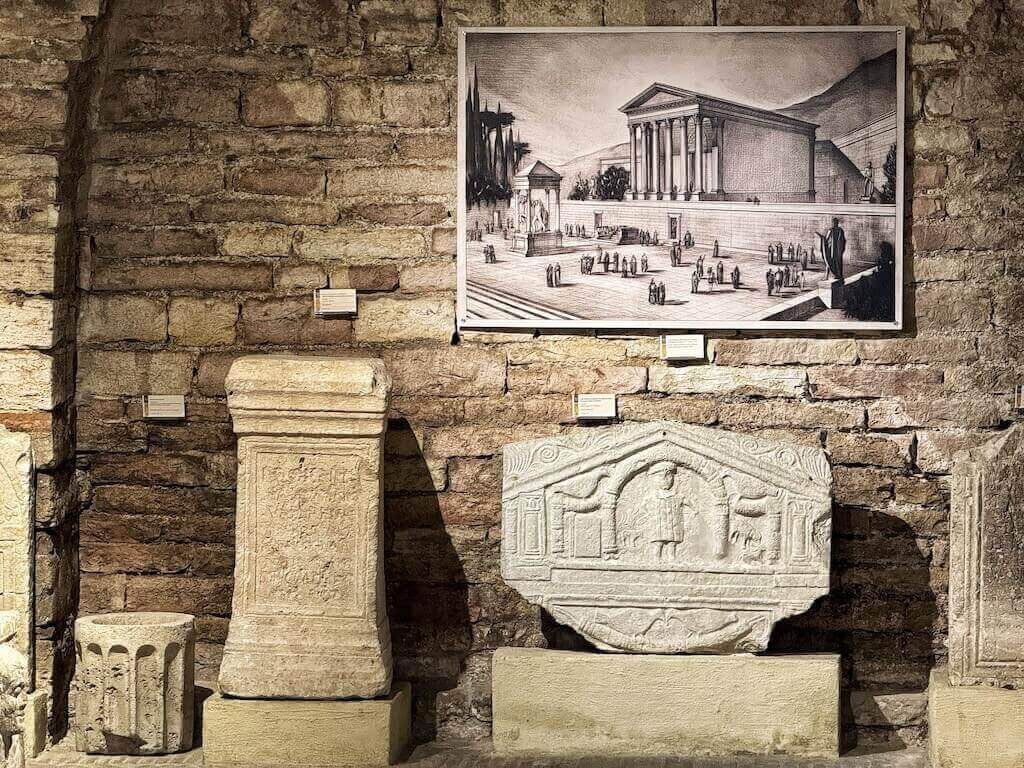
Beneath the square, you can visit the Roman Forum and Archaeological Museum (access to the Forum is from Via Portica). Descend a staircase to walk ancient paving stones, see carved sarcophagi, statues, and the original podium of the Temple of Castor and Pollux.
If you wish to explore more of its Roman past, one of the best things to see in Assisi is the Roman Domus, complete with Mosaic Floors. It’s located just off the square, at Via Portica 28. This was the Domus di Properzio.
Another one you may want to see is the Domus di Larario (you’ll find it in Via Santo Rufino 1). Here, archaeologists uncovered a domestic shrine and geometric floors.
Finally, you can visit Assisi’s Roman Amphitheater. It’s located in Via Anfiteatro. This takes a bit of work because what used to be the amphitheater is now engulfed in the curve of the houses here. The theater dates from the 1st century AD and was later used as a residential quarter.
Good to know: You can get a combined ticket that grants you access to the Foro Romano, the Rocca Maggiore, and the Pinacoteca Comunale, and an audio guide in your language of choice.

Visit the Tempio di Minerva
Minerva Temple is one of the most interesting places to visit in Assisi that isn’t directly related to its current religious importance. It has a perfectly preserved facade (one of Italy’s best-preserved Roman façades) and now houses the Church of Santa Maria sopra Minerva.
You can spot its six columns resting directly on the staircase, topped by a Corinthian-style capital.
Built in the 1st century BC, the Temple was meant to be dedicated to Hercules, but the discovery of a feminine statue nearby caused the building to be named after the goddess Minerva. Over time, it was used as a prison, for housing, workshops, and as a seat of the city council.
In 1539, Pope Paul III ordered the restoration of the temple and decided to turn it into a church. Due to the excellent condition of the original structure, the building is still commonly referred to Minerva Temple – though the official name is Chiesa di Santa Maria Sopra Minerva.
Admire the Torre e Palazzo del Capitano del Popolo
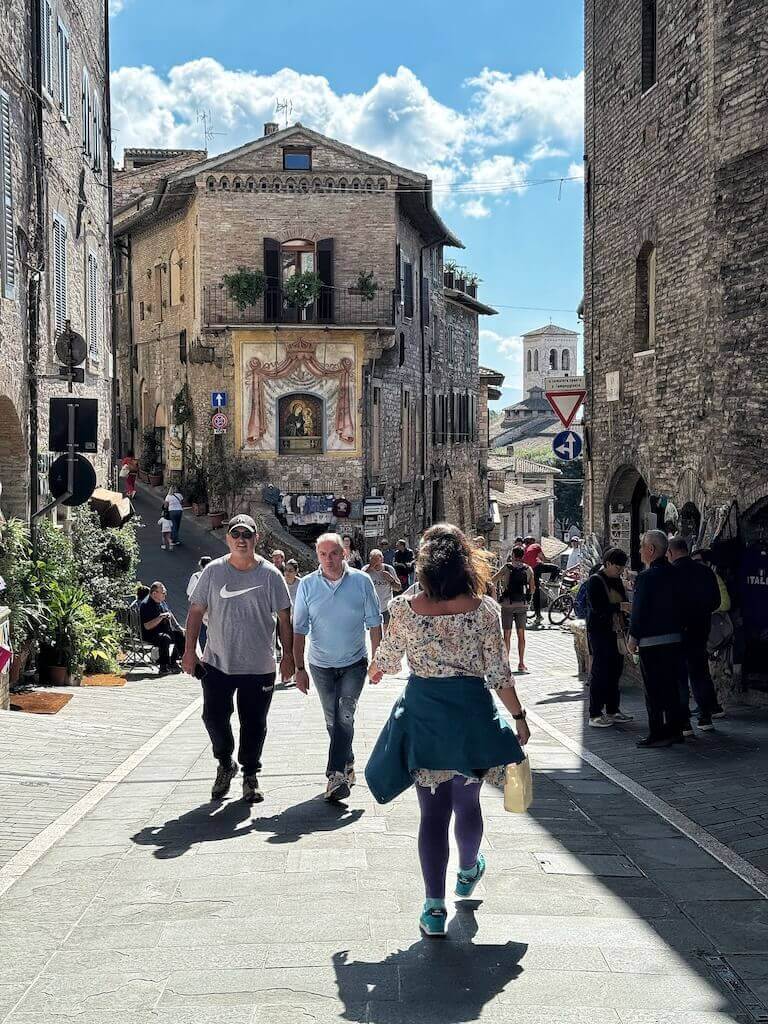
To the right of the Temple of Minerva, you will see the Tower of the Captain of the People. Completed in 1305, the Tower is 47 meters (slightly over 154 feet) tall, and it used to be the house of the Capitano del Popolo family.
Still further to the right, the Palace of the Captain of the People was the first public building of the square and housed the magistracy of the Capitano del Popolo.
In front of the tower, you will find a plaque in Subasio red stone, reporting the reference measurements of typical medieval Assisi products: bricks, tiles, squares and roof tiles. The municipal statute of 1469 indicated to artisans and merchants the use of those measurements.
And the Palazzo del Popolo, Palazzo dei Priori, and Palazzo Bonacquisti
Opposite the Temple of Minerva you can see two beautiful palaces related to the municipal life. One is the Palazzo del Popolo (People Palace), used as a venue for the assemblies of the General Council of the People. It was finished around 1308, after the enlargement of the square.
Next to it, the Palazzo dei Priori houses the offices of the Municipality of Assisi. When Assisi was annexed to the Savoy state in 1860, the ancient palace underwent major restoration and was turned into the seat of the municipal administration.
The beautifully decorated Sala della Conciliazione and Sala del Consiglio can be visited during events and conferences, but it is otherwise closed to the public.
Finally, dating from the 16th-century, Bonacquisti Palace is an important Renaissance building characterized by decorated ceilings and ancient masonry. It belonged to the noble Bonacquisti family, lords of Panzo.
Pose for a photo at Fontana dei Tre Leoni
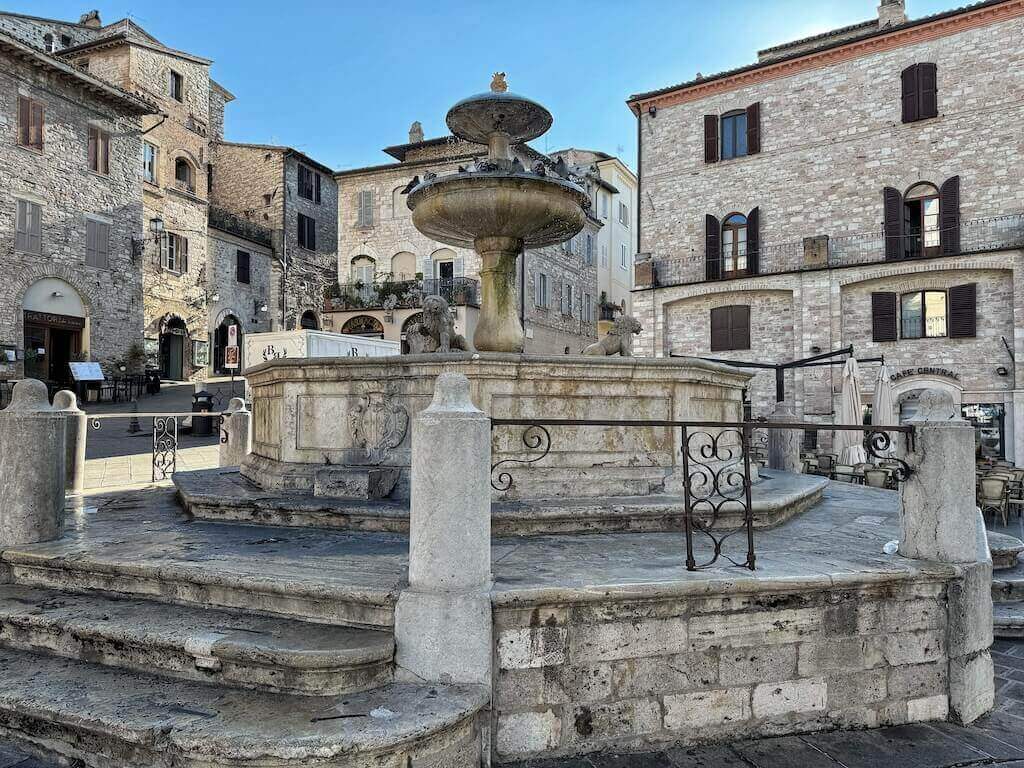
On an important square such as Piazza del Comune, a fountain could not be missing. The fountain’s name, Fountain of the Three Lions, comes from the three stone lions symbolizing the three urban districts of Assisi.
This is a gorgeous fountain, and a rather trafficked post – a meeting point for locals and tourists alike. So, don’t be surprised if you have to wait a bit for a photo – it’s one of the unmissable things to do in Assisi.
Visit the Chiesa Nuova
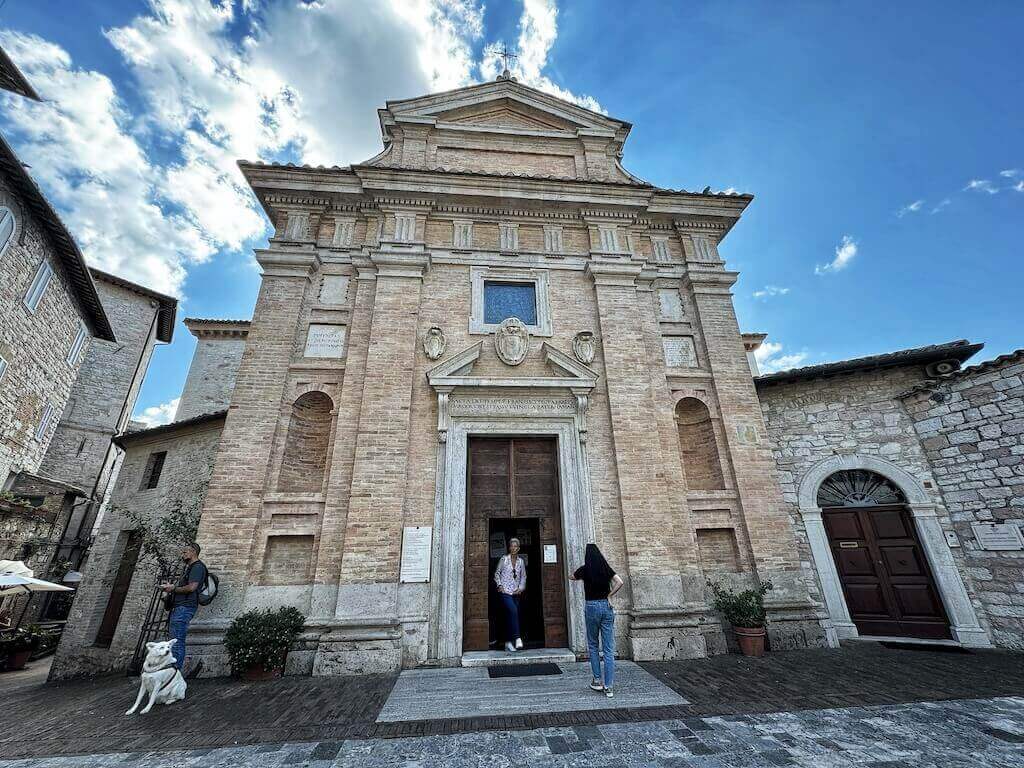
Next to Piazza del Comune, the New Church was built on the ruins of the house where St. Francis was born in 1182 and grew up. Since the growing number of pilgrims visiting Assisi, the transformation of the house into a Church started in 1615.
The small Church is a rare example of 17th-century religious architecture in Assisi: an elegant Greek-cross building with a dome. On the top of the Church’s portal, you will see an inscription in Latin that means “The house of Francis’ parents has become a temple of God; while the cell where he was imprisoned by his father is still visible.”
The Church interiors are decorated with frescoes by various local artists, with scenes from the Saint’s life, St. Clare’s life, and the representation of the Franciscan’ Martyrdom in Flanders and the Franciscans’ Martyrdom in Morocco by Cesare Sermei.
On the square in front of the Church, you will find a bronze statue by the sculptor Roberto Joppolo depicting St. Francis’s parents. The Church also houses a small museum of Franciscan objects, in what was once Tiberio Diotallevi’s house, an Assisian painter.
Peek into St. Francis’ House
While it’s well hidden among other buildings, visiting St. Francis’ house is one of the unmissable things to do in Assisi.
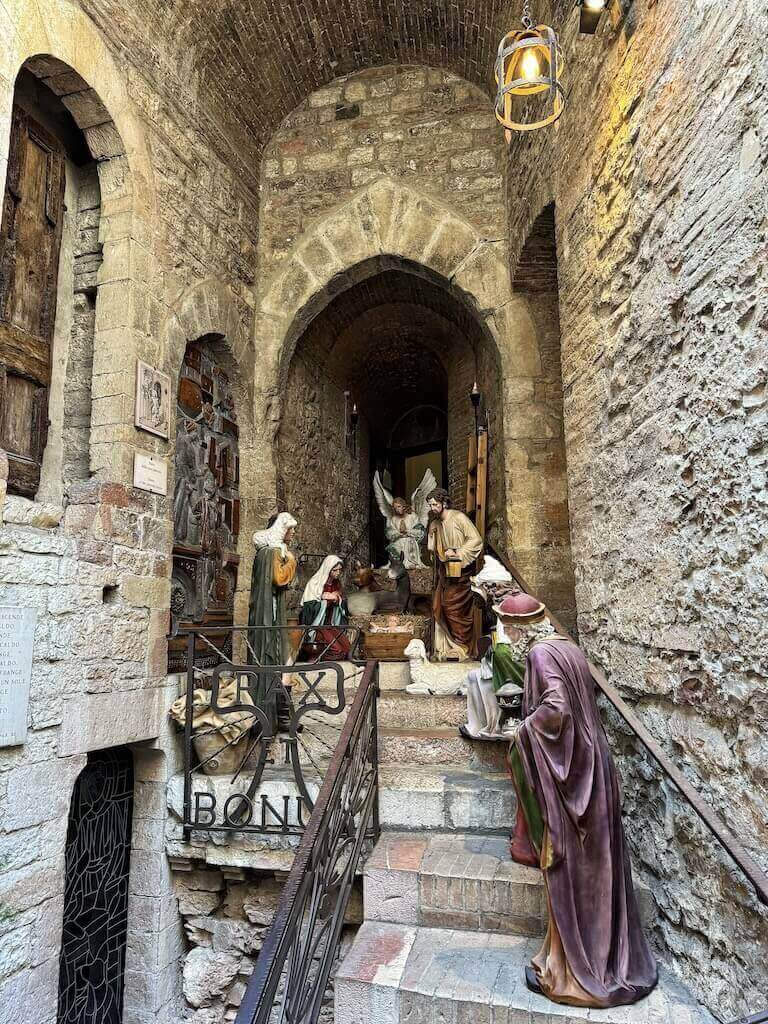
This is the house where St. Francis spent his childhood with his family (his father Pietro di Bernardone, his mother Pica, and his youngest brother Angelo). Most of the building has been engulfed by the Chiesa Nuova, but you can still get an idea of the structure of the house.
On the ground floor, there was the fabric store (his father was a wealthy merchant), and you can even see the small “prison” where the Saint was imprisoned by his father as a punishment for having some fabrics and a horse in Foligno to restore the abandoned San Damiano Church.
The second floor (currently the church) housed the family’s day rooms. The upper floor is no longer visible, but it housed the bedrooms.


Walk around Assisi Old Town
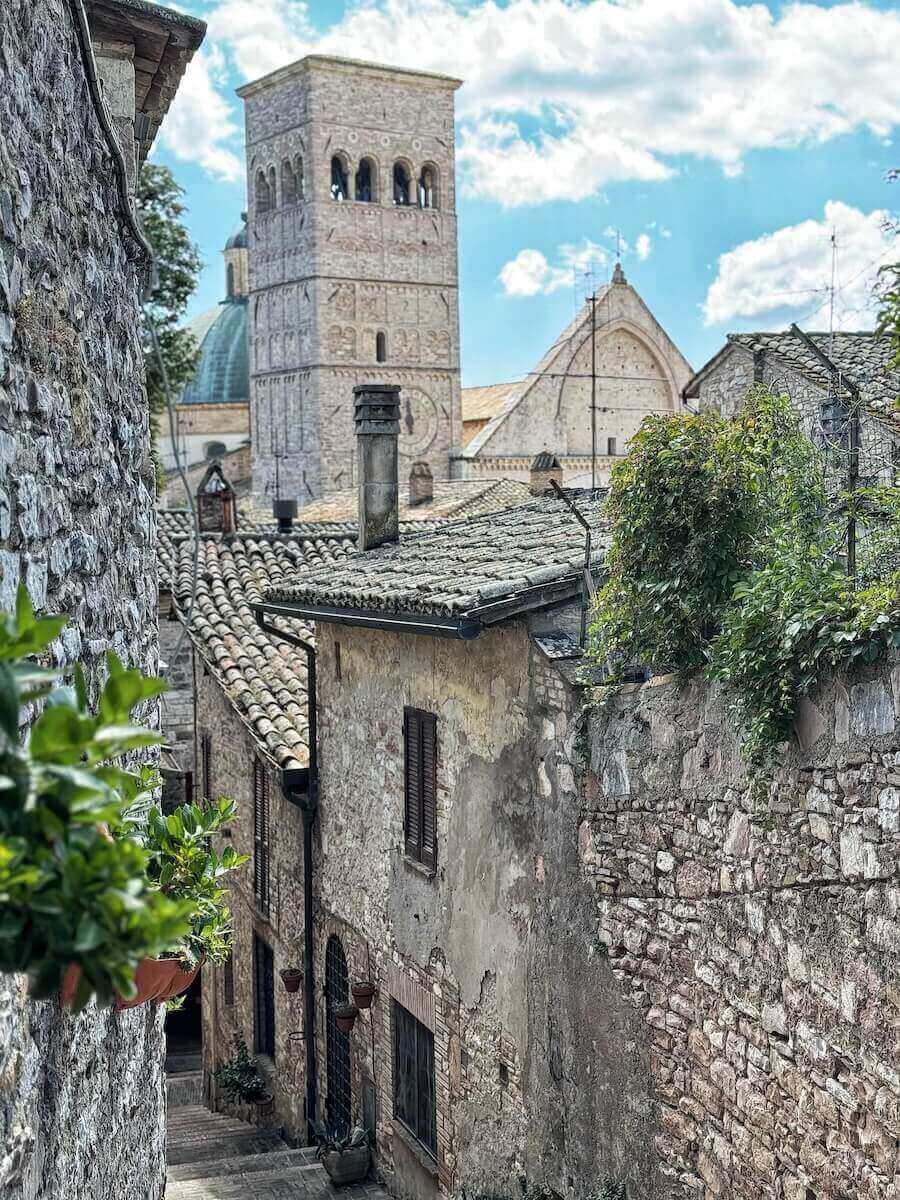
This is one of the most enjoyable things to do in Assisi. The city is a maze of narrow alleys, small courtyards, staircases, ancient doorways, and balconies decorated with colorful flowers.
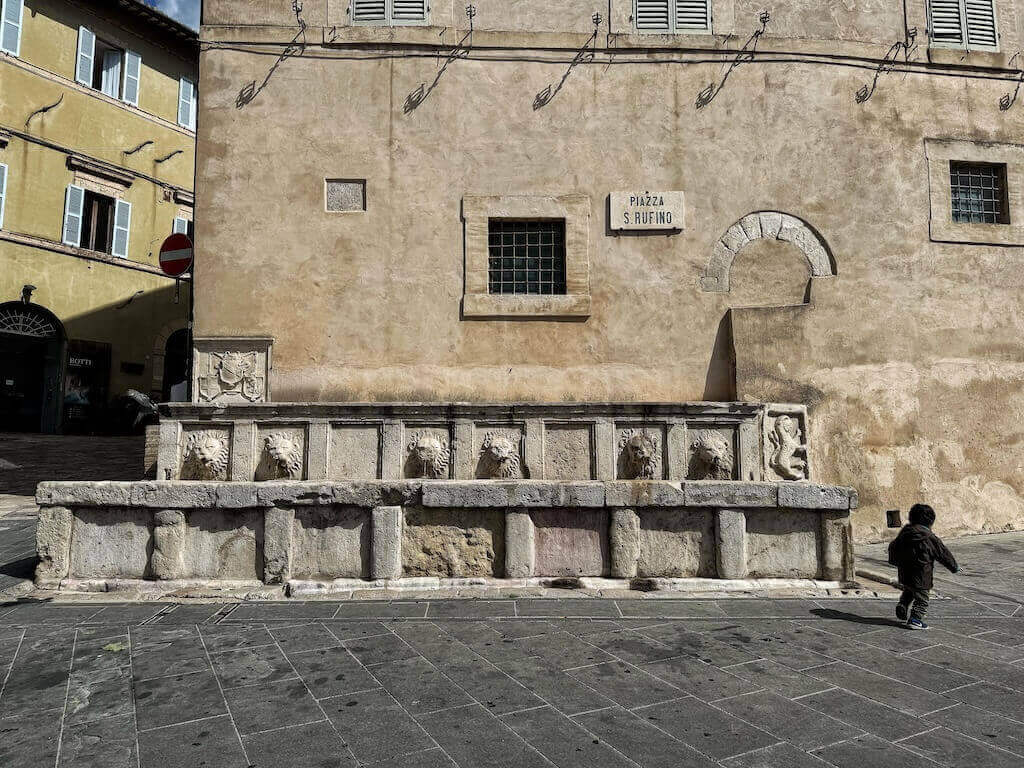
One of the nicest things to see is the San Rufino fountain, close to the cathedral. It is also known as the fountain of the six lions, because of the six lion heads from which the water flows. Built in 1532, made of travertine, it was one of the main sources of fresh water in the city.

There’s also the Oliviera Fountain, belonging to Ludovici family. It’s located in one of the most beautiful streets in Assisi – Via Superba – and there’s a plaque that says that anyone washing their clothes in the fountain would be fined (but people continued doing that).
Next to the fountain, an elegant portico is the front door of Palazzo Monte Frumentario, one of the first hospitals in Italy.
To make the most of Assisi, consider joining a guided walking tour. I recommend this walking tour that also includes a visit of St. Francis’ Basilica and San Rufino Cathedral. The tour lasts 2.5 hours and it’s a great introduction to the city.
Assisi has pledged to the removal of architectural, social and cultural barriers. For this reason, people with disabilities can move around town easily.
Walk St. Francis’ Way
Have you ever heard about St. Francis’s Way? The Via di Francesco, as we call it in Italian, is a pilgrimage trail that stops at some of the most important places where St. Francis preached.
Accessible on foot, by bike, and on horseback, it starts in Santuario della Verna, passes through Perugia and Assisi, Viterbo, and ends in Rome. Obviously, the route can also be walked the other way around. You will enjoy nature, the incredible views along the way, and meeting other like-minded travelers.

Take in the views from Rocca Maggiore
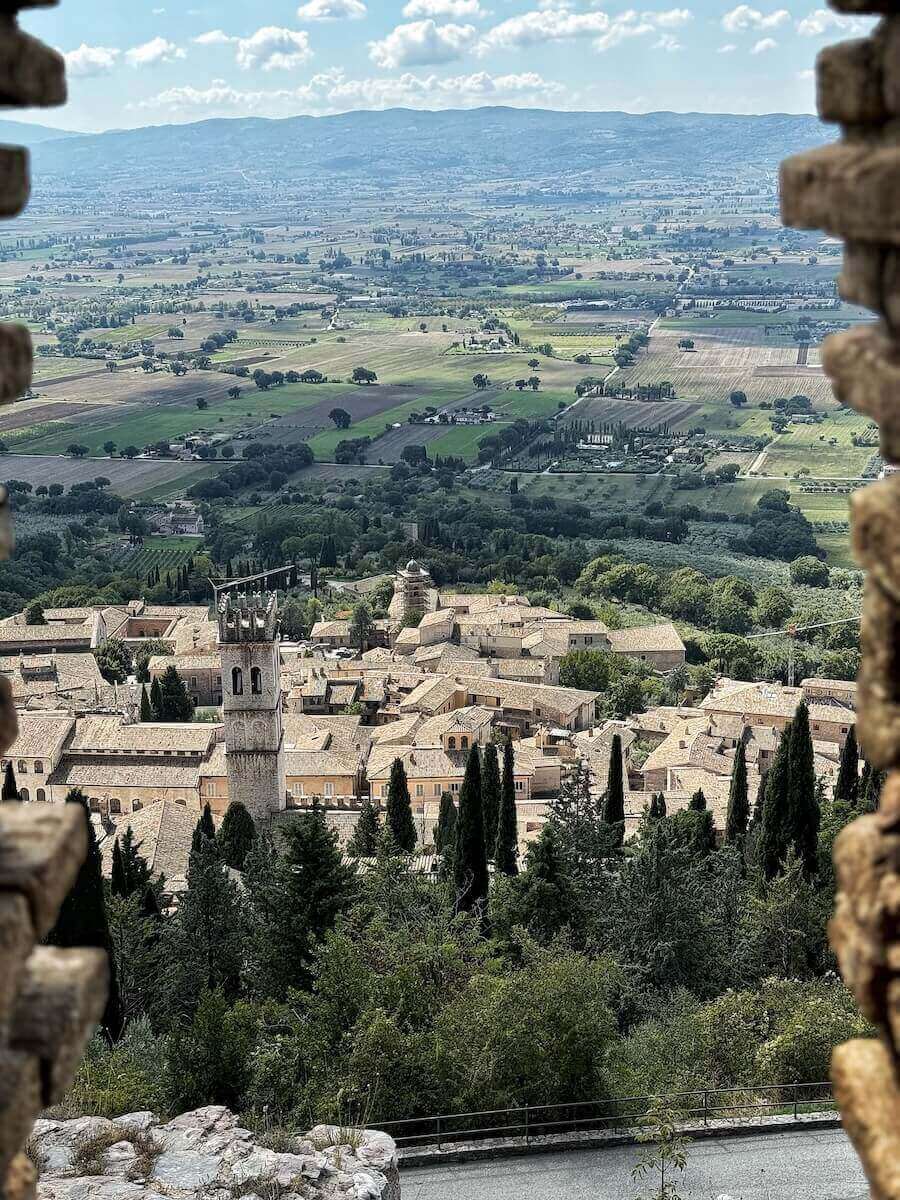
Taking in the views from Rocca Maggiore was one of our favorite things to do in Assisi. The way to get there is rather steep, as it is perched on top of a hill, but the view is rewarding.
The fortress has dominated the town, the narrow gorge crossed by Tescio River, and the surrounding valley for more than 800 years.
Construction of the fortress was commissioned by Frederick Barbarossa and dates back to 1173. The fort was then destroyed by the population during an uprising, but it was rebuilt by Cardinal d’Albornoz in 1365 and was included in the network of castles to defend the Papal State.
Rocca Maggiore was then enlarged and modified, and its intended use changed many times. It was finally sacked and abandoned in the 1600s. However, fortunately for us it has been preserved very well to the present day.
A long corridor connects the fortress to main tower, the castellan’s residence. It’s a nice museum to visit inside – though the exhibits vary on a regular basis. The main reason to visit is to enjoy the stunning views of the city.
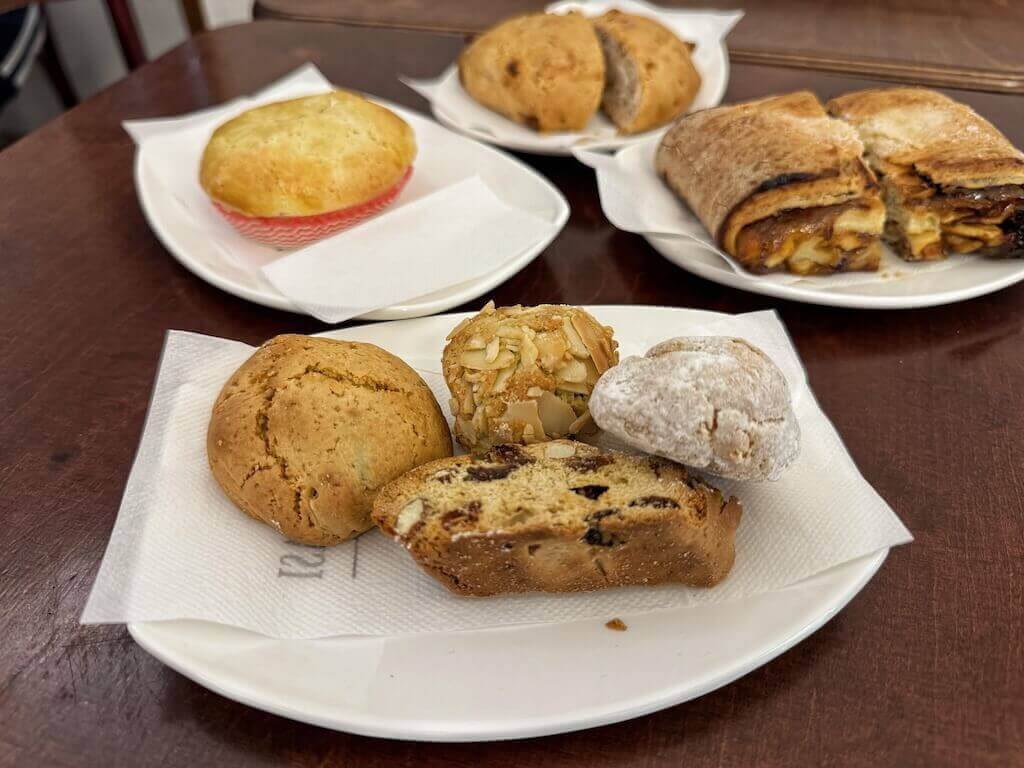
Have breakfast at Pasticceria Sensi
When my sister and I visited Assisi, we arrived there from the airport straight from an early morning flight, and we were desperate for breakfast and a good coffee. To taste the best local pastries and delicacies, we went to Bar Pasticceria Sensi.
Located on Corso Mazzini Giuseppe 14, close to Piazza del Comune, this pastry shop is one of the oldest in town. The small workshop was established in 1969, and it is still a family-run business, with family recipes used to base the most delicious sweets.
My sister and I picked a selection of both sweet and savory products typical of Umbria, including the Rocciata di Assisi, a rolled dough filled with apricot jam, apples, walnuts, raisins, pine nuts, almonds, and a pinch of cinnamon.
We also had Tozzetti, a crunchy cookie with raisins and almonds; the Biscotto Francescano, a honey shortbread with raisins; and Pancaciato, a savory bread with local cheeses and nuts. We also brought home the Easter Cake, a savory pie made with eggs and local cheeses.
Good to know: Not many people know this, but right by Bar Sensi there’s the Oratory of San Francesco Piccolino. This was the stable where St. Francis’ mother gave birth, and later on became an oratory thanks to the work of Piccardo, St. Francis’s nephew.
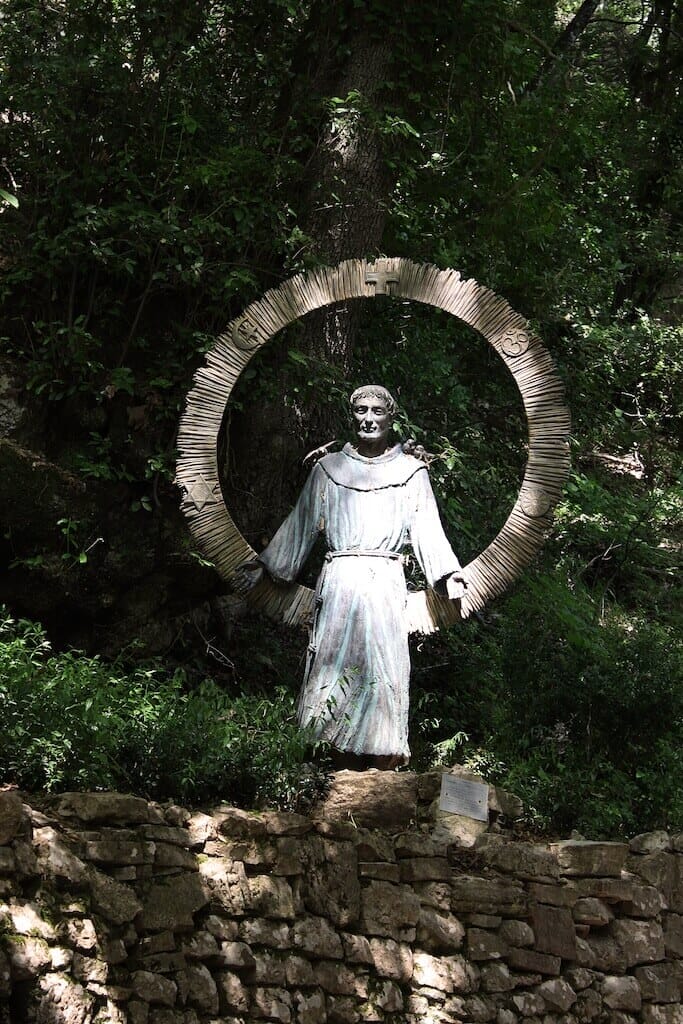
Visit the Eremo delle Carceri
The word “carceri” (prison) comes from the Latin ‘carcer’, which means a solitary, secluded place. St. Francis withdrew here to pray and lead an austere life, in close contact with nature.
Located about 4 km (2.5 miles) from town in the heart of the Mount Subasio forest, the Hermitage is one of the least popular places to visit in Assisi – likely because many don’t even know about it. But it’s worth it.
Here you will find the cloister with the well from which, according to legend, St. Francis let the water pour. You can also appreciate an impressive view of the Subasio Canyon. Other things you can see are the original cells carved in the rocks of the mountain, the Chapel of St. Mary Magdalene and the Oratory of St. Mary.
The highlight of the visit is obviously the Grotto of St. Francis: here the saint slept and prayed. A bridge connects the Hermitage to the other side of the forest, where the caves where St. Francis and his companions prayed are still visible.
Map of Assisi Attractions
As I am sure you have gathered, there are many things to see in Assisi, and you will find that a day is hardly enough to properly explore this small town in Umbria. For ease, I have created a map of the best Assisi attractions, so that you can more easily plan your itinerary.
How to use this Assisi attractions map: This map points out the things to see in Assisi. If you wish to enlarge it, use your computer mouse on desktop or laptop. You can also use your fingers on your smartphone. To save the map to your Google Maps account, you can click on the star next to the title. You can then view the saved map by clicking on “Your saved maps” in your Google Maps. For a larger version, simply click on “view larger map” in the top right corner of the screen.
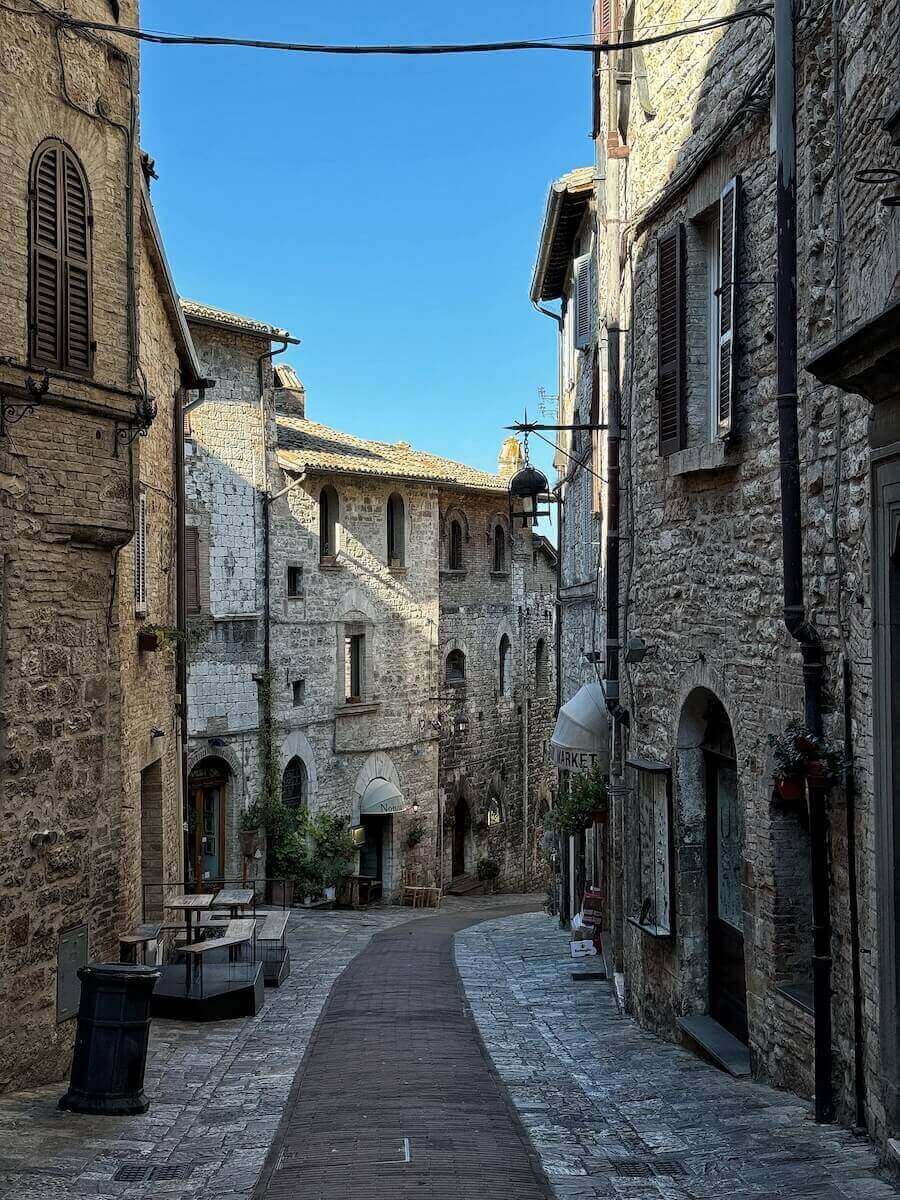
How Long Should You Stay In Assisi?
You need at least one full day to properly visit Assisi. One day in Assisi is enough to check out all the most important things to see in Assisi’s historic city center, wander the streets, enjoy a leisurely lunch, and maybe even have an aperitivo or dinner.
If you have one extra day to spend in Assisi, you can visit the other religious sites just outside the city center. You could also consider using Assisi as your base to further explore Umbria.
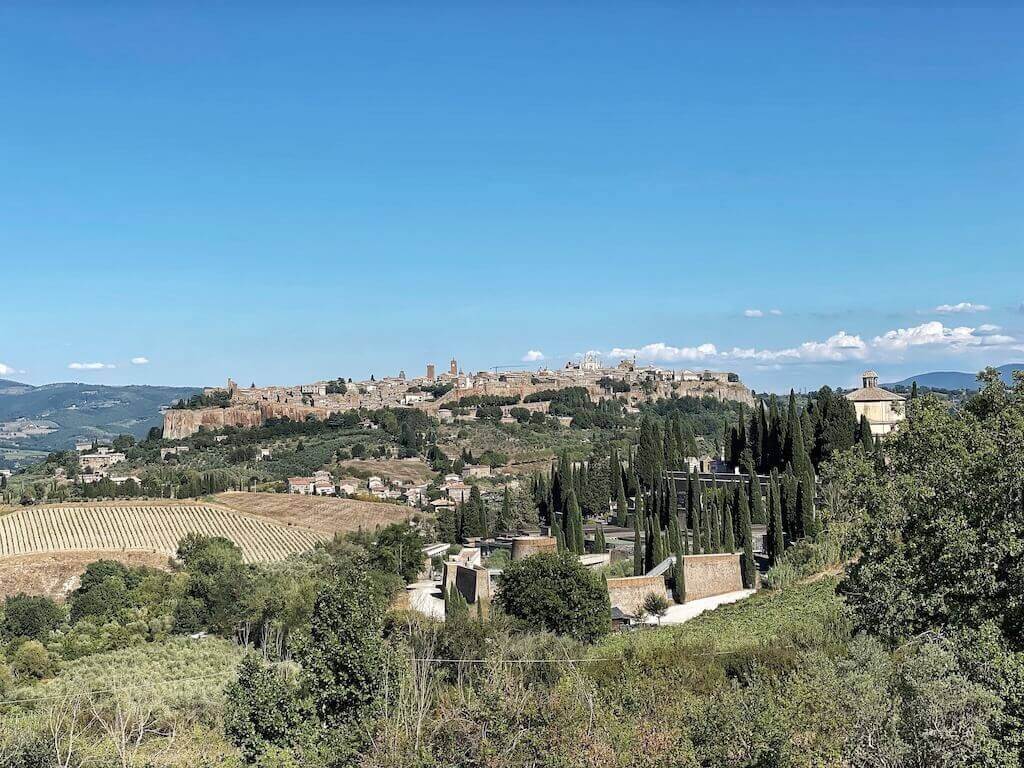
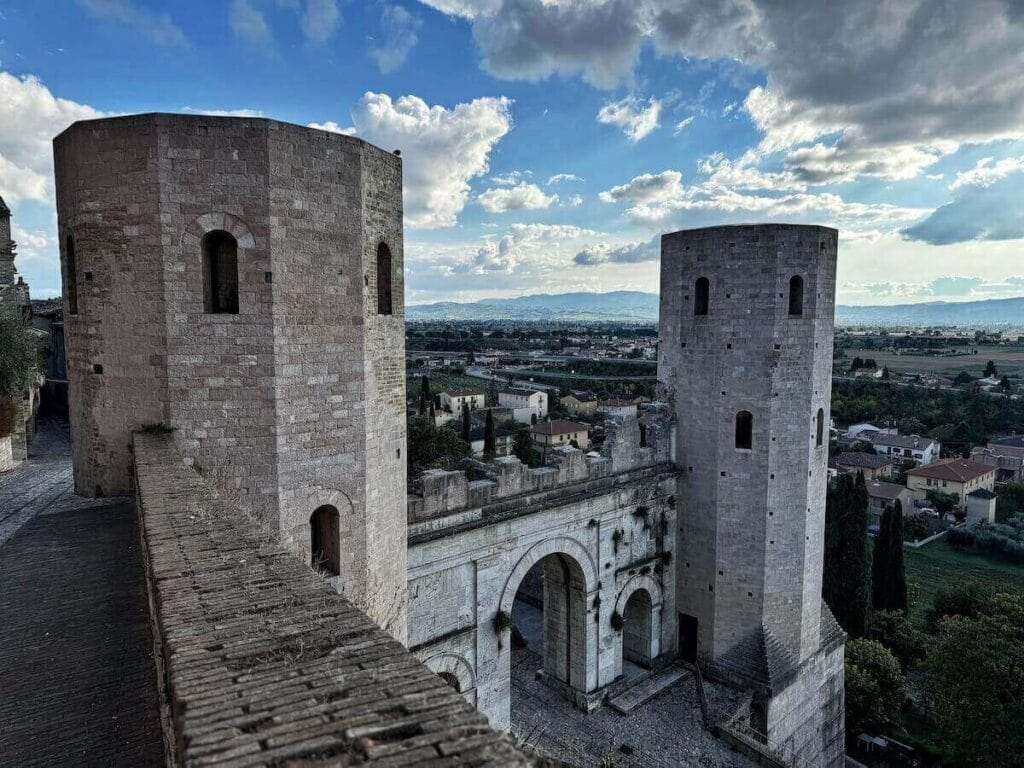
It’s easy to reach Spello (less than a 20-minute drive), which makes it an excellent destination for a day trip from Assisi, and even Spoleto, which is a 40-minute drive.
Below is a sample one-day Assisi itinerary.
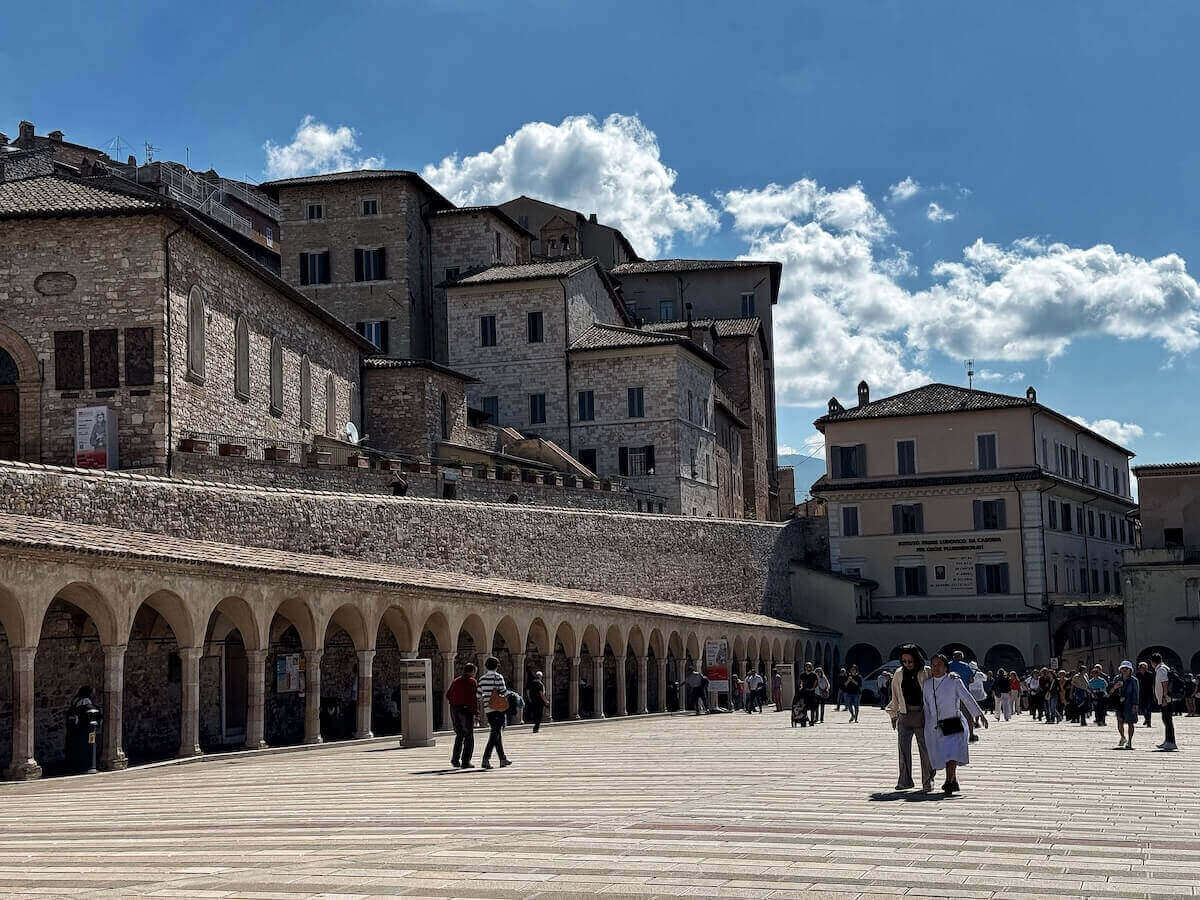
One Day In Assisi Itinerary
If you only have one day in Assisi, you can see the main sights on foot with an easy circular route that starts at the top of town and winds down through the medieval lanes. Wear comfortable shoes — there are some slopes — and plan to spend between 6 and 8 hours exploring at a relaxed pace.
Morning — Upper Town and the Great Basilicas
- Start at the Basilica di San Francesco d’Assisi: Visit both the Upper and Lower Basilicas and the Tomb of St. Francis (allow 1.5–2 hours). Arrive early to avoid crowds and enjoy the morning light.
- Walk up Via San Francesco to the Piazza del Comune. You’ll pass artisan shops and the medieval Palazzo del Capitano del Popolo tower. Continue walking along Via Mazzini to get to Bar Sensi, where you can stop for a good Italian coffee and Italian-style breakfast.
Late Morning — Piazza del Comune and Roman Assisi
- Explore Piazza del Comune, the heart of Assisi. Admire the Temple of Minerva (now a church) and the Palazzo dei Priori.
- Go underground to the Roman Forum & Archaeological Museum beneath the square — a fascinating glimpse of Roman Assisi.
- Optional: Peek into the Pinacoteca Comunale nearby if you enjoy medieval art.
Lunch Break
Choose a trattoria near Via San Rufino or Via San Gabriele Dell’Addolorata. Try strangozzi pasta with truffle, Umbricelli pasta with a meat sauce, or a simple Umbrian soup.
Afternoon — Churches and Views
- Walk to the Cattedrale di San Rufino, where St. Francis and St. Clare were baptized.
- Continue to the Basilica di Santa Chiara, home to the saint’s tomb and the original San Damiano Cross.
- From the terrace, take in one of the best views of the valley.
Late Afternoon/Evening — Rocca Maggiore
If you have energy, walk up to Rocca Maggiore, the medieval fortress watching over Assisi. The views are extraordinary, especially at sunset. Allow around 45 minutes to one hour for the visit.
After that, walk back to the historic center where you can look for an aperitivo or dinner spot.
Where To Stay And Eat In Assisi
Assisi is where to stay in Umbria to explore the quaint small towns, and you can easily use it as a good base for your trip instead of Perugia.
There are various excellent places to stay in Assisi, both in the historic center (typically self-catering apartments) and outside, in agriturismos. Here are a few recommendations:
- Agriturismo Molinella – Modern, cozy rooms in a countryside setting just outside the city.
- Appartamento Nonna Milde – Small apartment in the historic center, perfect for a couple.
- Nun Assisi Relais & Spa Museum – Gorgeous boutique hotel in the historic center.
In terms of where to eat in Assisi, you’ll also have a great choice. These are the places we tried and loved:
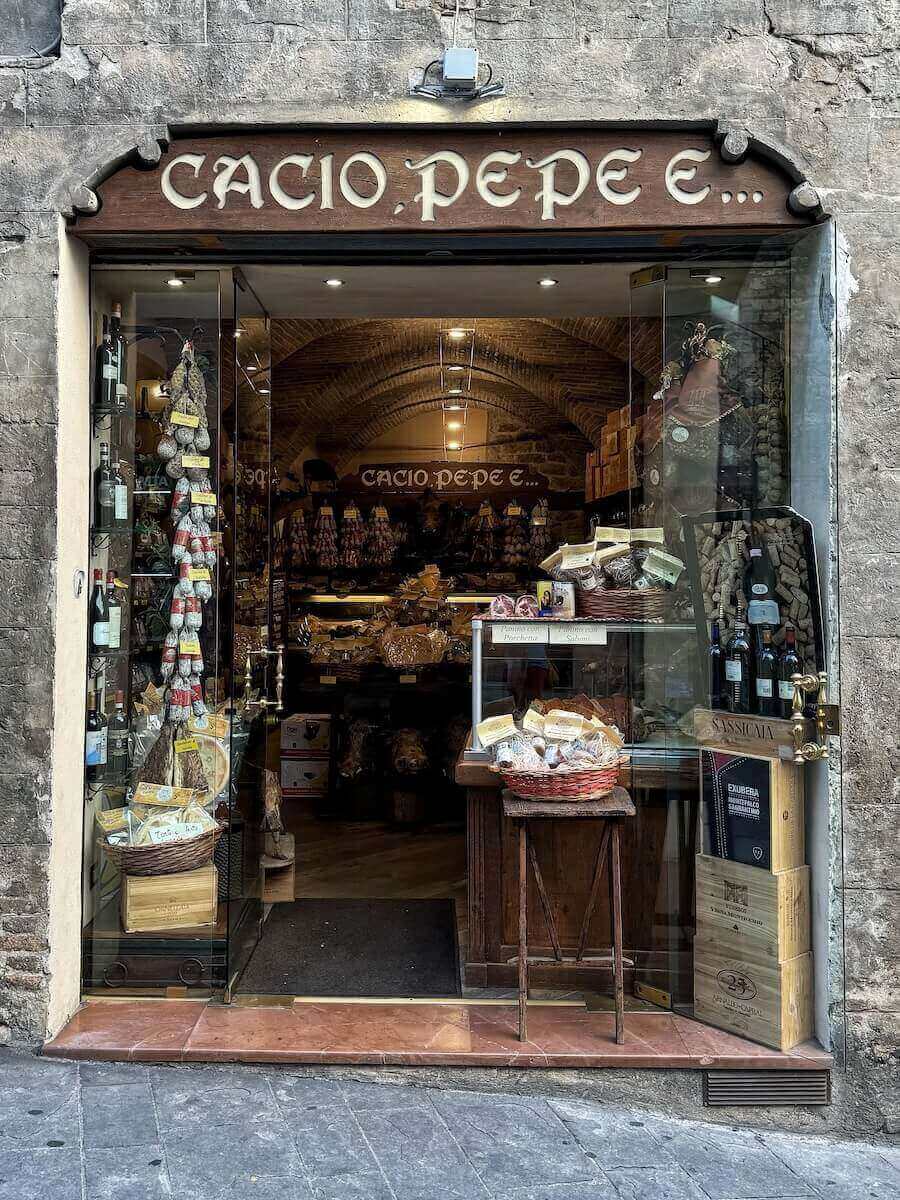
- Bar Sensi – Perfect spot for a classic Italian-style breakfast or a snack; they have several typical local sweets.
- Porcellino Divino – Delicious made-to-order sandwiches perfect for lunch.
- Bibenda – One of the best restaurants in Assisi, it has a great selection of wines.
- Taverna Casa Norcia – The best place to try the most traditional dishes.
How To Get To Assisi
By car
If Assisi is the first stop of your Umbria itinerary (as it was for us), you’ll find getting there from the airport incredibly easy. Car rental offices at Perugia Airport are in the terminal, just as you arrive.
From Perugia Airport, it’s an easy 20-minute drive to Assisi (15 km/9.3 miles).
If you are visiting Assisi on a day trip from Perugia, you’ll find the drive easy and pleasant. It’s just 25 km/15.5 miles, and it takes about 30 minutes to drive there.
In case Assisi is part of a longer Italy itinerary, here’s the driving distance and time from other cities in Italy:
- Rome – 190 km/118 miles, about 2.5 hours
- Viterbo – 126km/78 miles, about 2 hours
- Orvieto – 93 km/58 miles, about 1.5 hours
- Florence – 175 km/109 miles, about 2 hours and 10 minutes
I recommend using Discover Cars to find the best deals on car rentals. It’s a comparison site that shows you the various car rental companies in one location, and allows you to select a car based on your budget. It’s what we used for our Umbria trip, and we had no issues whatsoever.
Good To Know: Most of Assisi is a ZTL (Limited Traffic Zone), which means only residents are allowed to drive through and park in the historic center. You will need to park your car outside. When we visited, we used the Parcheggio Saba Matteotti in Piazza Matteotti, but you can also use the Porta Nuova parking.
By public transport
You can easily move around Italy using public transport.
Assisi train and bus stations are located in Santa Maria degli Angeli, near the Basilica Santa Maria degli Angeli and outside the historic center of the city. Trains and buses to Assisi all stop there. From there, you can take a taxi or the public bus, which stops just outside the historic center.
The direct train to Perugia takes 30 minutes.
There’s a direct train to Assisi from Florence Campo Marte station (it’s a regional train that takes about 2.5 hours).
There are no direct trains from Rome, Viterbo, or Orvieto.
Guided Tours of Assisi
If you don’t wish to drive, you will be glad to know that there are guided day trips to Assisi from a variety of other cities in Italy that also include transportation. Here are my top recommendations:
This Assisi and Orvieto day trip from Rome is very well rated. You will visit the Duomo of Orvieto, St. Francis Basilica, and enjoy a guided walking tour of Assisi.
This day trip from Florence stops in Orvieto and Assisi. It also includes a visit to St. Patrick’s Well in Orvieto. Keep in mind that as of spring 2026, the tour will no longer stop in Orvieto, but will go to Perugia instead.

FAQs on Assisi
One day is enough in Assisi if you just want to see the highlights. You will need two days if you also want to see the Eremo delle Carceri, the Roman sites, and Santa Maria degli Angeli.
There are many things to do in Assisi. Here’s what to do in Assisi in one day:
A walk in the historic center
Visit the gorgeous Cathedral of Assisi
Visit St. Francis of Assisi Basilica
Check out the temple of Minerva
Go to the hermitage Eremo delle Carceri
Visit the Basilica of Saint Mary of the Angels
Go up to the Rocca Maggiore for the views
Yes, you should definitely visit Assisi Italy. This is a unique town that beautifully combines religious traditions with art and history. It’s a popular pilgrimage destination: many Catholic people, as well as nuns and friars, visit Assisi from all over the world to see the birthplace of St. Francis. But you don’t have to be religious to appreciate the beauty of Assisi.
This is what to see in Assisi, Italy:
St. Francis Basilica
Basilica of Santa Maria degli Angeli
Santa Chiara Basilica
Eremo Delle Carceri
San Damiano Church
Rocca Maggiore
Piazza del Comune
Tempio di Minerva
No, there is a small fee to visit Rocca Maggiore. It’s worth paying for, because this is one of the most impressive Assisi attractions.
You can park in either the parking lot in Piazza Matteotti (marked on Google Maps as Parcheggio Saba Matteotti) or in the Porta Nuova parking, then use the lifts or escalators to the historic center.
No, taking photos inside the Basilica is forbidden.
There most certainly is. Make sure to cover your shoulders, chest, and knees whenever entering a church in Assisi. If you are visiting in the summer, it’s better to wear a longer skirt (or light pants, for men) and a t-shirt and bring a light shawl or scarf to cover your shoulders.
The best time to visit Assisi Italy is in the early Spring and Fall. Summer is generally very hot in Umbria, and brings larger tourist crowds to Assisi. You may also want to avoid visiting at the weekend. We visited on a Saturday at the end of September, and found it fairly crowded but still pleasant.

Conclusions: Is Assisi Worth Visiting?
Of course, Assisi is worth visiting! I think Assisi attracts lots of pilgrims and for religious people it’s a unique place to visit in Italy, but it also wins over atheists like myself for its sense of peace, acceptance and inclusion.
The town is beautiful, very clean and well kept, and you will find lots of excellent restaurants for any budget. In addition to the sweets and pastries I mentioned before, make sure to try the truffle and many truffle products – it’s typical of the region and it’s always on the menu.
The best time to visit Assisi Italy (much like the best time to visit Italy) is during spring and fall when temperatures are pleasant, though I recommend avoiding Christian holidays because the city gets really crowded with pilgrims and tourists.
Since winters are never too harsh or summers sultry, Assisi is a pleasant destination year-round. We visited at the end of September and enjoyed a sunny day with warm temperatures that were perfect for exploring. Be prepared to walk a lot, and for the slopes and lots of hills and staircases, because as written earlier, it is located on the side of Mount Subasio.
It’ll take you about a day to explore the main sights of Assisi, which is perfect if you are short on time – you can even visit on a day trip from Perugia or on day trips from Rome.
But if you want to experience the mystical vibe and linger longer, plan to stay at least two days. The good news is that there are many excellent places to stay in Assisi, and the city is a great base to explore the rest of the region.
Recommended Readings

PIN IT!

Claudia Tavani
Claudia Tavani was born and raised in Sardinia, and after moving between the United States and the United Kingdom, she's now back living in her hometown, Cagliari. She's a travel blogger and certified travel designer who loves planning trips and publishing guides, travel tips, and packing lists so that you don't have to. Owner of Strictly Italy, cat mom to Minnie. Loves pizza, hiking, archeology, cities, beaches, swimming, and running. Hates peppers.