
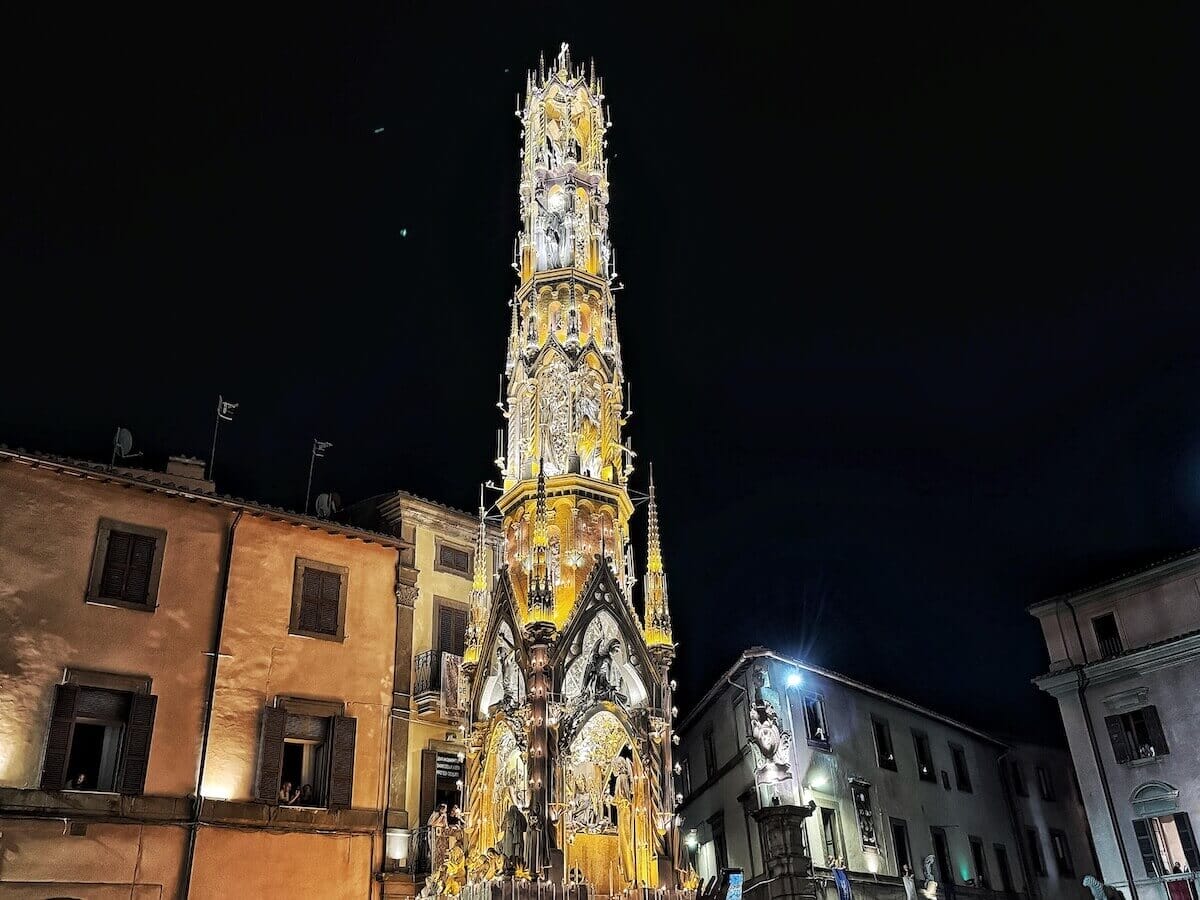
The Macchina di Santa Rosa is Viterbo’s most heartfelt festival, and one of the most unique celebrations you can expect to see in Italy.
I pretty much grew up with it, because even though I l was born and raised in Sardinia, my dad is from Viterbo, the capital of Tuscia. This is a city about 1.5 hours drive north of Rome. So of course, when we were kids, we’d join the celebrations whenever possible.
The first time I saw it, I was just a child. I still remember the thrill of waiting for the tower to pass by, the disbelief at how massive and beautiful it was, how narrowly it passed through the dark alleys of Viterbo, and the look of exhaustion on the facchini‘s faces (Santa Rosa’s porters).
Since then, I saw the Macchina di Santa Rosa many times, including in the last few editions.
This is such a special event in Italy that I decided to write about it and share everything I know, including my most useful tips to see it and appreciate it as much as I do. If you are visiting central Italy at the end of August or the very beginning of September, plan to spend a few days in Viterbo to explore the area (I promise it is gorgeous) and attend the festival.
My post, A Local’s Guide To Viterbo, will help you plan your trip to this lovely small city.
Quick Overview on the Macchina di Santa Rosa
Here’s a quick overview of what you need to know about the Macchina di Santa Rosa celebrations in Viterbo.
- Date: 3 September (every year)
- Start time: around 9:00 pm, every year
- Duration: roughly until midnight
- Route: about 1–1.2 km (0.6-0.7 miles) through the historic center of Viterbo
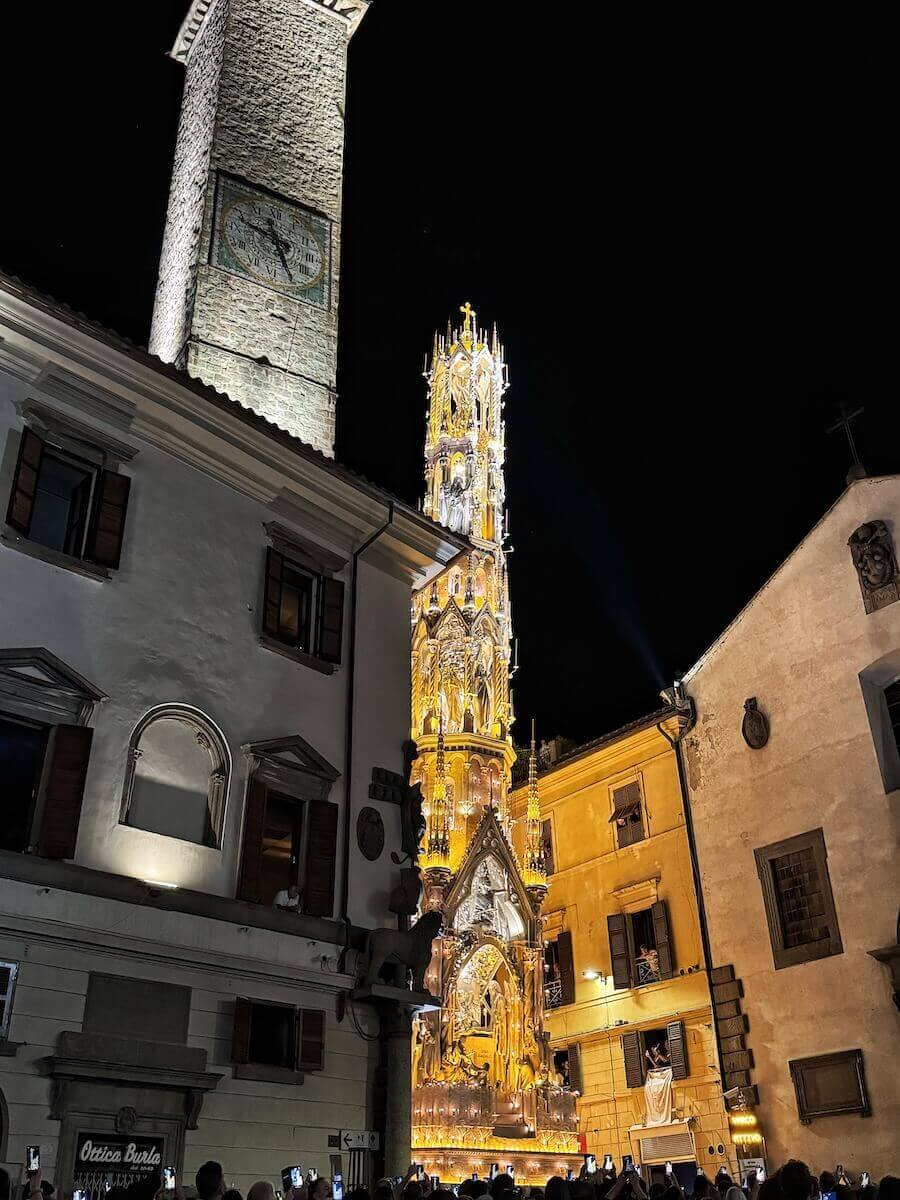
- What you’re watching: a ~30m illuminated tower carried by 100 “facchini” (porters)
- Livestream: TV2000 (online at tv2000.it and on the Play2000 app), and the YouTube channel of the Comune di Viterbo.
What is the Macchina di Santa Rosa?
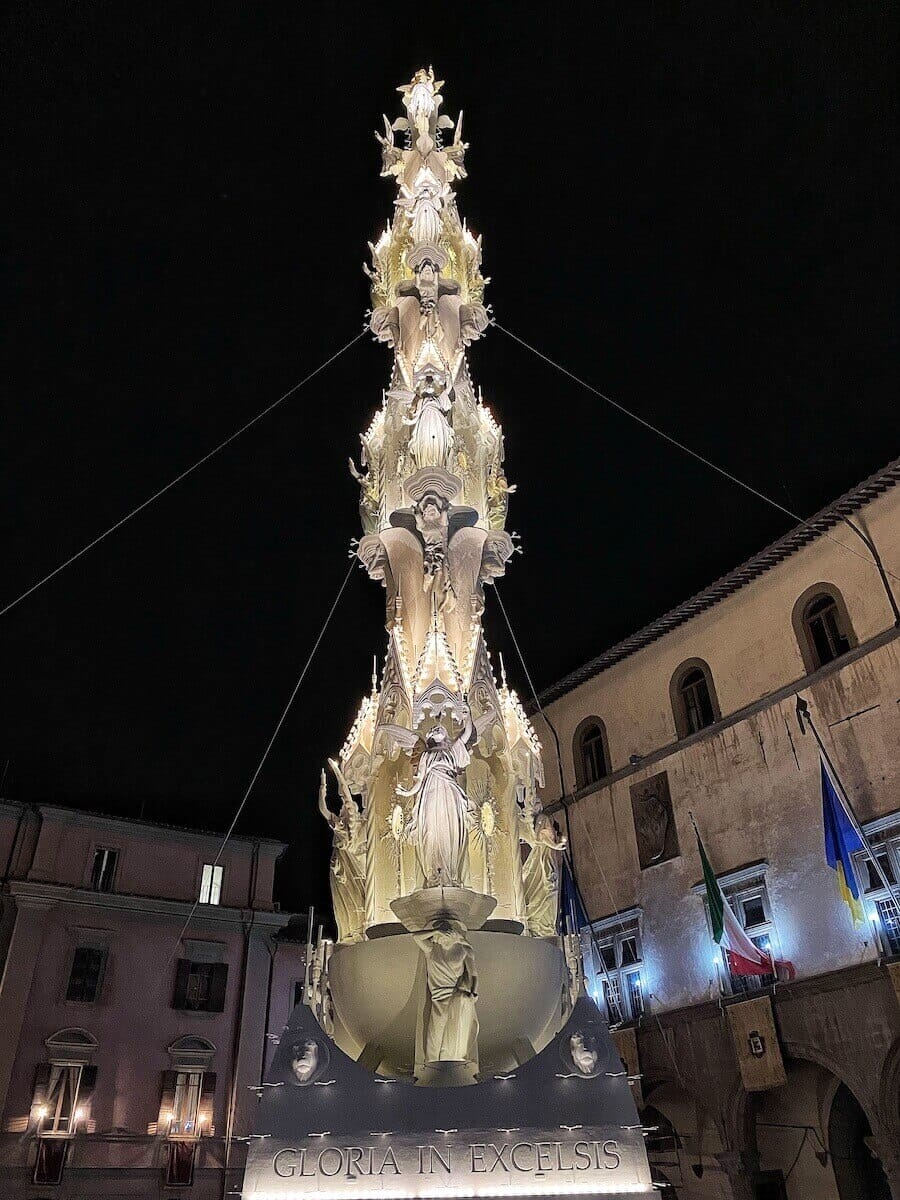
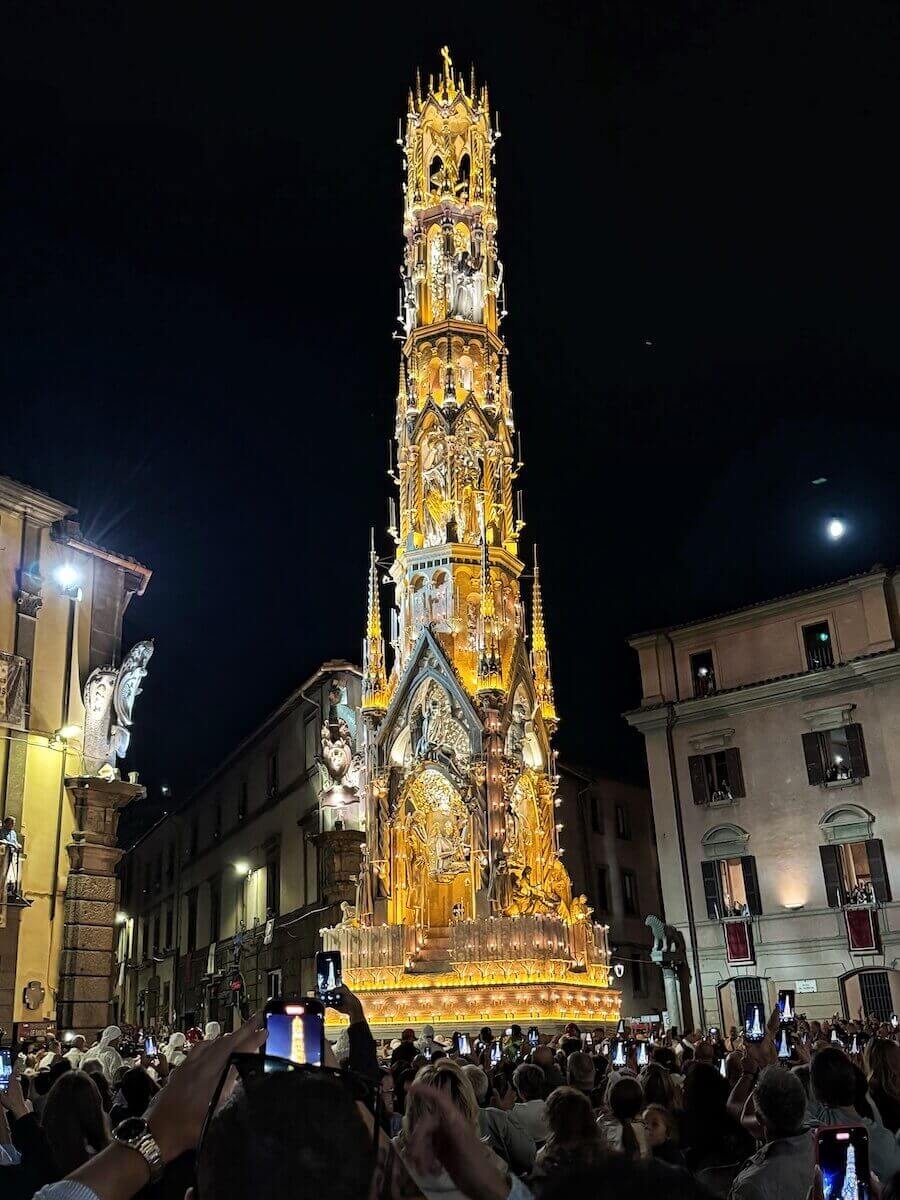
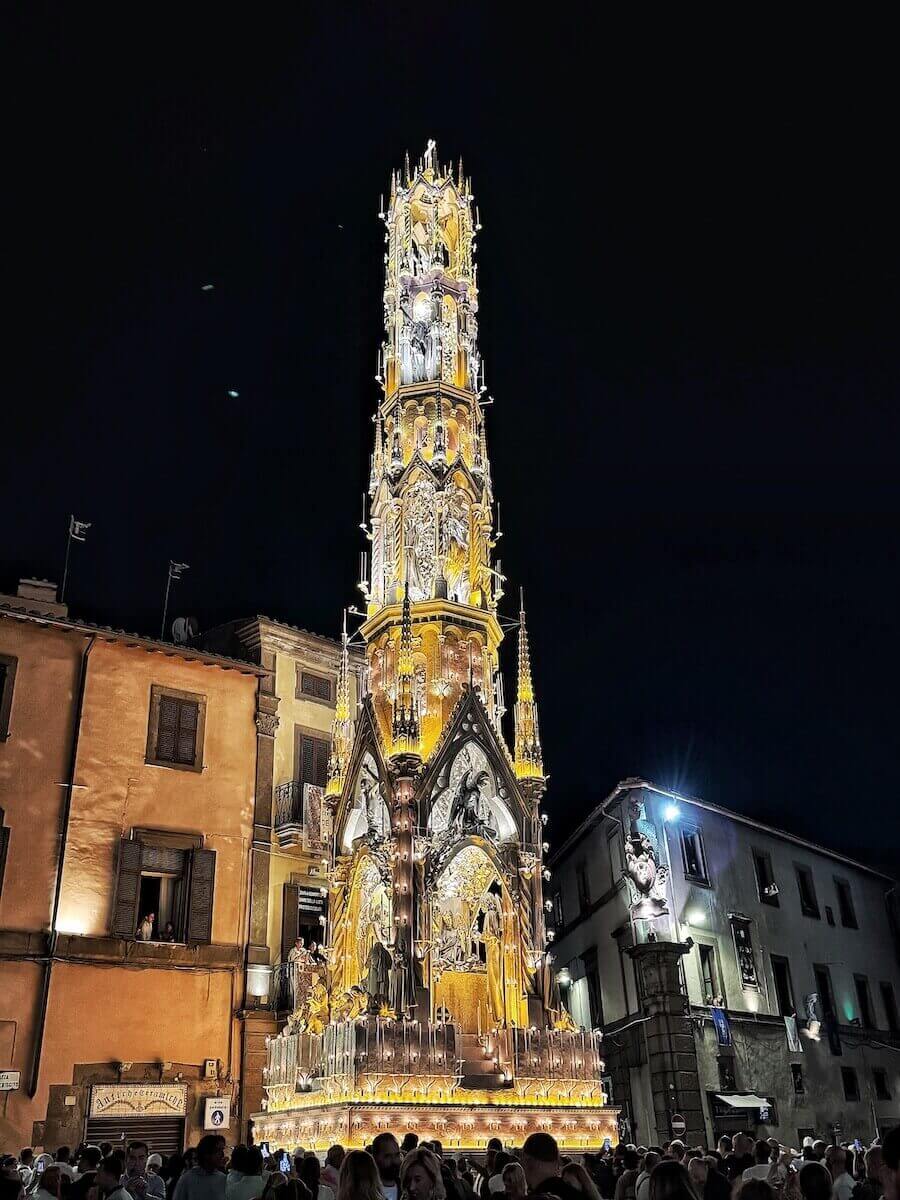
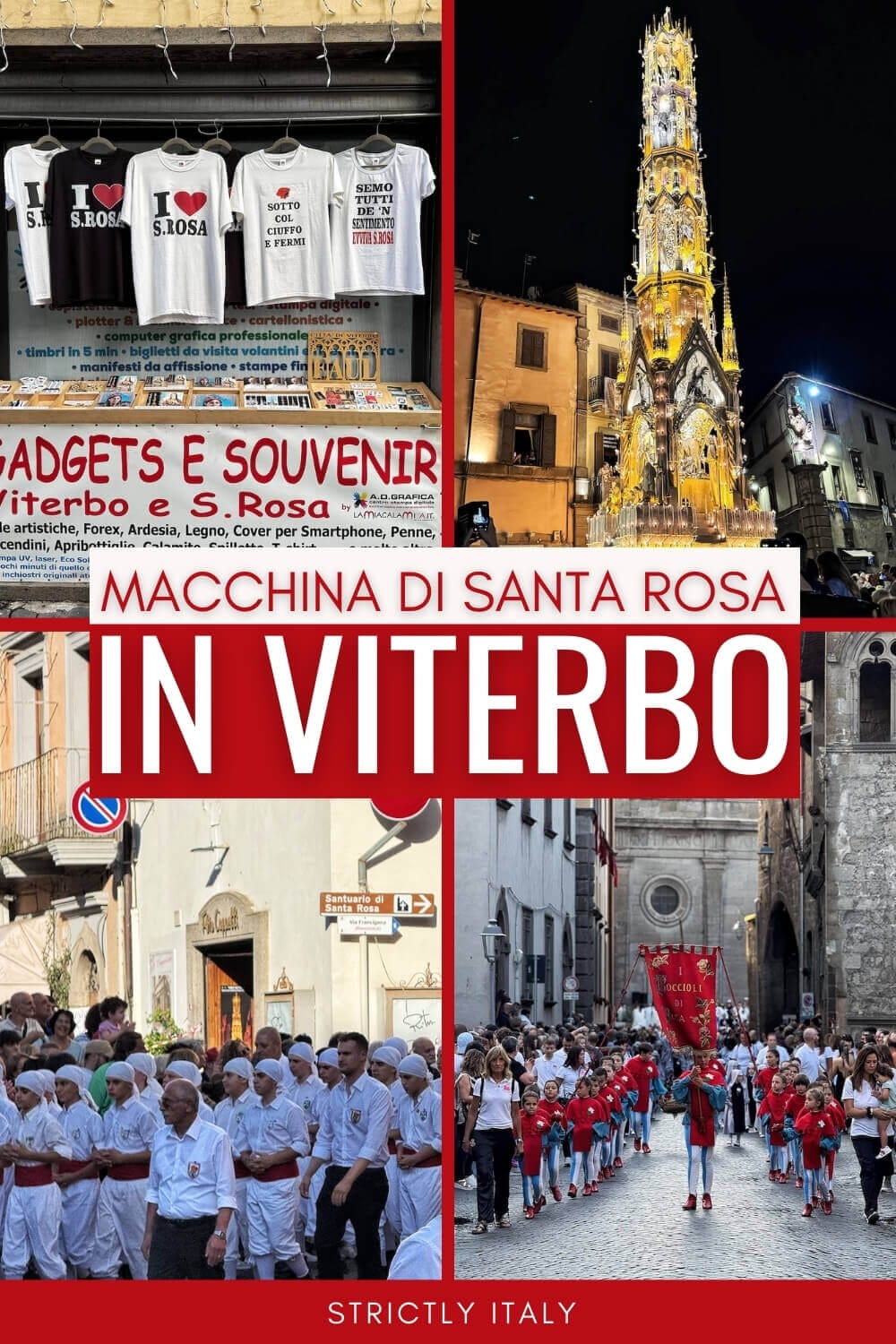
The Machine of Santa Rosa (that would be its name in English) is an illuminated tower carried around the streets of the historic center of Viterbo each year on September 3rd, in a festival dedicated to Saint Rose of Viterbo.
The tower, which is roughly 30-meter-high (that’s more than 98 feet), if not even taller, is carried by 100 porters (called facchini di Santa Rosa). The itinerary they follow is always the same: from the Church of San Cisto to the Church of Santa Rosa.
The tradition has been going on for centuries and has been inscribed by UNESCO as Intangible Cultural Heritage of Humanity since 1993.
It’s such a famous event here in Italy that it’s televised live. But while locals and Italians know about it, foreign tourists certainly don’t, and the few foreigners that attend find themselves completely immersed in the very festive (and local) atmosphere.
History of the Macchina di Santa Rosa
Who was Saint Rosa?
The origins of this centuries-old festival are inseparable from the life of Santa Rosa, more commonly known as Rose of Viterbo. As with many saints, her story sits at the intersection of documented history and religious legend.
Rose was born in Viterbo around 1233, during a turbulent period when the city was contested between the Papal States and the Holy Roman Empire. At the time, the region was under the control of Frederick II, Holy Roman Emperor, whose rule was widely contested.
Her parents were poor but deeply devout, and from an early age, Rose devoted herself to prayer, penance, and helping the disadvantaged. As a child, she’d pray for the conversion of sinners and encouraged others to live pious lives.
According to tradition, when Rose was 10 years old, she experienced a vision of the Virgin Mary, who instructed her to join a Franciscan community and to preach repentance to the people of Viterbo. She then became a nun in the Third Order of Saint Francis in Viterbo, an order open to laypeople committed to Franciscan ideals.
During this period, Rose wore a simple tunic tied with a cord and walked through the streets of Viterbo carrying a crucifix, preaching repentance and openly supporting the teachings of the Catholic Church. Her life was centered on prayer, austerity, and acts of penance.
Much of her time was spent in solitude at her father’s home, from which she would occasionally emerge to exhort the people of Viterbo to greater devotion.
Rose’s public mission lasted for roughly two years, until 12 January 1250, when Viterbo rose in revolt against the Pope. Despite her young age, Rose openly protested Frederick II’s presence in the city. As a result of this defiance, Rose and her family were exiled from Viterbo.
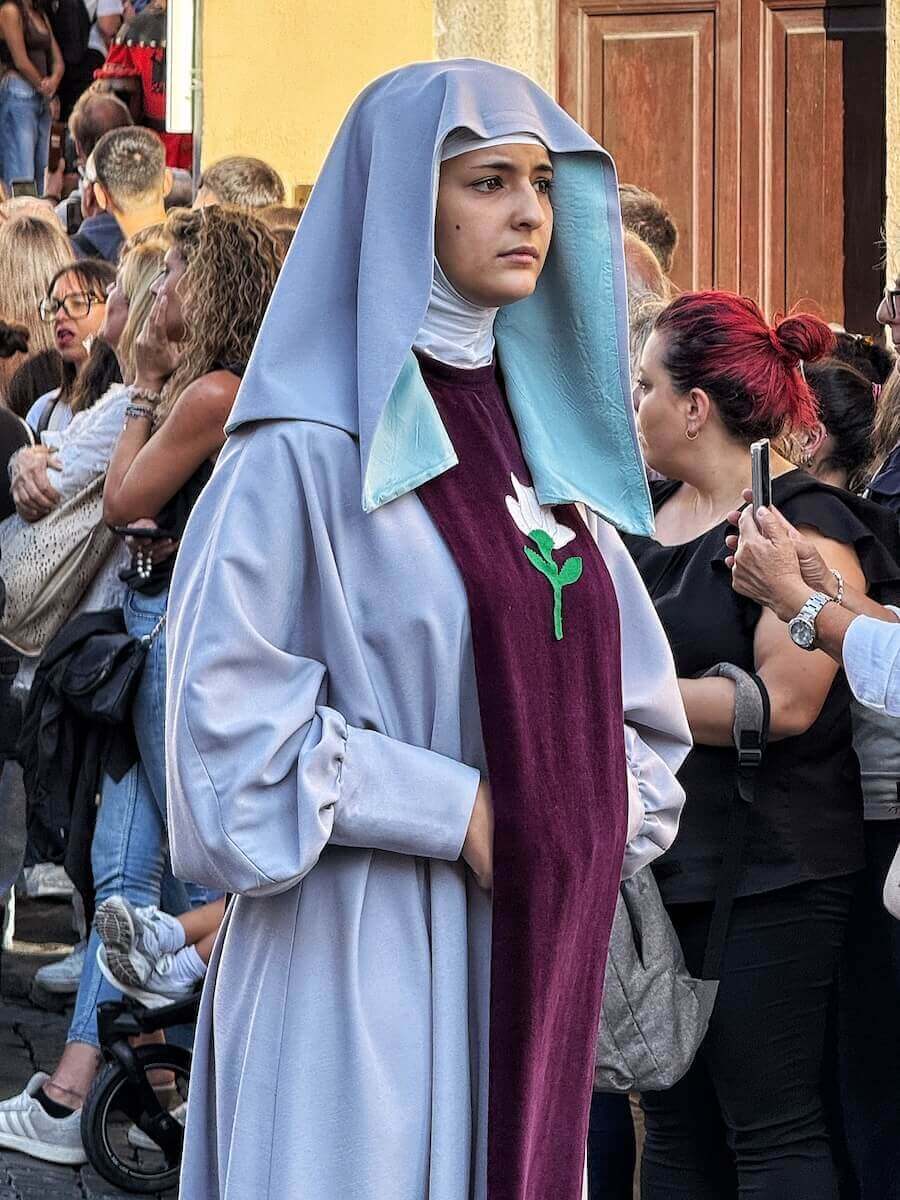
They sought refuge in the nearby town of Soriano nel Cimino, returning only after the Papal States regained control of Viterbo. On 5 December 1250, Rose is believed to have foretold the imminent death of Emperor Frederick II—a prophecy that came true shortly thereafter, when he died on 13 December 1250.
Soon after, Rose travelled to a nearby town to preach to a population said to be under the influence of a sorceress. It is here that the more mystical elements of her story emerge. Tradition holds that Rose converted both the sorceress and the entire town by standing unharmed for three hours on a burning pyre.
Later, Rose sought admission to the Order of Saint Clare, but was refused because she could not afford the dowry required for entry. She accepted the decision with humility, yet foretold that she would be admitted into the Order after her death. Rose died in her father’s home on 6 March 1251. She was buried in Poggio, at the parish Church of Santa Maria.
In the following year, Pope Innocent IV encouraged public veneration of Rose and formally opened the process for her canonization.
In 1257, six years after her death, Pope Alexander IV, a strong supporter of her canonization, ordered that her body be transferred to the church of the Order of Saint Clare monastery, the very community she had once wished to join.
Rose was declared a saint in 1457, more than two centuries after her death. The church where her body was kept was subsequently renamed the Church of Santa Rosa, a name it still bears today.
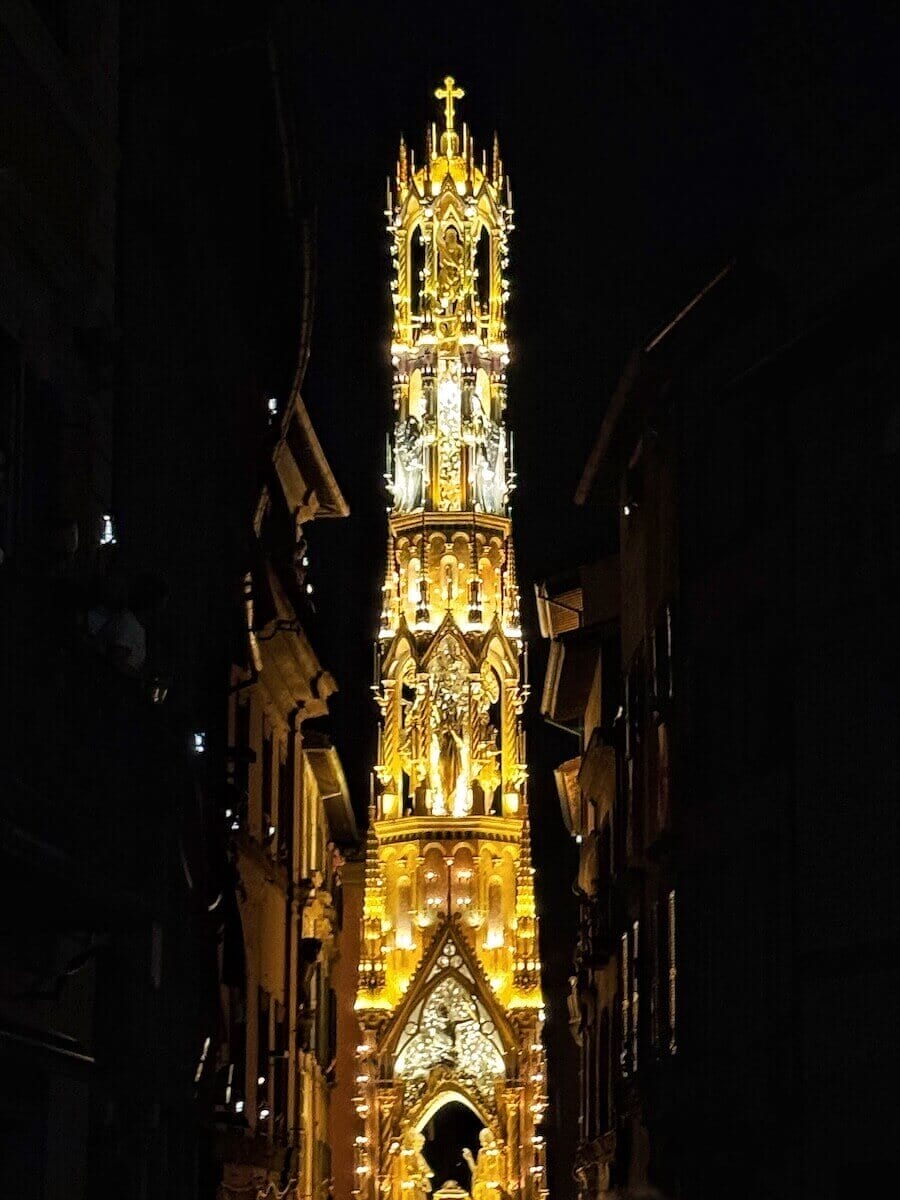
Origins and Evolution of the Macchina di Santa Rosa
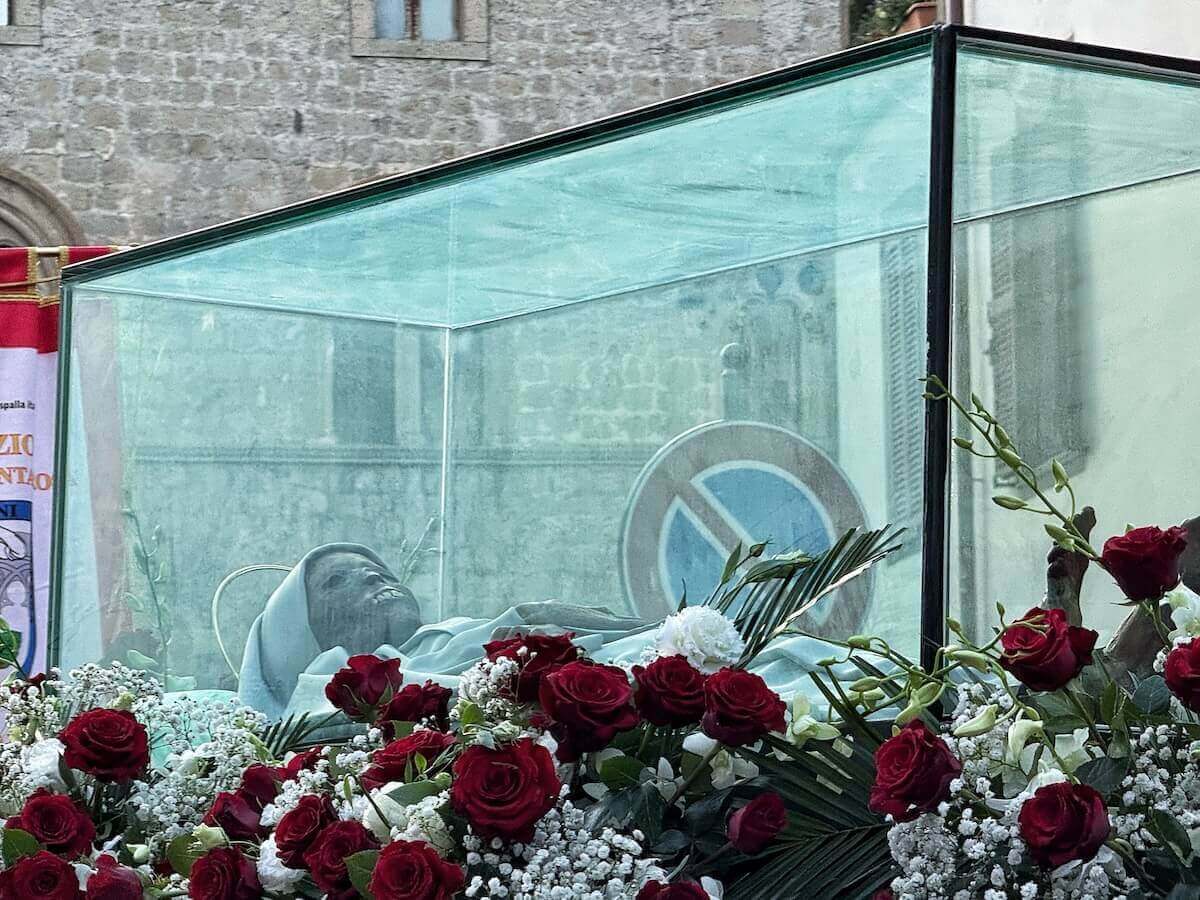
When Rose of Viterbo’s body was exhumed on September 4th, 1258, for its transfer, it was reportedly found intact and showing no signs of decay. In Catholic tradition, this phenomenon is known as incorruptibility and is believed to occur through divine intervention.
This event is considered the spiritual origin of the Macchina di Santa Rosa, although the early history of the festival—held every year on the night of September 3rd, the eve of Saint Rosa’s feast day—is partly shaped by legend.
The earliest reliable historical record of a macchina procession dates to 3 September 1686, when followers carried an illuminated structure through Viterbo along the same route used for Rose’s body in 1258. The term macchina comes from Ancient Greek theater, meaning a transport or lifting device.
Early celebrations were likely simple, featuring a statue of Saint Rosa beneath a lit canopy.
By the late 17th century, however, the macchina had evolved into a monumental structure, believed to have been designed in 1686 by Count Sebastian Gregory Fani. Over time, increasingly elaborate macchine were created, often funded by local nobility.
In the early 19th century, the event was banned by Pope Pius VII after several fatal accidents, including trampling, fires, and the macchina collapsing into the crowd.
The procession resumed in 1810.
The festival was cancelled again in 1893 due to heavy rain, a decision later seen as fortunate when authorities discovered a planned anarchist bombing. The Macchina di Santa Rosa was also suspended during World War I and World War II.
Throughout the centuries, the design of the macchina has continually changed.
- 18th century: altar-like, resembling a church tower
- Later periods: increasingly Gothic
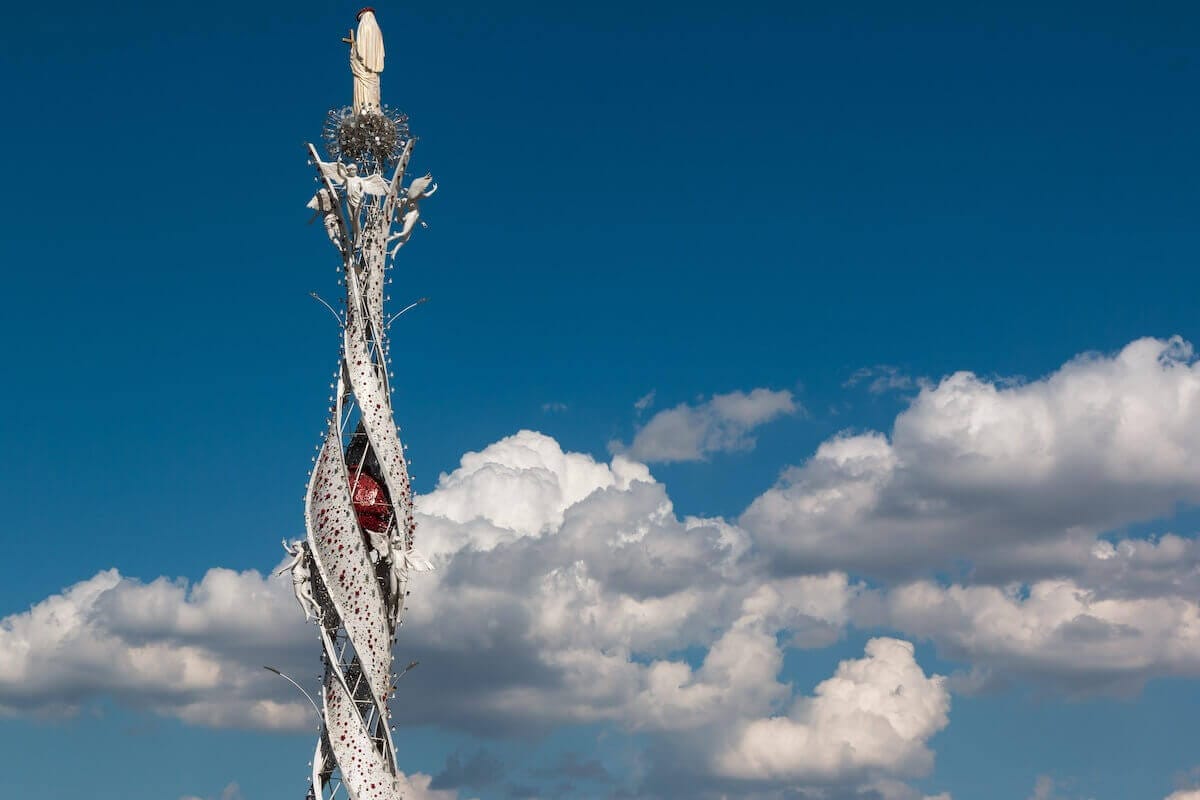
- Modern era: sculptural and contemporary in form
Until recent decades, the macchina was built from wood and papier-mâché. Today, it is constructed using steel and fiberglass.
A new macchina is selected through a design competition held roughly every four years. All winning designs must meet strict requirements:
- Minimum height: 28 metres (91.8 feet)
- Maximum weight: under 5 tonnes
- Maximum width: 4.3 metres (14 feet), due to narrow streets
Recent designs include Fiore del Cielo, used from 2009 to 2015, while many locals regard Volo d’Angelo as the most beloved macchina in the festival’s history.
The current macchina, in use from 2024, is Die Natalis, designed by Raffaele Ascenzi. My father and I saw it in September 2025, and we found it to be magnificent.
When do Macchina di Santa Rosa Celebrations Take Place?
Events leading to the parade start taking place in Viterbo a few days before the Macchina di Santa Rosa.
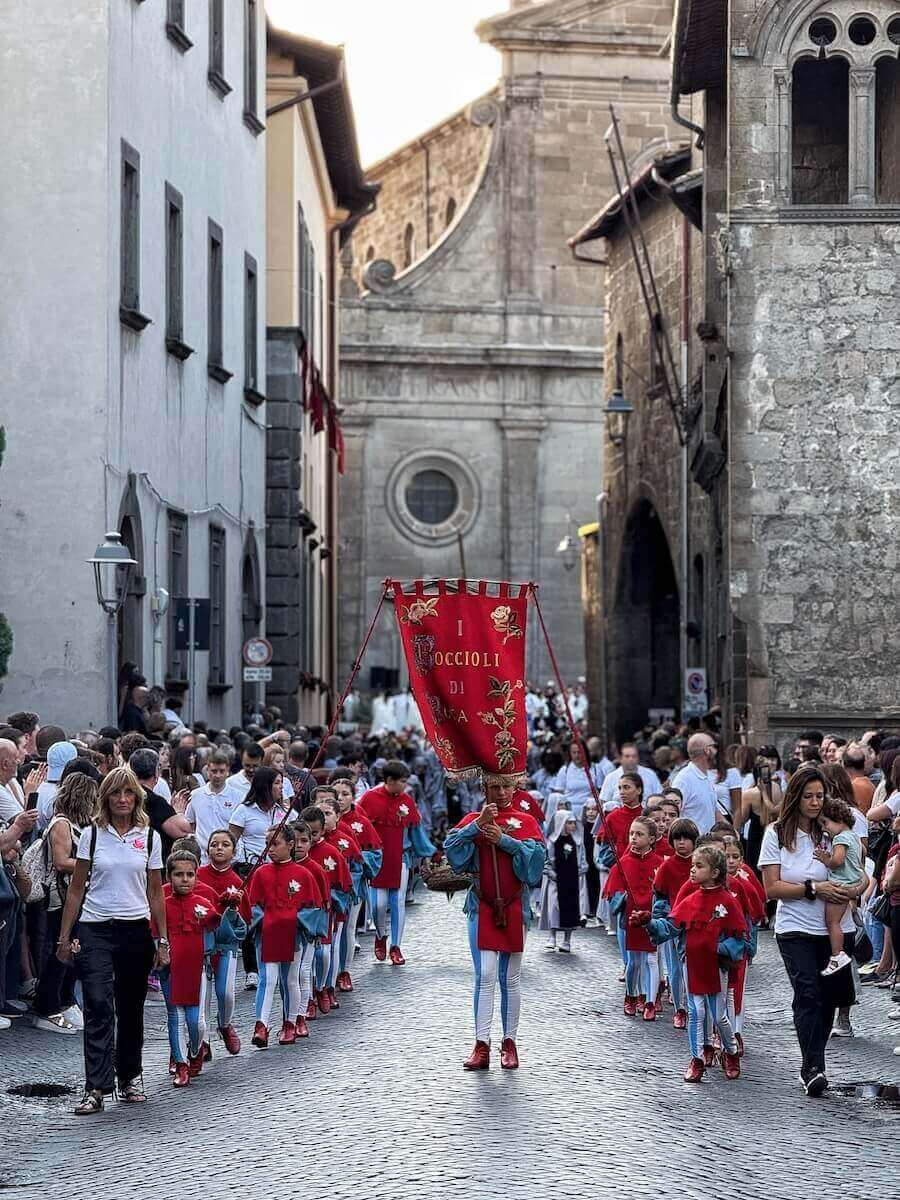
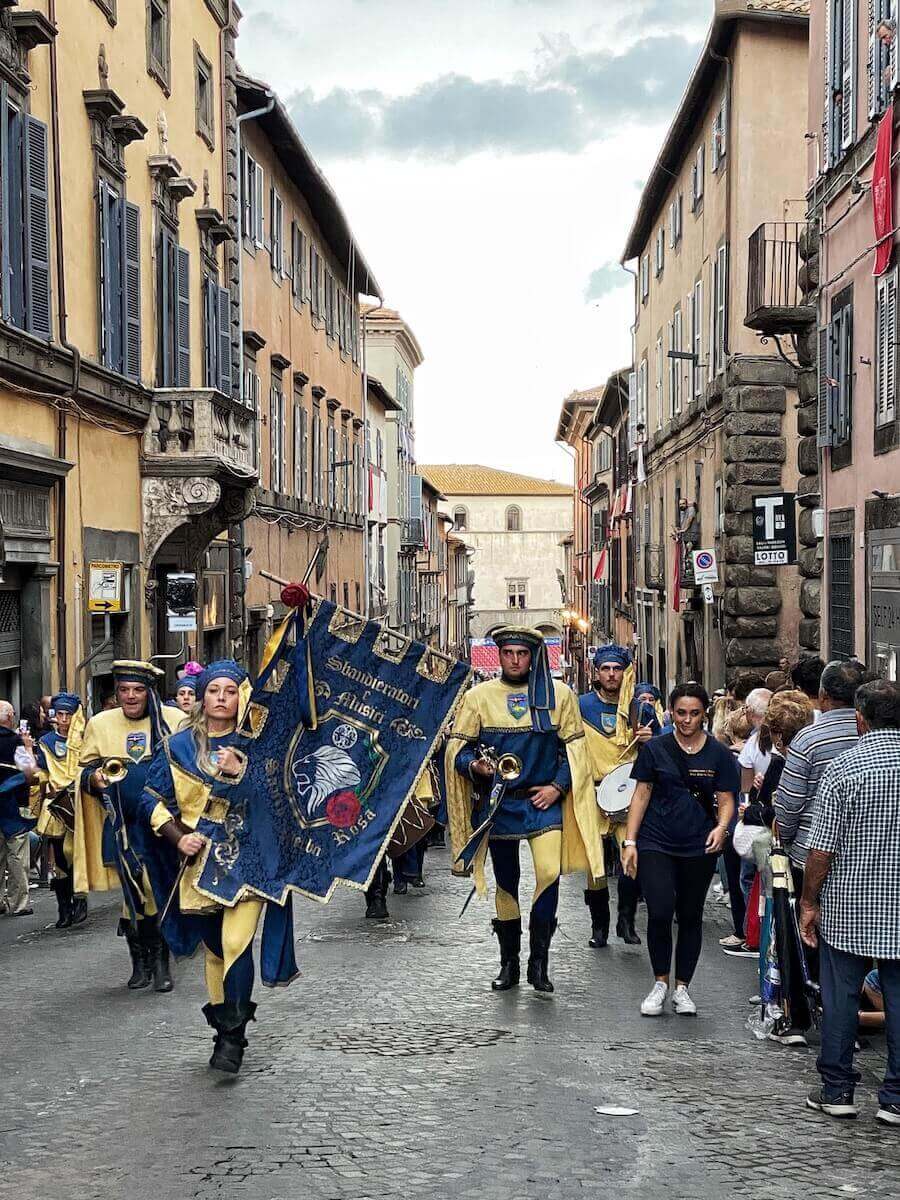
These culminate with the Corteo Storico (historic parade) that takes place on the afternoon of September 2nd. The historic parade sees locals dressed in costumes from the 13th century to the 19th century, along with the facchini, parade through the streets of the historic center, accompanied by a band.
During the very end of the historic parade, some facchini carry the heart of Saint Rosa. In 2025, for the Jubilee Year, the remains of the saint were carried instead.
The Macchina di Santa Rosa parade takes place on September 3rd and starts at 9:00 pm. The mass in commemoration of Saint Rosa is held on September 4th. On the same day, the streets and squares of Viterbo host a nice fair where you’ll find lots of local produce.
What if it rains?
The parade is suspended if it rains. Indeed, the cobbled alleys of Viterbo get slippery if it rains, and carrying the massive tower can become dangerous.
However, here’s an interesting fact that my family living in Viterbo shared with me: it never rains during the Macchina di Santa Rosa parade. When I attended the parade in 2022, we could see a storm brewing in the hills around Viterbo, with thunder and lightning. And yet, not a drop of water fell in Viterbo, as my cousins had promised (it rained the following day).
Macchina di Santa Rosa — Festival Day Timeline
Morning
The day begins with the historic center of Viterbo filling with locals and visitors. Finding a good place to watch the procession becomes a priority early on, as the best viewing spots are quickly claimed.
Throughout the day
The atmosphere is festive and emotional. Locals—especially younger residents—sing hymns in honour of Saint Rosa, applaud, and cheer the facchini as preparations continue across the city.
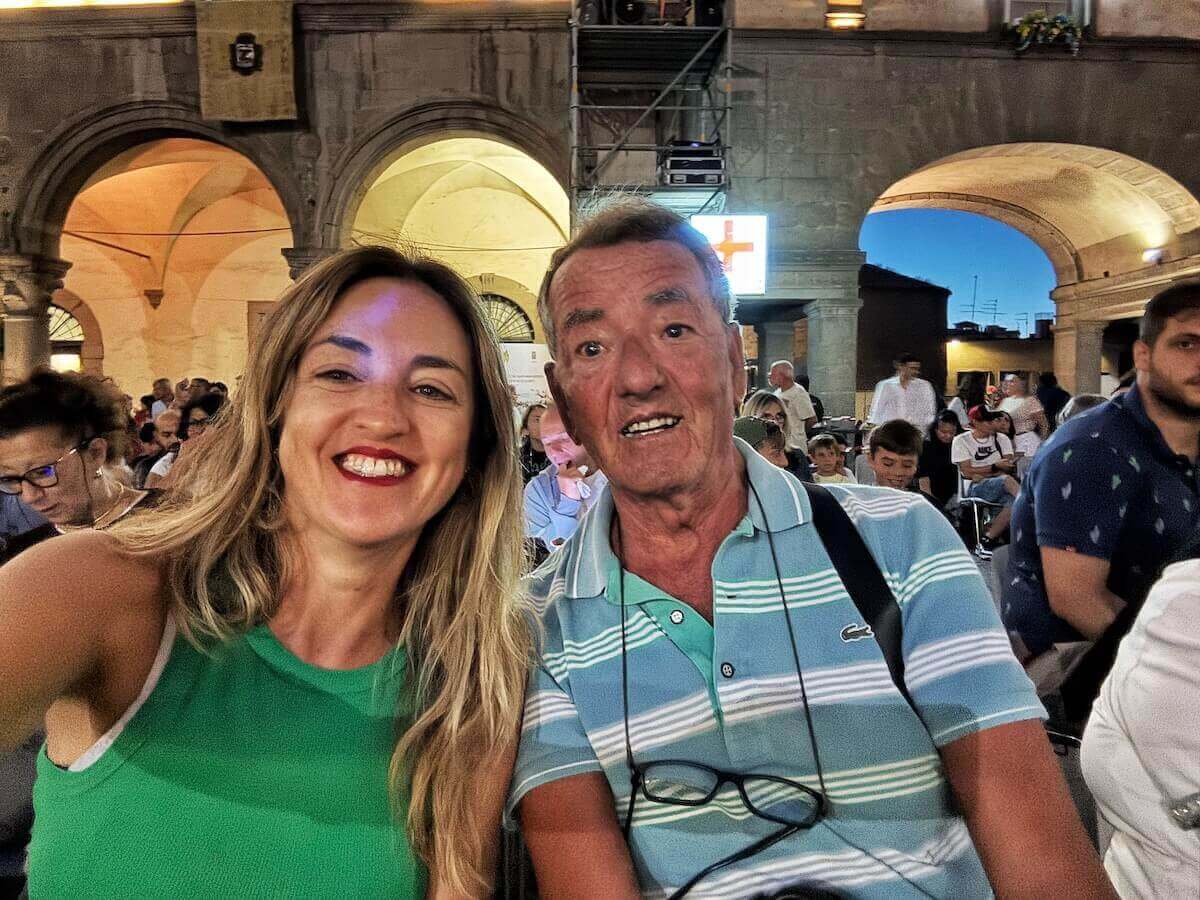
In Piazza del Plebiscito, temporary stands are set up, offering guaranteed seating for the procession. Access here is by prepaid ticket, and these seats sell out almost as soon as they are placed on sale.
Elsewhere, side streets become crowded with people setting up informal viewing spots, sitting on balconies, or leaning out of windows.
Late afternoon / early evening
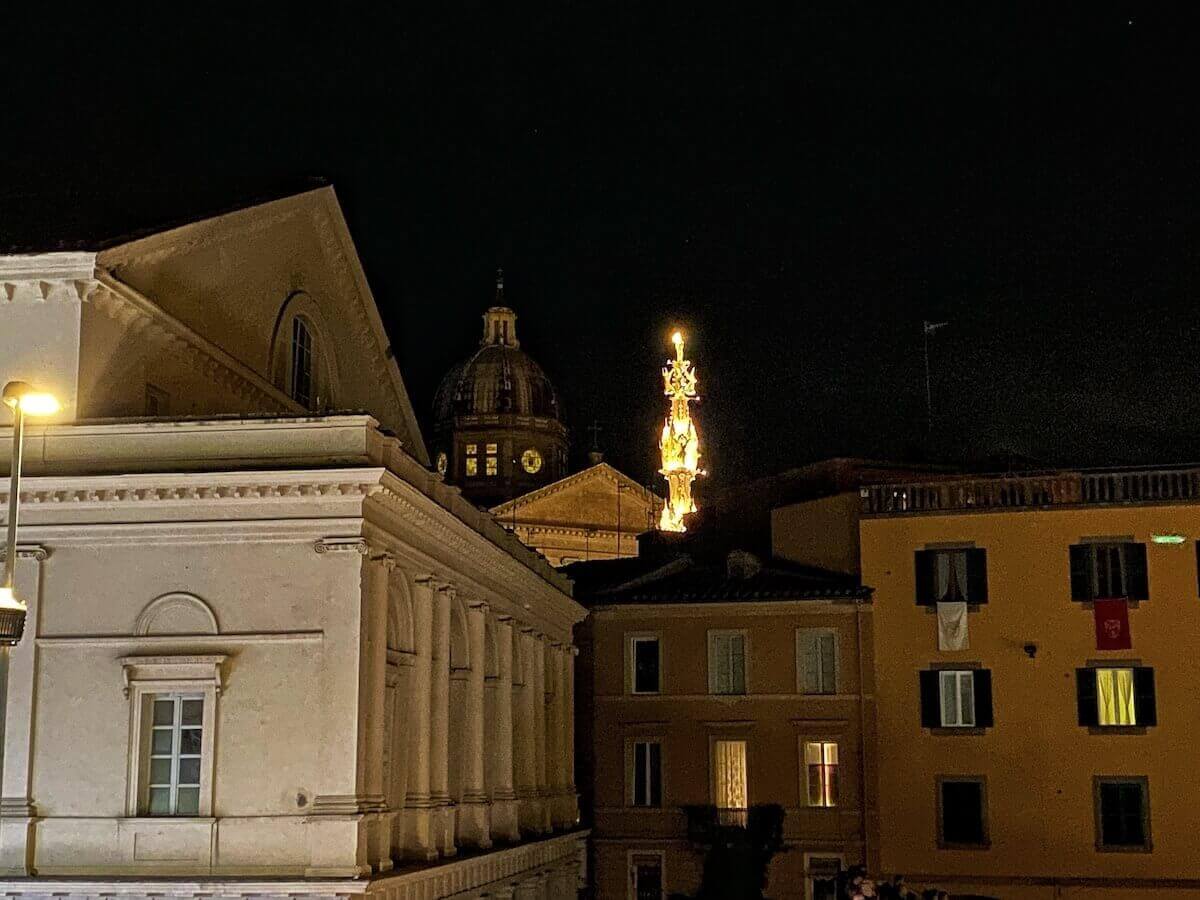
As sunset approaches, final preparations intensify. The Macchina, built over the summer months in the grounds of the Church of San Sisto, remains hidden from view. During this time, its structure and lighting system are repeatedly and carefully checked.
Around 9:00 pm
Viterbo is plunged into darkness as the city’s streetlights are switched off. The official procession begins at approximately 9:00 pm, led by the local band playing traditional hymns.
The band marches along the route the Macchina will later take, but in reverse—starting from the Church of Santa Rosa and proceeding to the Church of San Sisto. Here, the facchini receive a blessing intended to protect the procession from accidents or danger.
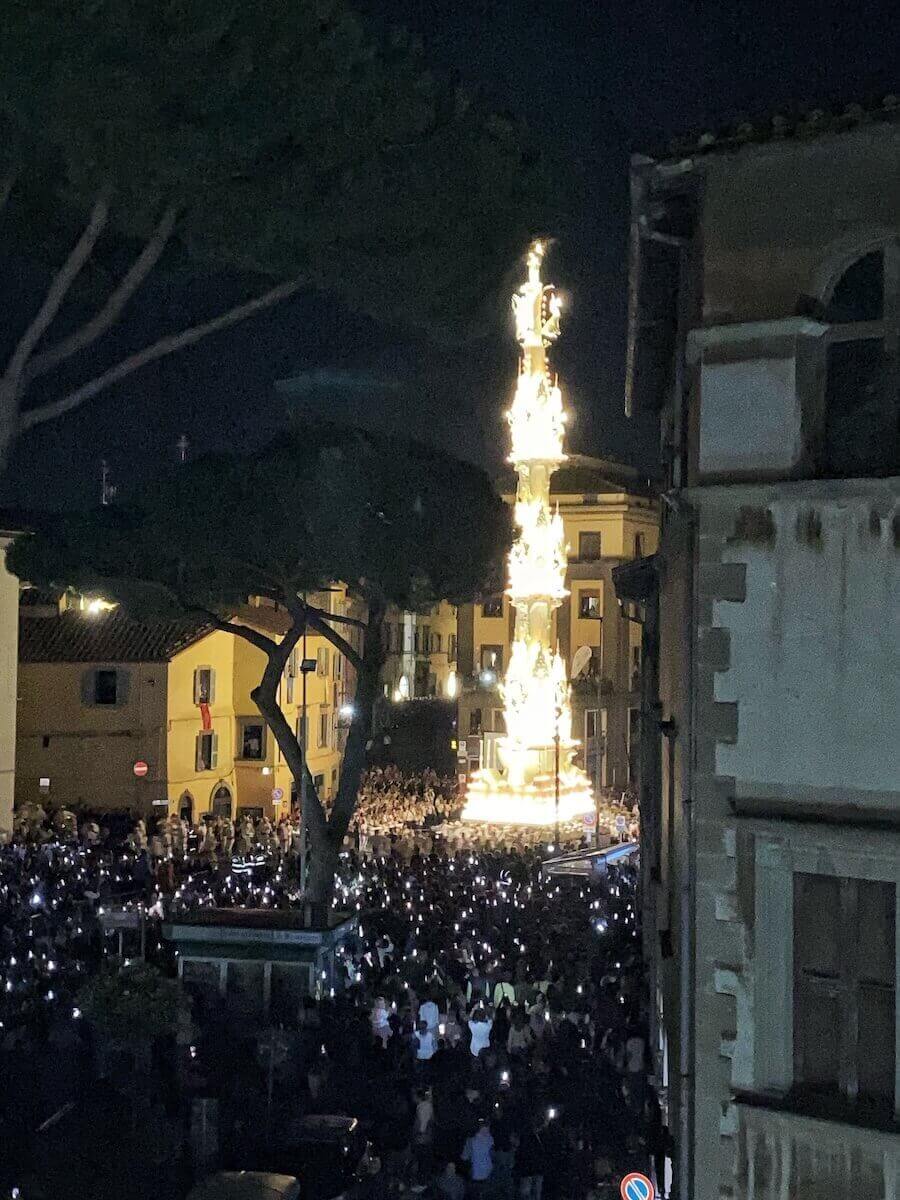
Then, the transport of the Macchina di Santa Rosa begins. The white sheet covering the structure is removed, revealing the illuminated Macchina as its lights are switched on. It is then lifted and carried along the route through the streets of Viterbo.
Late evening
The procession concludes at the Church of Santa Rosa, where the Macchina is placed outside the church. It remains there for several days, allowing visitors to admire it up close.
Recent history note
The event was cancelled in 2020 and 2021 due to the COVID-19 pandemic, during which the Macchina was only displayed in Piazza del Plebiscito. The traditional transport returned in September 2022.
Who Are the Facchini di Santa Rosa?
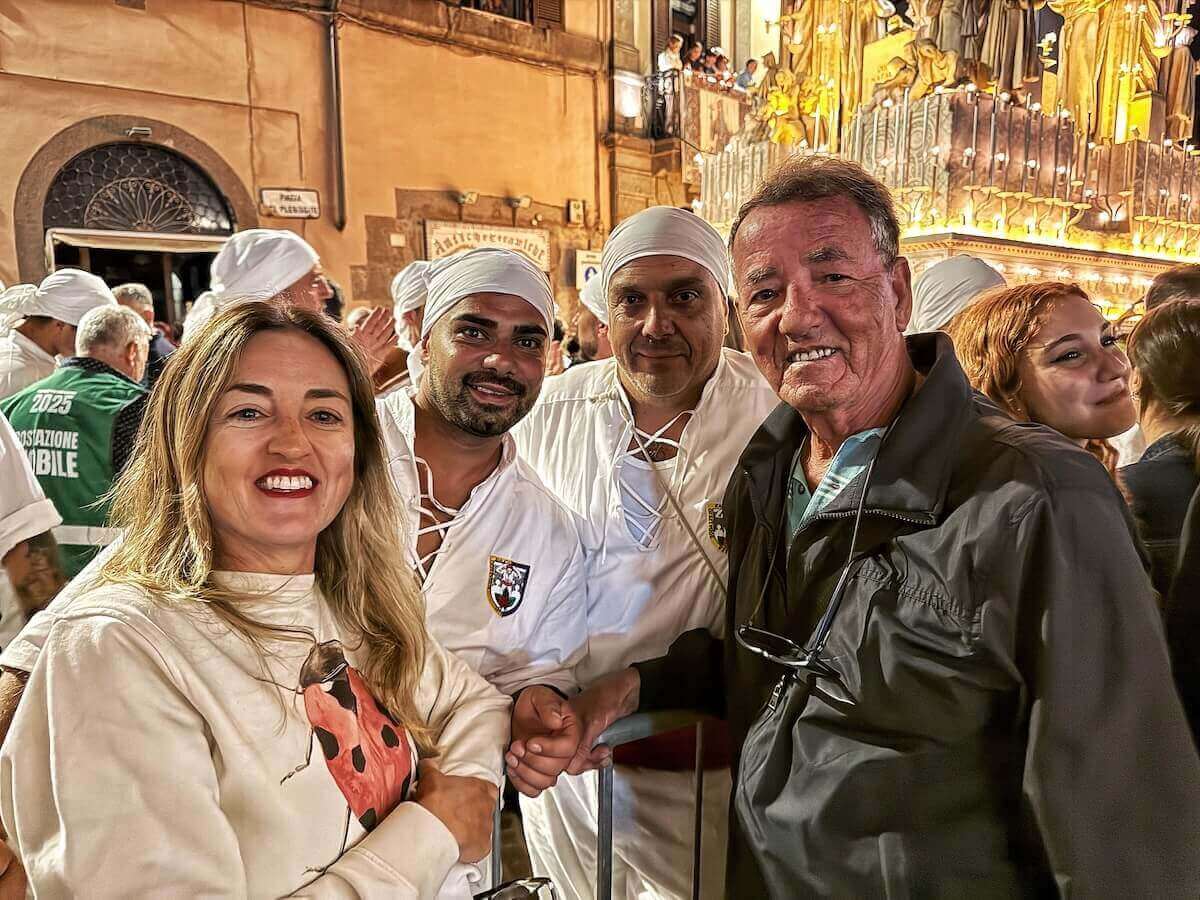
The facchini are the porters who carry the Macchina di Santa Rosa during the annual procession in Viterbo. They are responsible for the safe transport of the structure through the city’s narrow streets and are considered one of the most important elements of the tradition.
The facchini belong to a dedicated guild known as the Sodality of the Facchini of Santa Rosa, founded in 1978. The Sodality preserves the festival’s traditions, oversees safety during the transport, and promotes its cultural significance. It was also one of the signatories of the application that led to the event’s recognition as UNESCO Intangible Cultural Heritage.
Becoming a facchino in Viterbo is regarded as a great honour. Candidates must pass a strict physical test, which requires carrying a 150-kilogram (over 330 pounds) box on their shoulders for 100 meters (almost 330 feet) without stopping.
The statutes of the Sodality state that any person who passes the test is eligible to become a facchino. Although there is no formal restriction based on gender, no woman has ever served as a facchino.
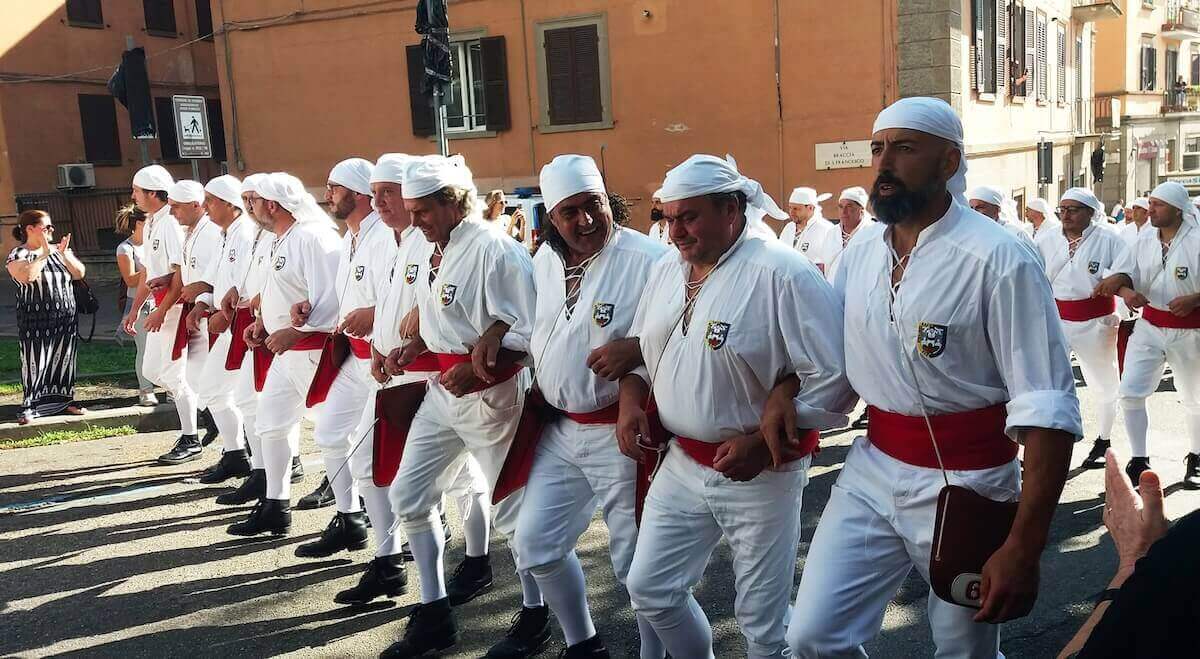
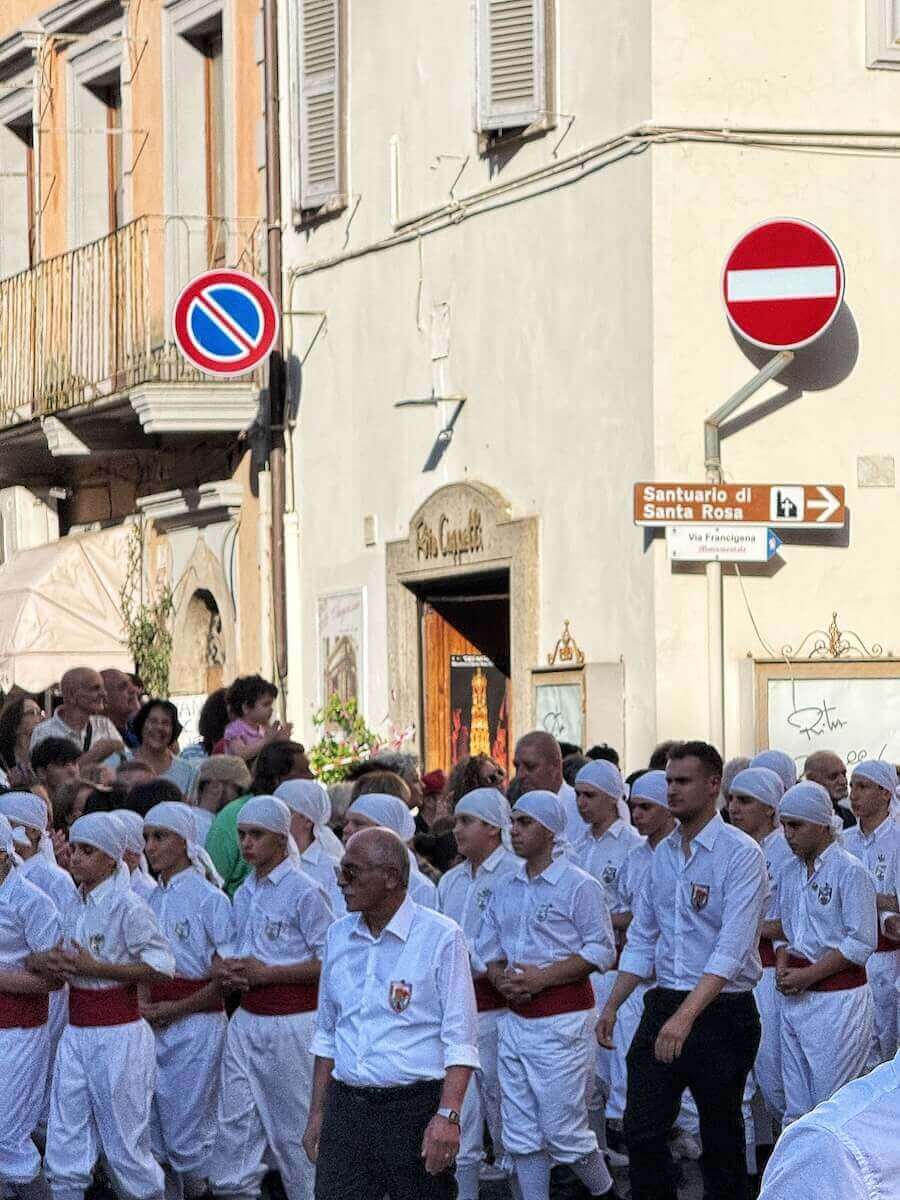
During the procession, facchini wear a white uniform with a red sash at the waist and a white bandana reinforced with leather. Before the transport begins, they receive a formal blessing.
The group is directed by a capofacchino (foreman), who shouts commands in Italian or the local dialect. Common commands include “sollevate e fermi” (“lift and stand still”) and “semo tutti d’en sentimento,” meaning “are we all feeling it?”
For much of the transport, the facchini work almost blind, relying entirely on the foreman’s instructions and on four guides positioned along the sides of the Macchina.
Each facchino has a specific position and wears leather shoulder padding to protect against the weight. The most sought-after role belongs to the 63 porters inside the perimeter of the Macchina, who support the structure using their necks rather than their shoulders.
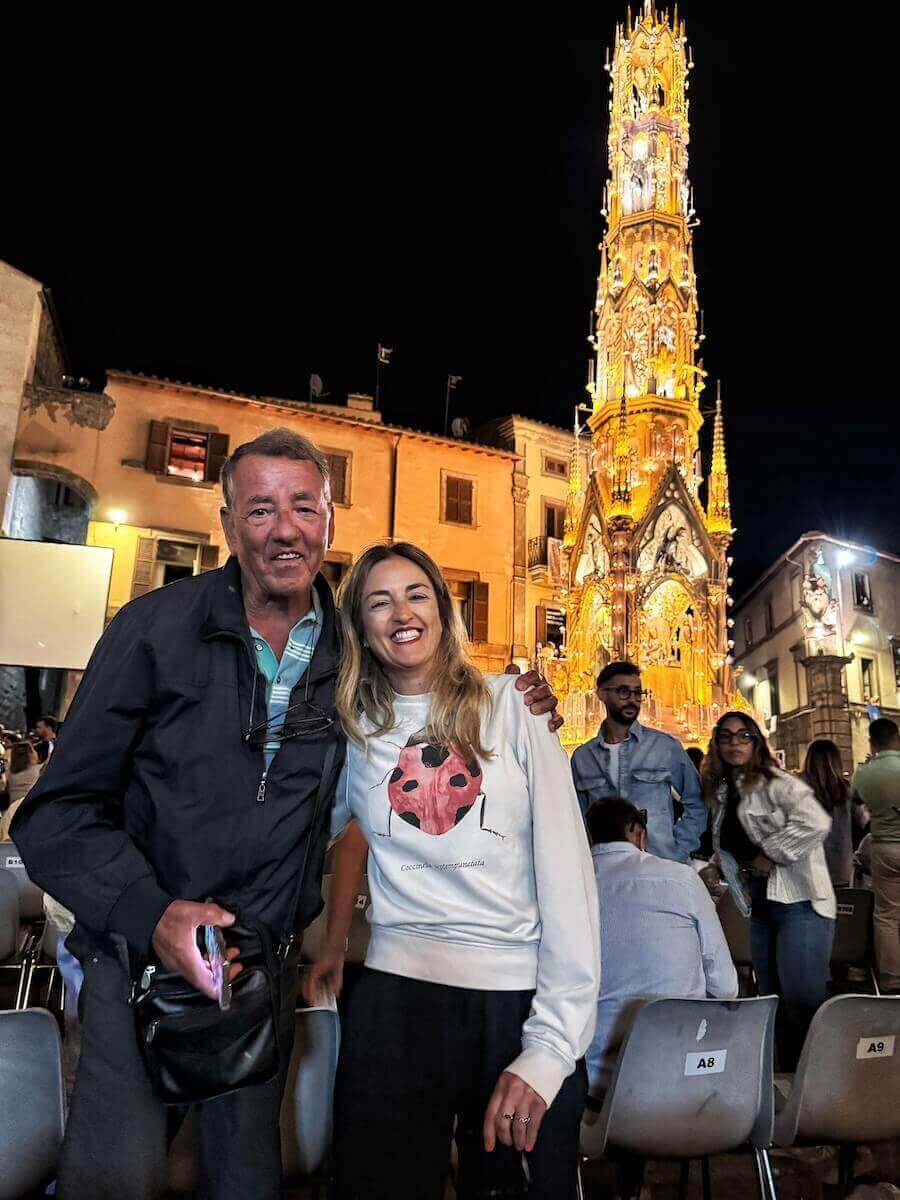
The task is physically demanding and technically complex. Viterbo’s streets are extremely narrow, and in some places the Macchina passes with only one or two centimeters to spare.
In these moments, the spallette laterali—the facchini positioned along the sides—must quickly change position while the Macchina is still moving, shifting from the outer to the inner side in a movement that appears almost choreographed.
Macchina di Santa Rosa Itinerary
The route followed by the Macchina di Santa Rosa is over a kilometer long (between 0.6 and 0.7 miles), and always makes the following stops in Viterbo:
- Porta Romana – The starting place. It’s next to the Church of San Cisto.
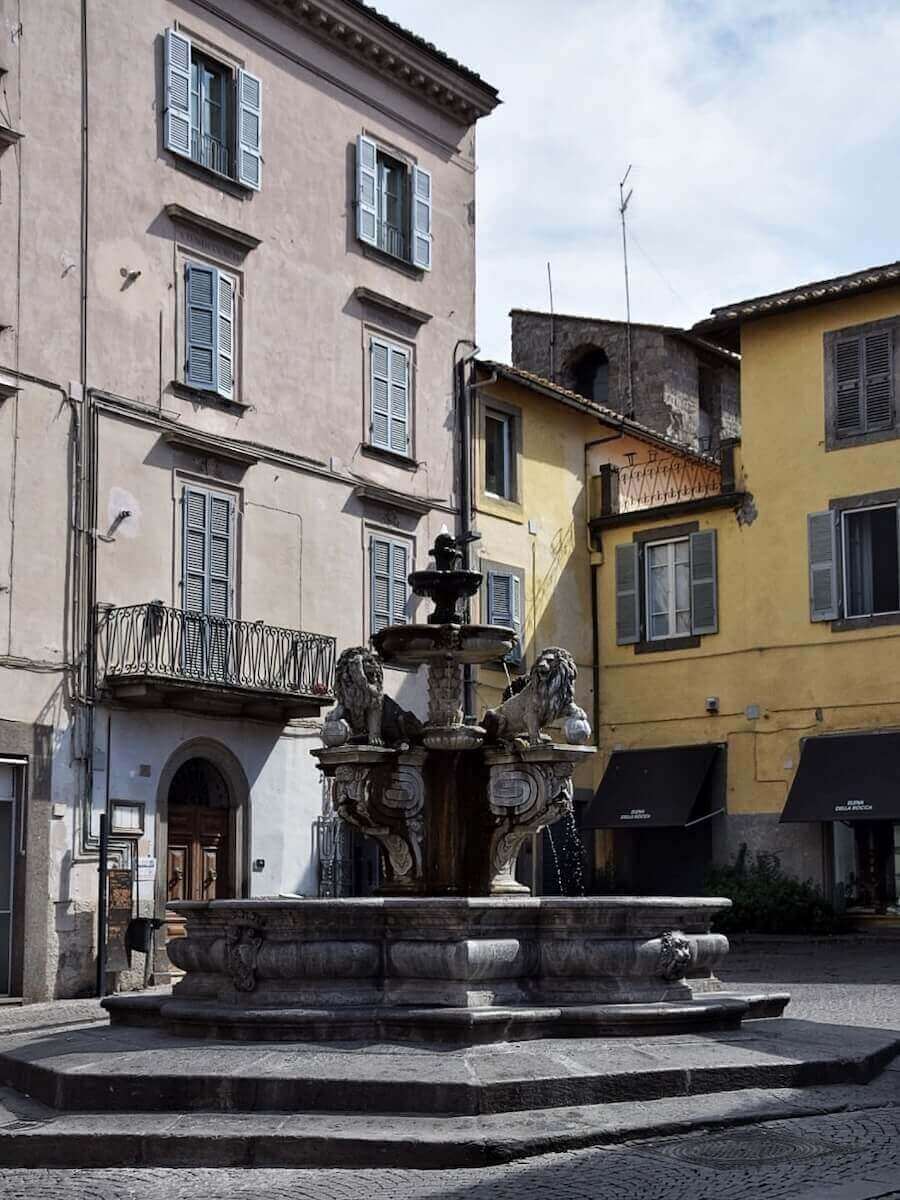
- Piazza Fontana Grande – First major pause.
- Piazza del Plebiscito – In front of the town hall. Here, the facchini rotate the macchina as a sign of reverence (and to greet the watching crowd).
- Piazza delle Erbe.
- Corso Italia – Here, the Macchina di Santa Rosa stops by the Chiesa del Suffragio. It’s the narrowest and trickiest portion of the course.
- Piazza del Teatro – The last stop before the macchina is carried uphill to the Santa Rosa Church.
- Final climb to the Santa Rosa church and sanctuary.
Even if the route is always the same, it can vary slightly year to year. For example, in 2022, it was paraded along Via Marconi and then back to Piazza Verdi before being carried up to Santa Rosa Church.
Macchina di Santa Rosa Tickets
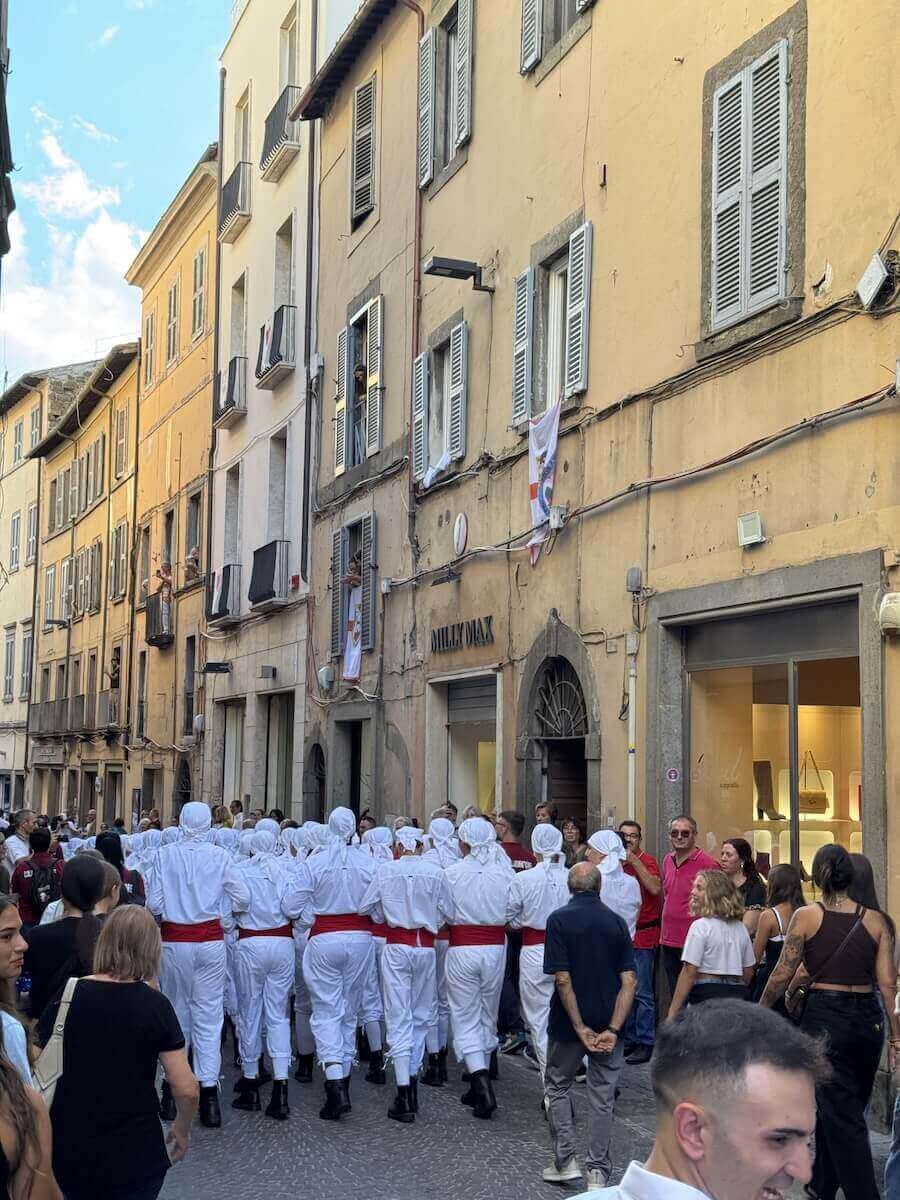
While watching the Macchina di Santa Rosa parade is completely free, you can also buy tickets (which typically cost €28 + the booking fee) for a seated area, which is normally located in Piazza del Plebiscito (the second stop during the parade).
Getting hold of tickets is quite an ordeal, with tickets released at midnight around a week before the parade, and the sale website getting clogged. Last time my dad and I went to see the Macchina di Santa Rosa, in September 2025, I stood in a virtual line until 2:00 am before I could finally get the tickets, which were sold out soon after.
For information on Macchina di Santa Rosa tickets, you should follow the website of the Comune di Viterbo or the Comune di Viterbo Facebook page (the latter is a more reliable source), which is regularly updated (but keep in mind that the page is only in Italian).
Where to Stand to See the Macchina di Santa Rosa (For Free)
As I have said before, attending the Macchina di Santa Rosa celebrations is free – though you’ll have to bear the crowds a bit.
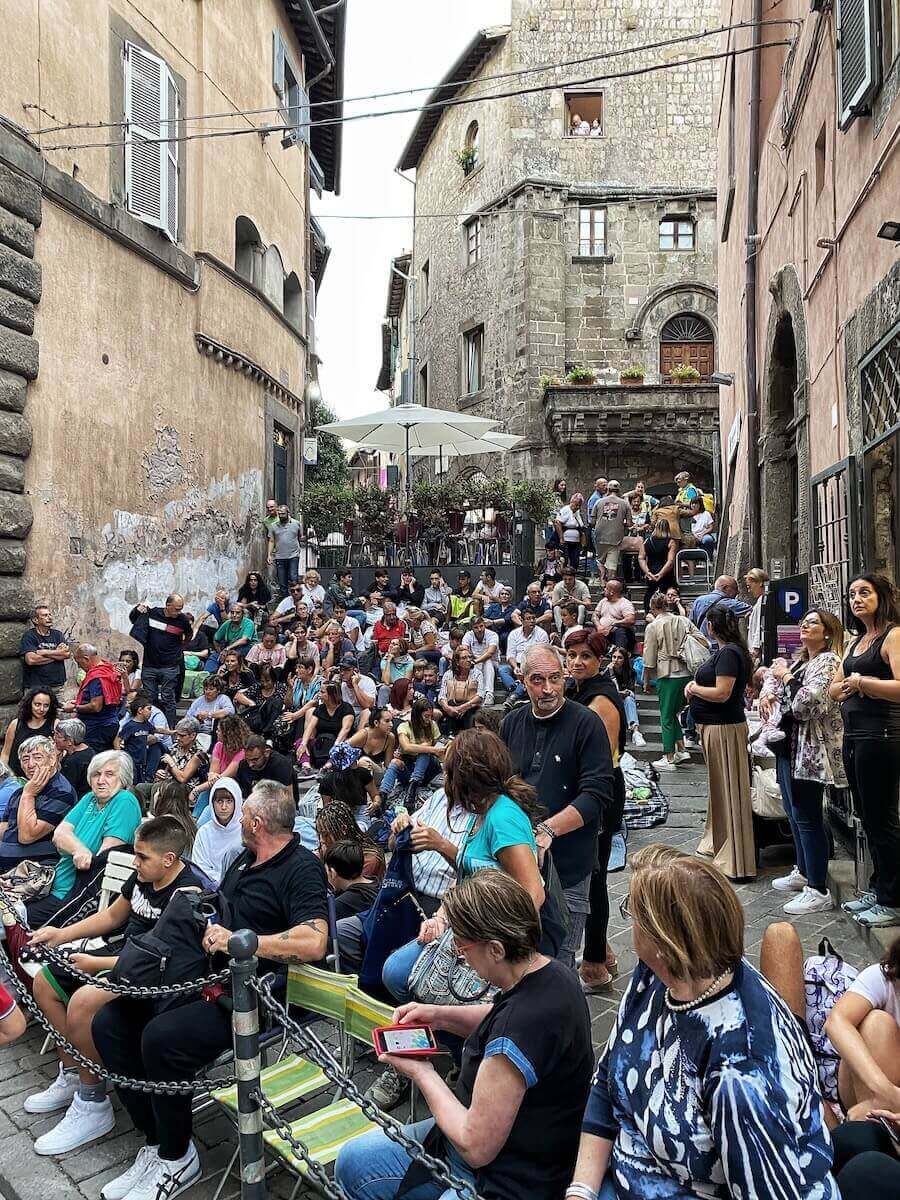
Most locals will stand somewhere along the route waiting for the illuminated tower to pass. They will start heading to viewing points along the itinerary in the morning, often bringing small camping chairs to sit while they wait (though in theory this is forbidden).
Younger generations will often sleep in various spots along the route from the night before, something that shows how important this festival is for them.
Here are the best spots to see the Macchina di Santa Rosa:
Porta Romana (start of the transport)
This is where the Macchina di Santa Rosa begins its journey. It’s one of the most emotional moments, with a strong sense of anticipation as the facchini prepare to lift the structure. Expect large crowds and arrive very early if you want a good view.
Piazza Fontana Grande
One of the best places to watch the Macchina di Santa Rosa pass – typically, it’s where my cousins go to see it. The square offers more open space than most streets, making it easier to see the full height of the structure and the coordination of the facchini.
Piazza del Plebiscito
A central stop along the route where the procession slows down. This is a good spot to appreciate the details of the Macchina di Santa Rosa. One thing to keep in mind, however, is that this is also where the seated and ticketed spots are located, so space is a bit more limited.
Piazza delle Erbe and nearby streets
These narrower sections of the route feel more intense and dramatic. You’ll be very close to the Macchina di Santa Rosa, but visibility can be limited if you’re not near the front.
Sanctuary of Santa Rosa (final ascent)
The final stretch and arrival at the sanctuary is the most symbolic part of the transport. It’s deeply moving, especially as the Macchina di Santa Rosa reaches its final destination. However, it can be quite crowded.
Tips for choosing your spot:
- Arrive well in advance, especially near the main squares
- Narrow streets offer atmosphere, open squares offer better visibility
Good to know: Once the route is closed, moving between viewing points is difficult.
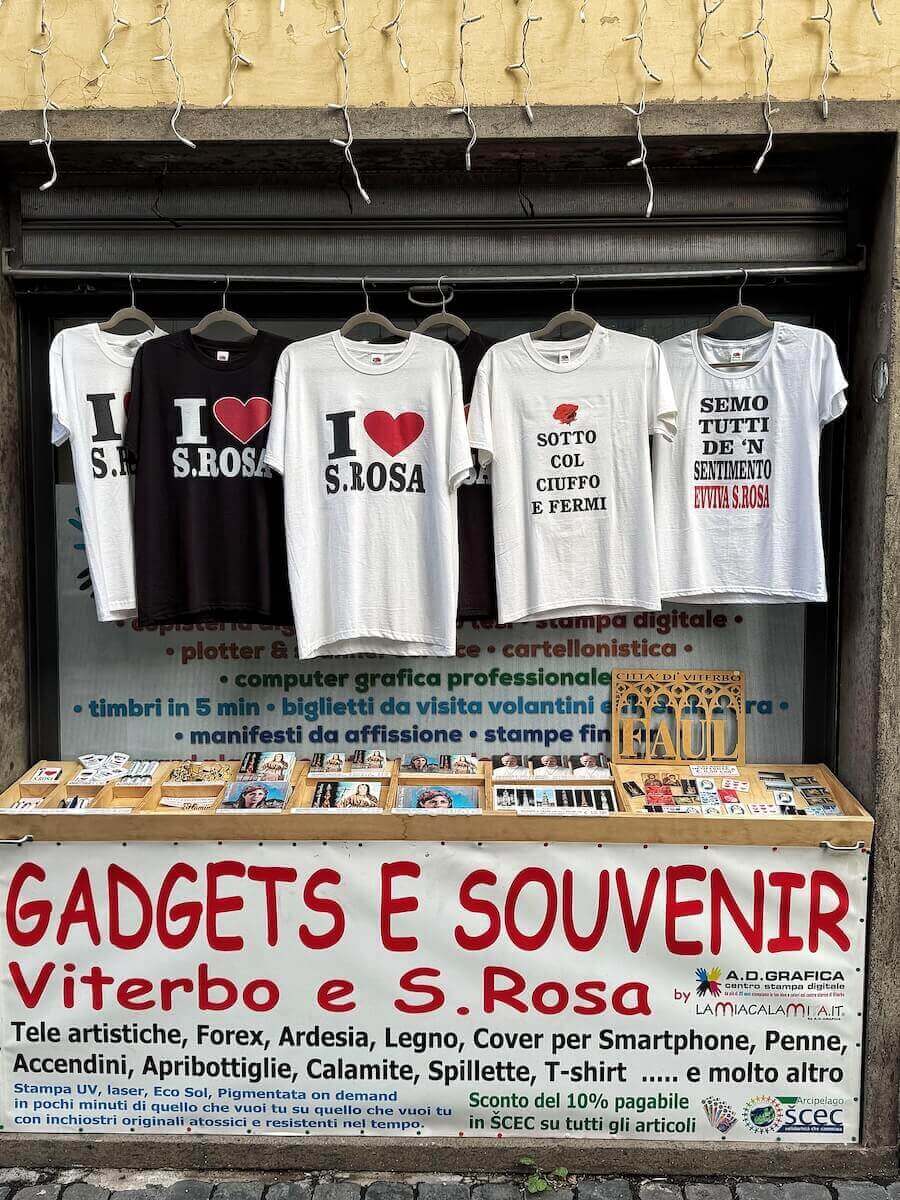
Secret expert tip: In my many wanderings of Viterbo, I found an incredible spot, which is a great place to stay in Viterbo and a great spot to see Santa Rosa, a small guest house that has a terrace with views of Corso Italia and Piazza Verdi – it’s called Compasso Suites.
Macchina di Santa Rosa First-Timers’ Checklist
Here’s a quick checklist in case you are looking to attend the Macchina di Santa Rosa celebrations:
- Arrive by 7:00 pm if you have tickets. If not, you will need to be there much earlier (early afternoon) to grab a standing spot along the route.
- Wear closed shoes – There are crowds, Viterbo’s historic streets are cobbled.
- Bring a light jacket or sweater – Temperatures in Viterbo at this time of year drop quite a bit when it gets dark.
- Bring water and food – You can get a sandwich to bring with you in one of the many cafès or grocery stores along Corso Italia.
- Plan your exit route – Many streets in Viterbo close during the transport of the Macchina di Santa Rosa, including to pedestrian traffic. If you are coming by car, park outside the historic center (more info about this in a bit).
Where to Park in Viterbo during Santa Rosa Celebrations
If you are staying in Viterbo, chances are your hotel or guest house will be in the historic center, and you won’t need to drive and look for a parking spot. If, however, you are staying outside of town and need to park your car, you will need to know where.
The gates to the historic center are closed during the celebrations, typically from the morning, and at times from the night before, so you’ll have to park outside the walled city.
Parking spaces close to the historic center are limited and fill up fast, so you’ll have to go early in the day.
Otherwise, there are some parking lots far from the center, near the Cassia Nord – San Lazzaro commercial area, and in Via Palmanova, and Via Santa Maria in Gradi. From there, you can take a shuttle bus that drops you off in Piazzale Antonio Gramsci, near the historic center – it will be marked clearly with a Santa Rosa sign, so you can’t miss it.
How to Watch Macchina di Santa Rosa Online
If you can’t attend the Macchina di Santa Rosa celebrations (which I wholeheartedly recommend), you may still be able to see it on TV here in Italy, and even online. Here’s where:
- TV – Tv2000 (channel 28 on TV, channel 157 on Sky, or channel 18 on satellite TV).
- Online – tv2000.it or on the Play2000 App.
- Social Media – Social media channels of the Comune di Viterbo – Visit Viterbo on Instagram, Comune di Viterbo Informa on Facebook, and Comune di Viterbo on YouTube.
Macchina Di Santa Rosa FAQs
The Macchina di Santa Rosa is a towering illuminated structure carried through the historic center of Viterbo every year, on the night of 3 September, in honor of Saint Rosa, the city’s patron saint. It is lifted and transported by 100 men known as facchini.
The main transport of the Macchina di Santa Rosa takes place every year on 3 September, during the celebrations dedicated to Saint Rosa of Viterbo.
On the days leading to the main celebrations, other events take place: the Corteo Storico (a historic parade with people dressed in traditional costumes from the 13th century onwards) and the “mini Macchina di Santa Rosa”, where a smaller version of the statue is transported by facchini children.
The procession follows a fixed route through Viterbo’s historic center, starting near Porta Romana and ending at the Sanctuary of Santa Rosa, where Saint Rosa’s remains are kept.
Yes. The Macchina di Santa Rosa is a public religious and cultural event, and watching the transport along the route is free. However, if you want a more comfortable experience, tickets to sit at Piazza del Plebiscito are put on sale around 10 days before the event.
Yes: this is a very popular event for people of Viterbo, and thousands of people attend every year.
The event is one of the most important religious traditions in Viterbo and has been recognised by UNESCO as Intangible Cultural Heritage, highlighting its cultural and historical significance.
Places To Visit Connected To Santa Rosa
Museum of Sodalizio dei Facchini di Santa Rosa
The Museo del Sodalizio dei Facchini di Santa Rosa is dedicated to the men who carry the Macchina di Santa Rosa and to the centuries-old tradition surrounding the festival.
Housed in Via San Pellegrino, the museum is small yet interesting, as it offers insight into the physical, technical, and spiritual aspects of the transport, focusing on the role of the facchini rather than the Macchina itself.
Inside, you can see historic uniforms, leather shoulder and neck padding, tools, documents, and photographs that illustrate how the procession has evolved over time. The museum also explains the selection process, training, and organisation of the facchini, as well as the commands used during the transport and the strict safety rules that govern it.
The museum is located in Via S. Pellegrino 60-62 in Viterbo. It’s free to visit and open from Wednesday to Sunday, from 10:30 am to 1:00 pm and from 3:30 pm to 6:00 pm.
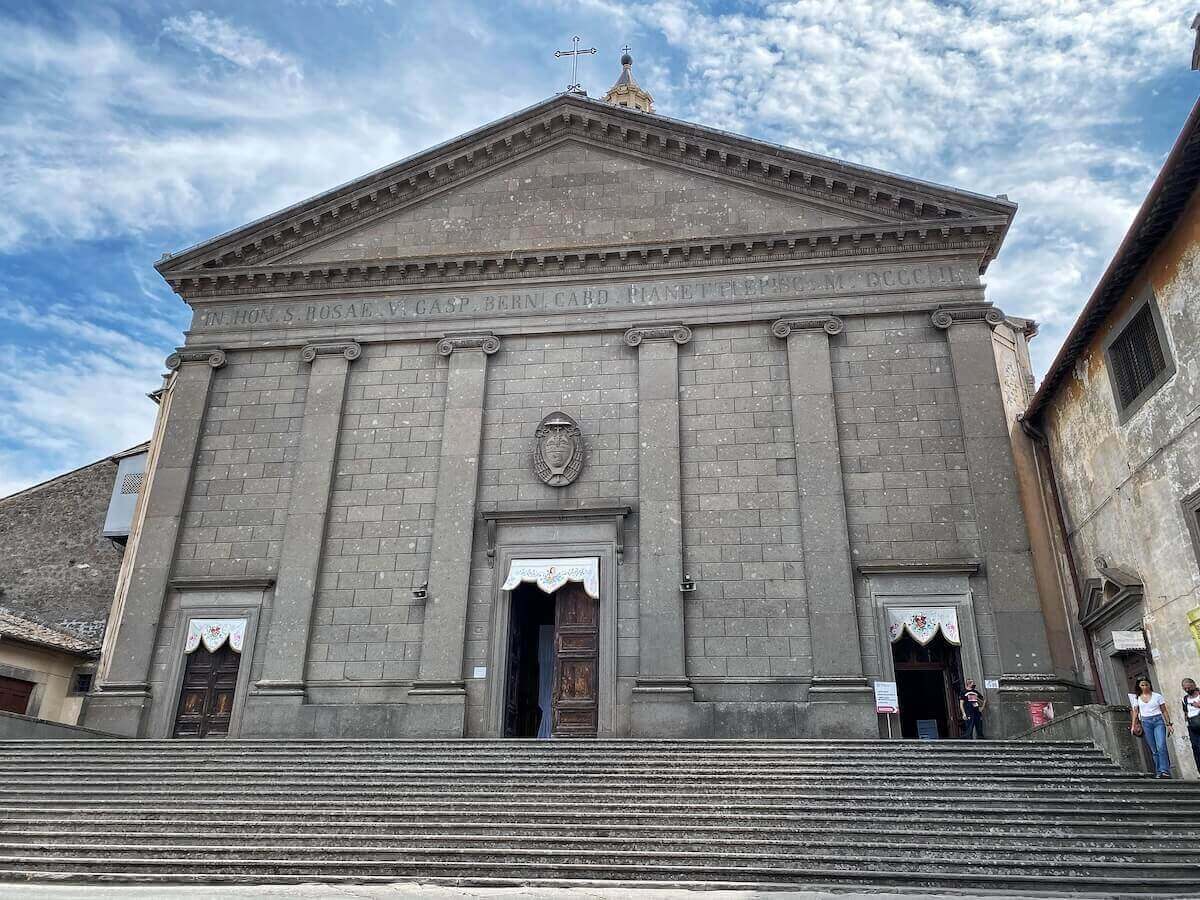
Church of Santa Rosa
The Church of Santa Rosa in Viterbo is one of the city’s most important religious landmarks and the spiritual heart of the Macchina di Santa Rosa celebrations. It stands on the site of a former monastery of the Order of Saint Clare, the religious community that Santa Rosa wished to join during her lifetime.
The church houses the remains of Saint Rosa, preserved in a glass reliquary above the altar, and has been a place of pilgrimage for centuries. Following her death in 1251, Santa Rosa’s body was transferred here in 1258, and the church was subsequently renamed in her honor.
The church is architecturally simple and austere, something which reflects the humility associated with the saint herself. During the Macchina di Santa Rosa procession on 3 September, this is the final destination of the transport, where the Macchina is placed outside and remains on display for several days.
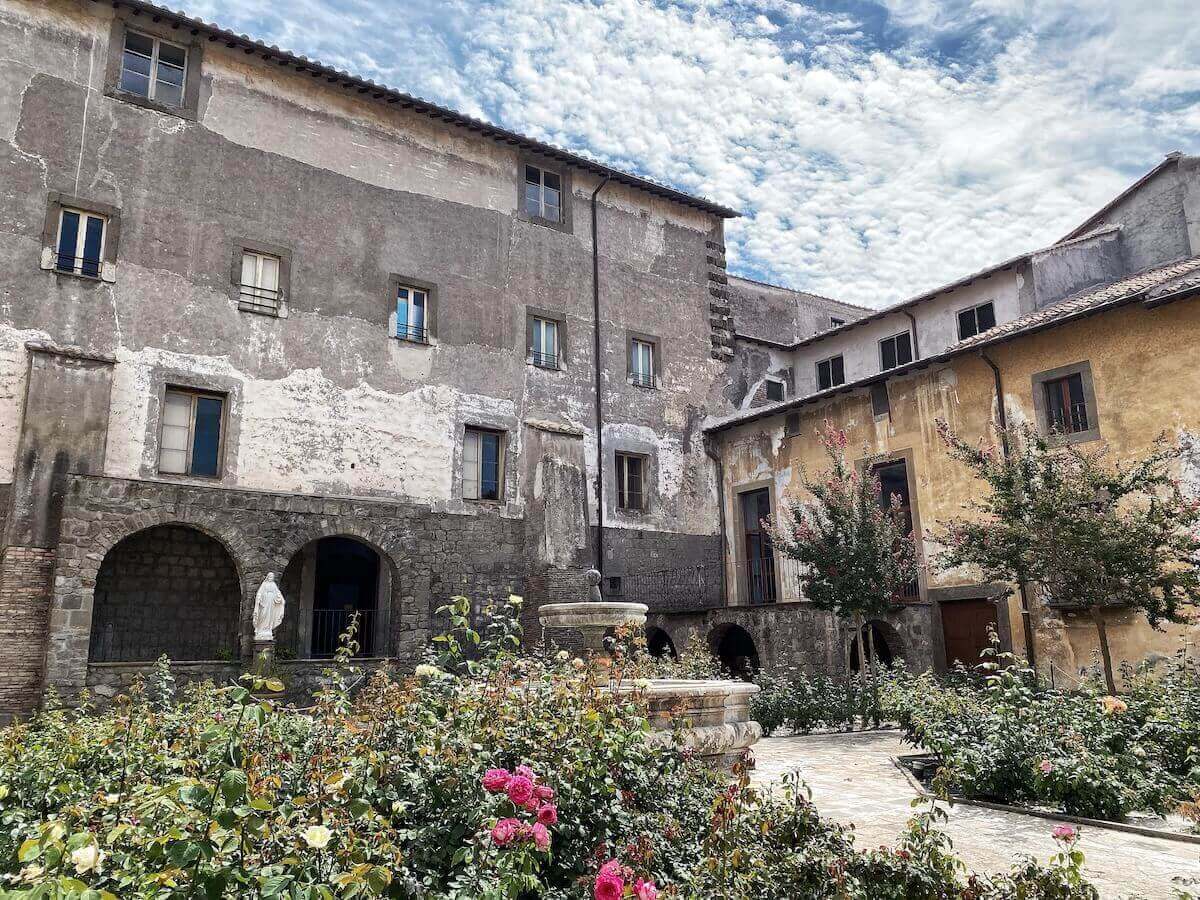
Casa Di Santa Rosa
The House of Santa Rosa (Casa di Santa Rosa) in Viterbo is traditionally believed to be the place where Saint Rosa lived and died in 1251. Located in the historic center of Viterbo, the modest building reflects the simplicity and poverty that characterized her short life.
Today, the house is a small place of devotion rather than a museum. Inside, you can see a simple interior that recalls the domestic environment of 13th-century Viterbo, along with devotional objects linked to the saint. Here you can get a better sense of Santa Rosa as a young woman deeply rooted in the everyday life of medieval Viterbo.
The site is closely associated with the final period of the saint’s life, when she returned to live in her father’s home following her rejection from the Order of Saint Clare.
The Casa di Santa Rosa is located in Via Casa di Santa Rosa 8, and it is open on Thursday, Saturday, and Sunday, from 9:30 am to 12:30 pm and then again from 3:30 to 6:30 pm.
Final Considerations
The Tuscia region of central Italy, and its capital Viterbo, are hardly ever on the tourist radar for foreigners, which makes them even more special. I am probably biased, as this is where part of my family is from, but I find the region gorgeous, and I truly believe it is worth exploring, especially if you want to see Italy off the beaten path.
You will need a car to explore this part of the country, which is perfect for a road trip.
If you happen to be in this part of the country at the very beginning of September, make your way to Viterbo. The Macchina di Santa Rosa is absolutely worth seeing, especially if you’re interested in Italy’s living traditions rather than staged events. This is not a parade designed for tourists, but a deeply rooted religious celebration.
What makes it exceptional is the combination of scale, devotion, and precision. Watching a towering illuminated structure carried through medieval streets by the facchini is dramatic and moving – I find myself brought to tears every time I attend. The atmosphere is intense yet respectful, shaped by hymns, silence, applause, and collective anticipation.
Even for visitors who are not religious, the Macchina di Santa Rosa parade is a rare opportunity to witness a tradition that has been preserved for centuries. It also provides insight into how strongly local identity, faith, and community are intertwined in central Italy.
I really hope you decide to attend!
Recommended Readings
Further Readings
For more information about the Tuscia region, make sure to read this post:
PIN IT!

Claudia Tavani
Claudia Tavani was born and raised in Sardinia, and after moving between the United States and the United Kingdom, she's now back living in her hometown, Cagliari. She's a travel blogger and certified travel designer who loves planning trips and publishing guides, travel tips, and packing lists so that you don't have to. Owner of Strictly Italy, cat mom to Minnie. Loves pizza, hiking, archeology, cities, beaches, swimming, and running. Hates peppers.