
Rome’s Jewish Quarter dates back to 1555 and is buzzing with so much history and culture that it’s a must-see while in Rome.
There are many amazing things to do in Rome – after all this is one of the best cities to visit in Italy.
The Jewish Quarter tops the list of attractions in Rome for those interested in history, especially Jewish history. Although it represents a dark part of Jewish history, it has flourished into something magnificent and enchanting, representing humankind’s resilience and ability to turn something tragic into something culturally magical.
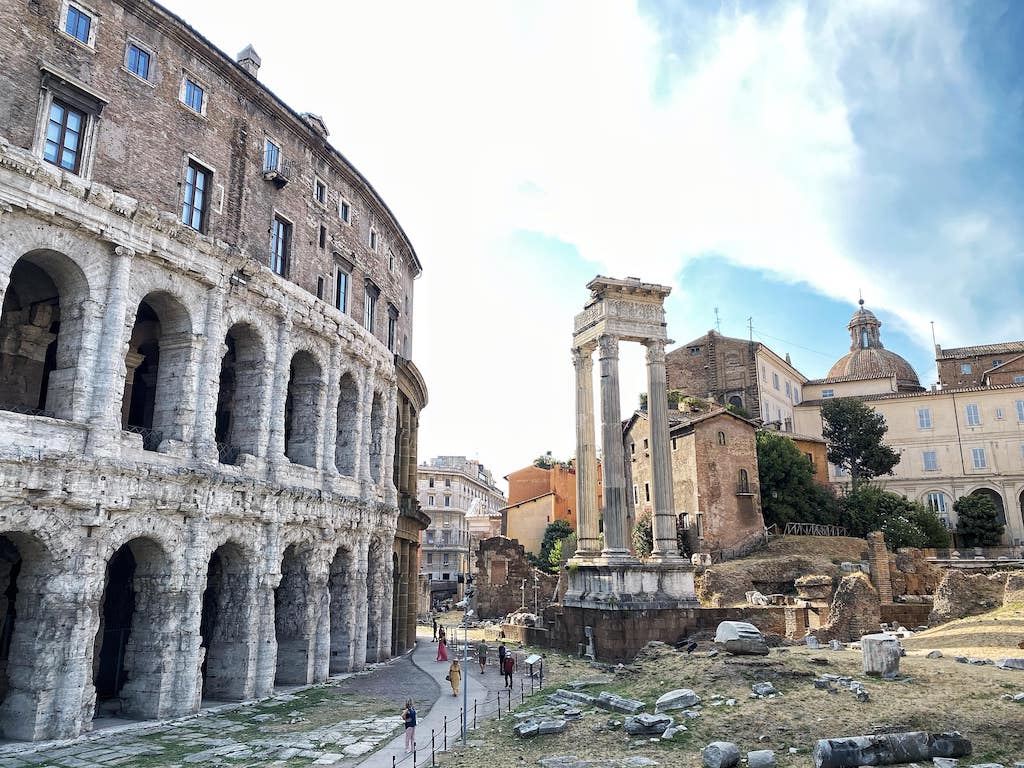
Several landmarks, like the Great Synagogue and Marcello Theater, have stood the test of time. It’s also a bustling, small neighborhood with unique food that strays from traditional Italian food, which might be a nice change.
I go to the Jewish Ghetto any time I am in Rome – including on my most recent visit. This is one of the areas of Rome I enjoy the most, and while it is in the historic center and easy to walk to, it’s not nearly as busy as the rest.
Before visiting the Jewish Ghetto, you should try to understand its history to locate all the most important landmarks and make the most of your time there.
I lived in Rome for a while, still travel there pretty regularly, and as I have said, I have visited the Jewish Ghetto many times. I’m here to share everything you need to know before visiting Rome’s Jewish Quarter and the best things to do in the Jewish Ghetto.
My post The Best Tips For Visiting Rome is an essential read for first timers in the city.
You should also read my post When To Travel To Rome for insights on the best time to visit the city, and my guide How Long Should You Stay In Rome? to decide how many days to stay there.

What To Know Before Visiting Rome’s Jewish Quarter
Brief history of the Jewish Quarter
The establishment of the Jewish Ghetto
There’s a record of a significant Jewish community in Rome going back to the 2nd century BC. Many of them settled in the Sant’Angelo District of Rome, but it wasn’t until 1555, with a brutal decree from Pope Paul IV, that the Jewish Ghetto was officially established.
Even though Rome’s Jewish community is one of the oldest and largest outside of Israel, they faced many challenges back in the day. Pope Paul IV’s decree forced all Jews into the small quarter; they built walls around it and had three main gates that were locked at night.
They put a lot of people into a small, undesirable place (the Tiber River was prone to flooding). The streets and houses were very crowded, and people were forced to build up instead of out, as the designated quarter simply was not large enough.
This meant the community was forced to live in filth and poverty in an area prone to extreme flooding, and because of the tall buildings, it saw little sunlight.
The decree not only dictated where Jews could live but also stripped them of almost all their rights. Jews were restricted economically and religiously, and to top it all off, the Jewish community also had to pay for the construction of the ghetto, had to pay a yearly tax to live there, and had to request permission to live there (even though they had no other choice).
Short reprieve and further repression
The Jewish community lived under extreme repression for hundreds of years until Napoleon’s troops arrived in Rome and destroyed the Ghetto walls as a power move against the Catholic Church.
In 1798, the Roman Republic replaced the Papal States and repealed the 1555 decree. However, the reprieve only lasted one year, then the Papal States were restored.
It wasn’t until the 19th century that things started to change. In 1848, Pope Pius IX allowed Jewish people to live outside of the Rome Jewish Ghetto, and in 1850, the tax on Jewish people was eliminated.
In 1861, when Italy was finally unified, the Kingdom of Italy replaced the Papal States and made further drastic improvements for the Jewish community. The walls were once again torn down, and the Ghetto was all but destroyed.
The Great Synagogue of Rome was built in 1904, and more apartment buildings and freedoms were granted to the Jewish community.
Unfortunately, we all know what’s to come. The freedom didn’t last, once again. Nazi Germany reinstated Rome’s Jewish Ghetto in 1943. The German authorities sealed off the Ghetto once again, forcing the Jewish community back within the restricting walls.
Over 1,000 Jewish prisoners were sent to Auschwitz, and only 16 survived the horrors.
The Jewish Ghetto today
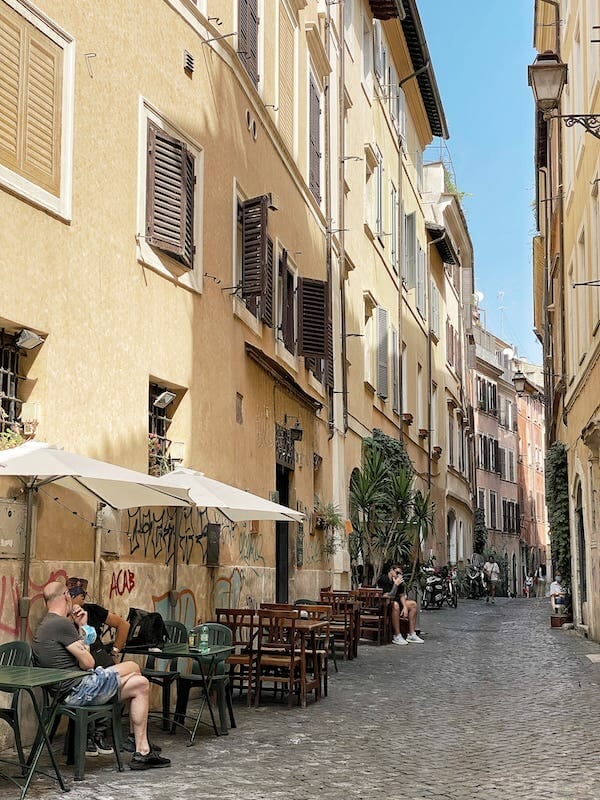
Today, the Jewish Ghetto stands tall as a testament to its brutal history and to celebrate its ever-lasting culture and traditions. The Jewish community is not imprisoned within the walls anymore, but there’s still a very large community keeping the Jewish Ghetto in Rome thriving.
You can visit the Ghetto and learn more about its history, visit the memorials commemorating all the tragic lives lost, and sample the rich cuisine.
How to get to the Jewish Quarter
The Ghetto originally extended from Ponte Fabricio to the Portico d’Ottavia, following today’s Via del Portico d’Ottavia. It cut through Piazza Giudea and extended along Vicolo Cenci (now Via del Progresso) back to the Tiber River. Across the river lies the Isola Tiberina (Tiber Island).
The Jewish Ghetto is located near many of Rome’s most iconic attractions. To get an idea of distance, it’s about a 15-minute walk from the Roman Forum, a 10-minute walk from the Pantheon, and a 20-minute walk from Trevi Fountain.
You can also take bus lines 30, 46, and 64 to the Ghetto. If you’re coming from Termini Station, you can take bus line 70 to Largo Torre Argentina and walk from there.

Things To Do In The Jewish Ghetto Rome
Take a walking tour
The Jewish Ghetto is only a few blocks long, so you don’t need to join a guided walking tour to see it all. However, a walking tour can help you learn more about its history and culture.
Most walking tours include the main sites in the Ghetto, including the Great Synagogue and Portico d’Ottavia. The advantage is that you get a lot more information than you would if you were walking through alone and some insider tips about where and what to eat.
I have actually been on several tours in the Ghetto and found them essential to get a better understanding of this unique neighborhood of Rome.
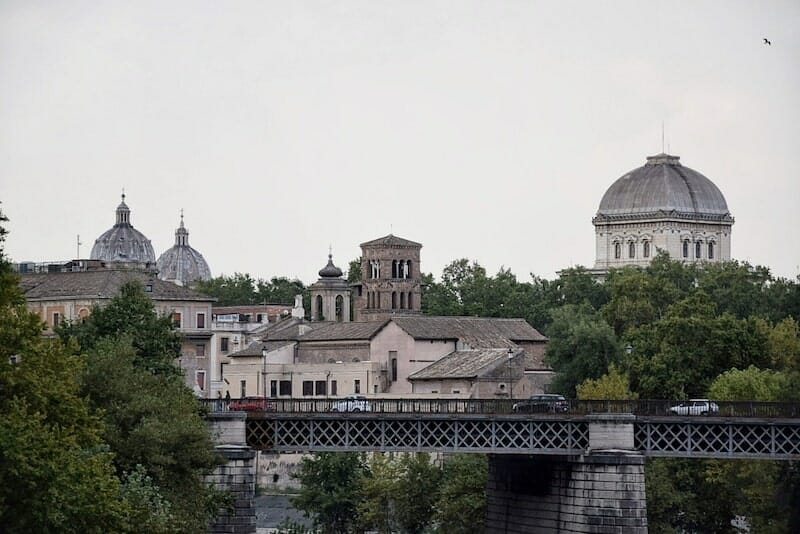
If you decide to do a self-guided walking tour, I recommend starting at Ponte Fabricio, the bridge that connects to Tiber Island, then slowly working your way through the Ghetto and stopping in at all the main monuments. It should only take a few hours to explore the Jewish Ghetto from start to finish, including the museum, the Great Synagogue, and other sites.
I took this Jewish Ghetto Walking Tour with my sister and couldn’t recommend it enough. The tour includes a guided walking tour of the Theater of Marcellus, Fontana della Tartarughe, the Jewish Ghetto, the Great Synagogue, Portico d’Ottavia, and Tiber Island.

Or a food tour
If you’re considering a walking tour, you should also consider a walking food tour, especially if you’re a foodie: it’s one of the best things to do in the Jewish Ghetto Rome. Not only will you walk through many of the main historical sites, but you’ll learn a lot about the cuisine that’s unique to this part of Rome, where to eat, and what to eat.
The cuisine in the Jewish Ghetto is, not surprisingly, a bit different from Roman cuisine. Being the area Jewish, kosher food is more prominent.
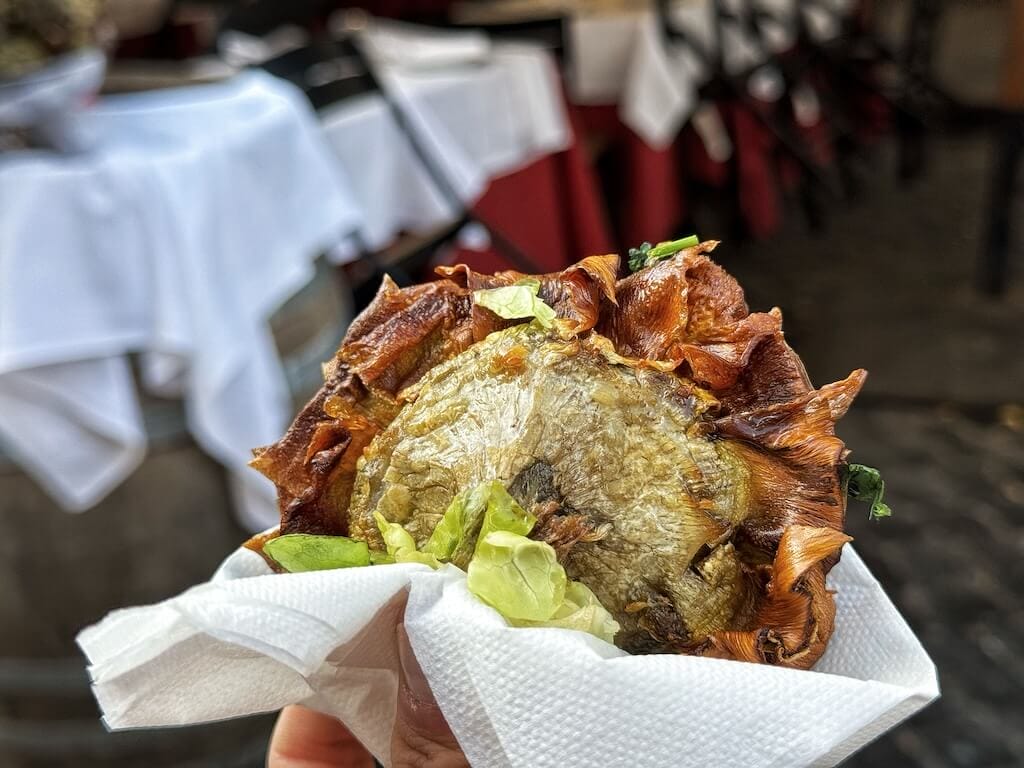
One of the most popular specialities in the area is fried artichokes (carciofi alla giudia), made with only local artichokes and strictly seasonally (typically a winter food). Most restaurants will prepare them differently, but almost all travelers rave that Nonna Betta on Via Portico d’Ottavia has the best fried artichokes.
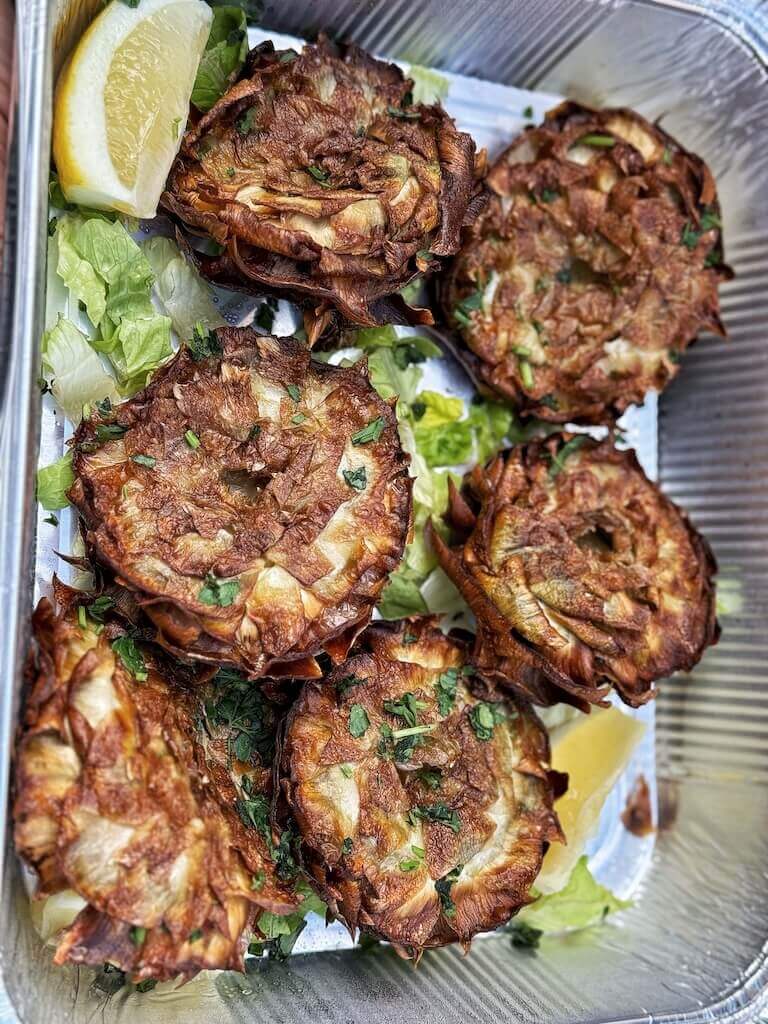
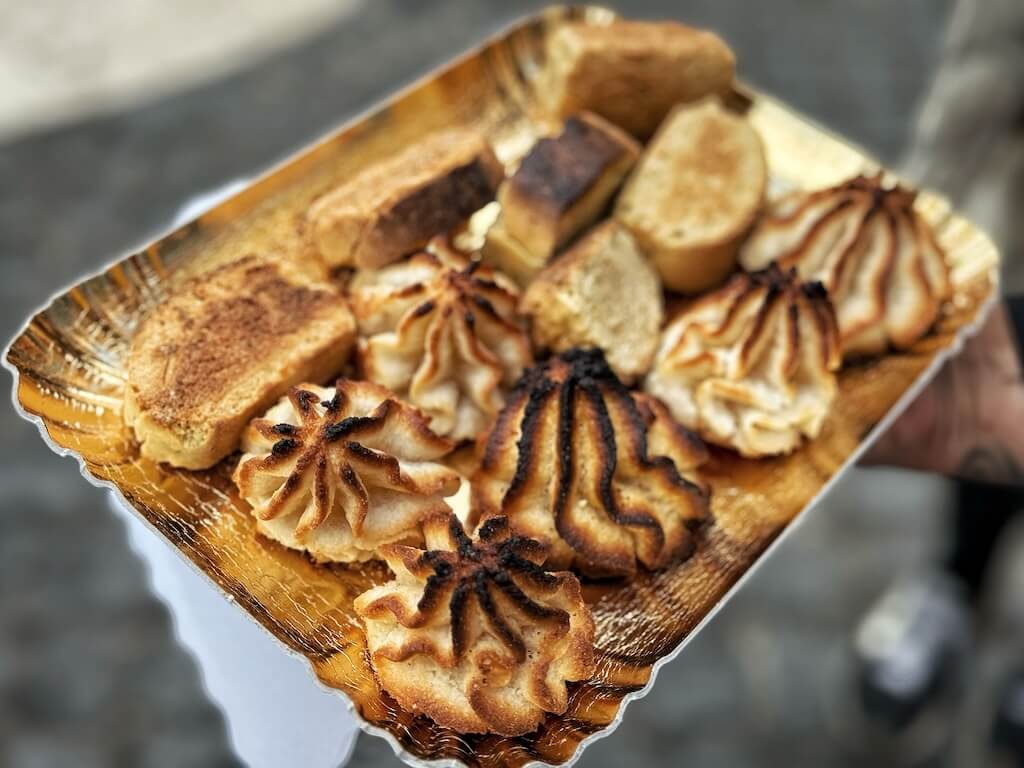
Other typical dishes from the Jewish Ghetto revolve around fresh fish, courgette, offal, and beef. Much of the food was originally fried to add flavor and for hygienic reasons. The entire community lived in poverty, so spices and extra ingredients weren’t an option for many, so frying the food was one common method.
For an incredible walking food tour that includes a walk-through of the Jewish Ghetto, I recommend this Jewish Quarter & Historic Center Local Food Tour. The tour begins at the Portico d’Ottavia, and from there you’ll go around to try local specialties, starting with delicious fried artichokes and fresh Jewish baked goods from Pasticceria Boccione in Via del Portico d’Ottavia. You’ll then walk to the Historic Center, where you’ll try other local delicacies and make your own Spritz on a rooftop in Trastevere.
My article All The Must Try Food In Rome guides you through the best traditional dishes of Roman cuisine.
Visit the Jewish Museum
The Jewish Museum should be your first stop when visiting the area. Located in the basement of the Great Synagogue complex, it consists of seven rooms with a selection of different exhibits.
The museum primarily focuses on the establishment of the Ghetto and its devastating years following. It showcases an array of artifacts, including important manuscripts, historical documents, furniture, and marbleworks.
It also paints a picture of what life was like for the Jewish community and how the community as a whole overcame socio-economic struggles and successfully integrated into the city while holding onto its identity and traditions.
It’s a personal perspective and an important piece of Jewish history in Italy.
Then go to the Great Synagogue (La Sinagoga)
The Jewish Museum is in the basement of the Great Synagogue, so it only makes sense to also tour the Great Synagogue for a more up-close-and-personal perspective on Jewish religion, congregation, and traditions.
There’s no question that visiting the Great Synagogue is among the best things to do in the Jewish Ghetto.
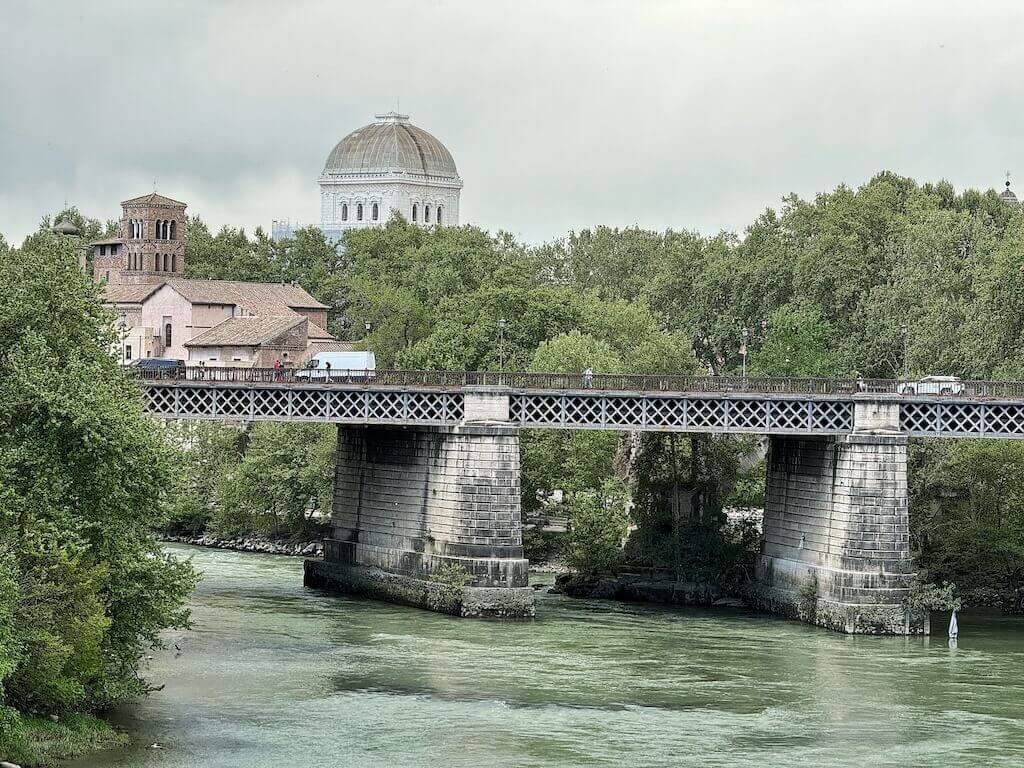
The Great Synagogue was inaugurated in 1904 and is still an active place of worship and a symbol of freedom. It was built on the banks of the Tiber River after the walls of the Ghetto were torn down.
Placing it in the very same neighborhood where Jews were forced to live, work, and survive was a very purposeful position.
It celebrates the freedom finally achieved by the Jewish Community and is still an incredibly important place for the community and the city to this day.
Keep in mind that the Synagogue (and the museum it hosts) observes Shabbat, so it open from Sunday to Friday early afternoon.
Check out Marcello Theater (Teatro Marcello)
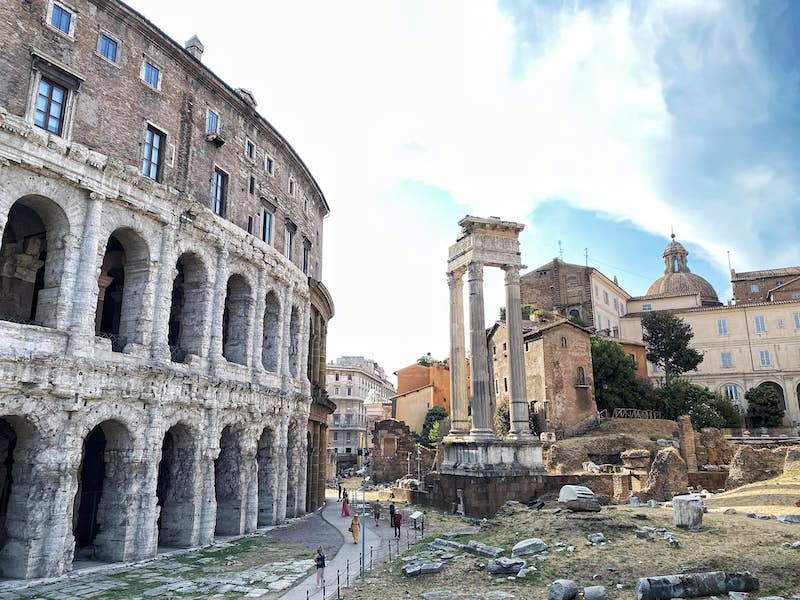
Teatro Marcello is actually just outside the official “walls” of the Jewish Ghetto in Sant’Angelo, so it’s just a short walk away from the ghetto. It’s often called the “Jewish Colosseum” because of its proximity to the Quarter and resemblance to the Colosseum.
The theater’s construction was begun by Julius Caesar and finished by Augustus around 17 BC. It also hosted secular games in Rome around 17 BC, and it’s thought that the theater was in regular use up until the 4th century.
You cannot tour the inside of Marcello Theater, but you can explore the outside and learn more about its fascinating history.
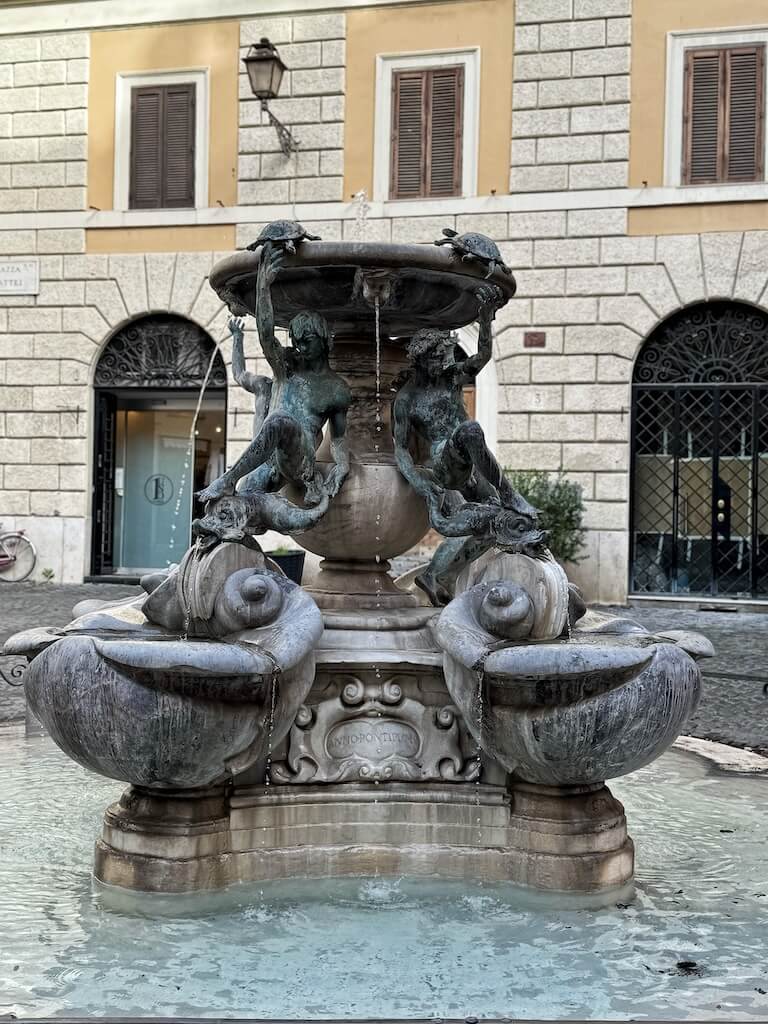
Admire the Turtle Fountain (Fontana delle Tartarughe)
Turtle Fountain, or Fontana Delle Tartarughe in Italian, is another must-see in the Jewish Ghetto. It’s located in Piazza Mattei, a very small square in the Jewish Ghetto.
The fountain was built between 1580 and 1588 to supply water to the residents of the Jewish Quarter. Water still flows from the top of the fountain, but it’s definitely more decorative than resourceful today. Unfortunately, one of the turtles was stolen in the 1970s, so one is a replica, but the rest of the bronze masterpiece is the original.
It’s one of the most iconic fountains in Rome, though, and it’s worth a quick stop while exploring the area on foot.
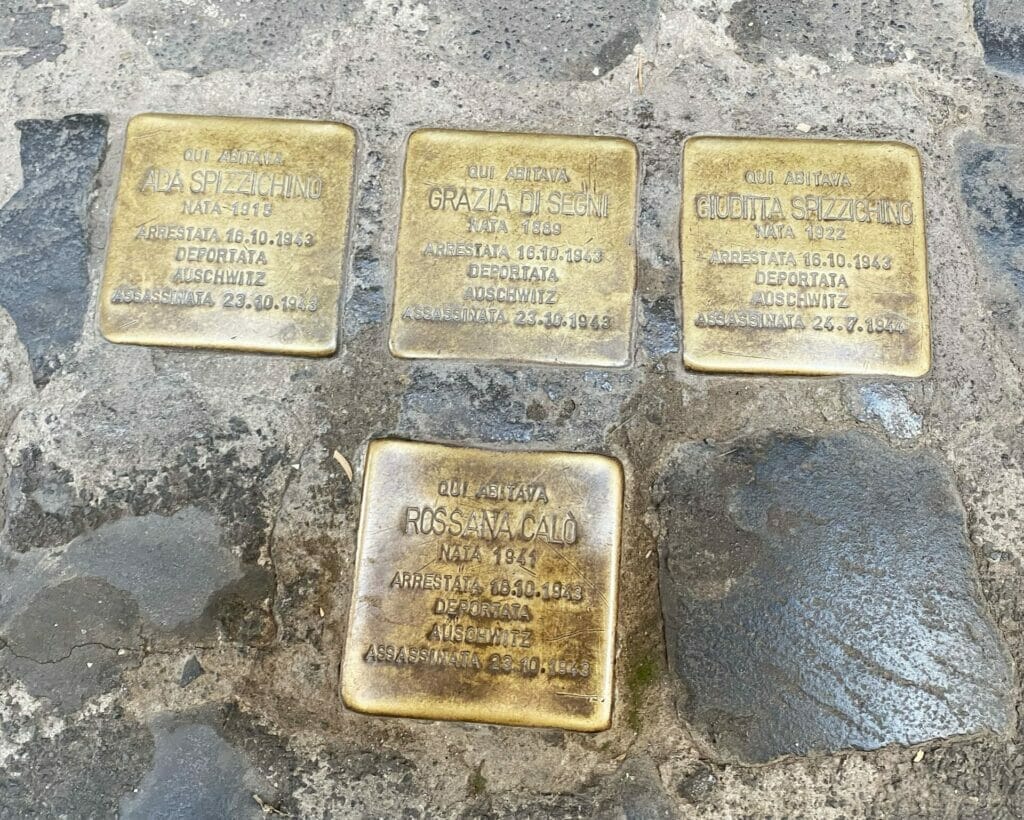
Find the “Tripping Stones” (Pietre d’Inciampo)
The Tripping Stones, or Stumbling Stones, are small brass plaques throughout the Jewish Ghetto (and other parts of Italy and Europe) to commemorate the Jewish lives lost during World War II.
There are actually thousands spread all around Europe, and they mark the last place a Jewish person was standing when they were persecuted. The stones are a part of the Stolpersteine Project. There are over 20,000 stones throughout Europe in more than 1,200 locations.
The stones state the victim’s name, birthdate, arrest date, and where they were deported. This is a fantastic way to remember the lives lost and make it feel more personal by marking exactly where they were standing when their lives were turned upside down.

Spend some time in 16 October 1943 Square (Piazza 16 Ottobre 1943)
Speaking of travesties upon the Jewish Community, the story behind Largo 16 Ottobre 1943 is another one that’ll tug on your heartstrings.
This is a small square in the Jewish Ghetto that’s named after the date the Gestapo raided the community, October 16th, 1943.
It’s hard to say precisely what happened on that day, but one well-known story tells the tale of how the Nazi secret police promised the Jewish community that their lives would be spared if they delivered 50 kilograms of gold within the next 24 hours.
The Jewish community rallied together and was miraculously able to come up with 50 kilograms of gold. The secret police collected the gold and proceeded to round up everyone and still sent them off to concentration camps.

Walk along Via del Portico d’Ottavia
Via del Portico d’Ottavia is the main walking street in the Jewish Ghetto. It’s only about one block, so it won’t take too long to walk the whole way through.
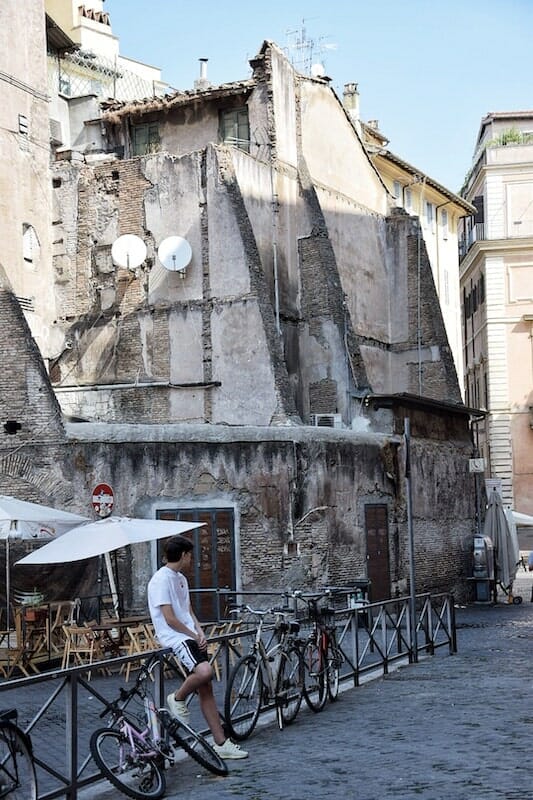
The street is actually right where a wall ran, and it shows a fascinating perspective of what the Jewish Ghetto was like and how it has grown today. On one side, there are many buildings from the former Ghetto, and on the other side, there are newer and nicer buildings that have since been built.
This is where most of the restaurants, shops, and cafes are located in the Jewish Ghetto, so you should go there for a good snack and some souvenir shopping.

Then marvel at the Portico di Ottavia
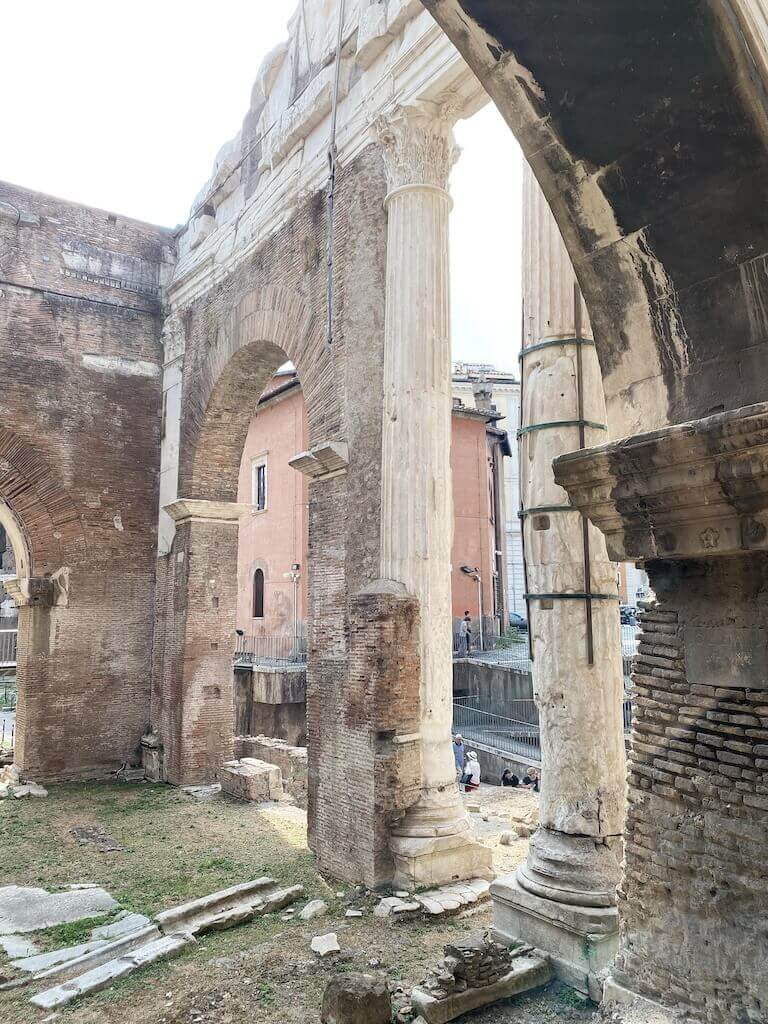
Not to be confused with the street Via del Portico d’ Ottavia, you also have to check out the ruins of the Portico d’Ottavia. The crumbling ruins are what’s left of an ancient Roman gate built in the 2nd century BC.
The gates once opened up to a library and two temples dedicated to Jupiter and Juno. Jupiter was the king of all gods in Roman mythology, and Juno, his wife, was the queen.
The building was later used as a fish market from the Middle Ages to the 19th century. This is a really interesting tidbit of Roman history, so take a moment to explore and read the inscriptions on the wall.
As a bonus, there’s no entry charge, so it’s also one of the best free things to do in the Jewish Ghetto.

Visit Kiryat Sefer Bookshop (Kiryat Sefer Libreria Ebraica)
Kiryat Sefer Bookshop, or Kiryat Sefer Libreria Ebraica, is the only Jewish bookstore in Italy. It sells a variety of publications, from fiction books by Jewish authors to prayer books for all occasions to cookbooks and more.
The bookstore also hosts presentations by the authors and workshops for the community, depending on the week’s schedule.
You don’t necessarily need to buy a book here, but it’s an important building in the Jewish community, so it’s worth checking out while exploring the Jewish Ghetto. It’s located next to the Great Synagogue, so it’s also very easy to visit while exploring.
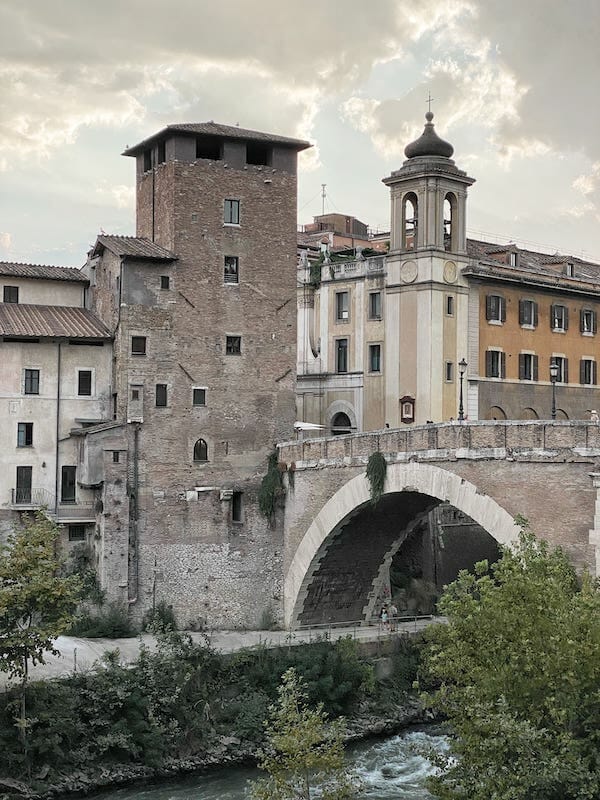
Walk across Ponte Fabricio (Bridge) To Tiber Island
Ponte Fabricio is the bridge that connects the Jewish Ghetto to Tiber Island, the smallest inhabited island in the world.
But Tiber Island’s legacy is so much more than its size. It has a really rich history, linked with medicinal magic and ancient Roman mythologies.
On the island, you can visit the Church of San Bartolomeo Apostolo and explore some short walking paths. The largest building on the island is actually Hospital Fatebenefratelli, which is still in use to this day.
It takes less than 10 minutes to walk from the heart of the Jewish Ghetto onto Tiber Island, so it’s worth checking out while exploring this area.
Where To Eat And Drink In The Jewish Ghetto
If you’d like to have lunch in the Jewish Ghetto, I highly recommend dining at Giardino Romano. This little hidden gem is the perfect place to linger with a nice bite to eat while exploring the Jewish Ghetto.
Its menu celebrates Judeo-Roman flavors, from tripe to carciofi alla giudia (fried artichokes), succulent lamb, and oxtail dishes. If you have an hour or two, this chill spot, with a beautiful terrace, is my favorite place for lunch in the Jewish Ghetto.
For drinks, Bar Totò is a must-visit. It’s a historic watering hole tucked away in the heart of the Jewish Ghetto. You can sip on aperitivos and espressos or treat yourself to a tasty sandwich.
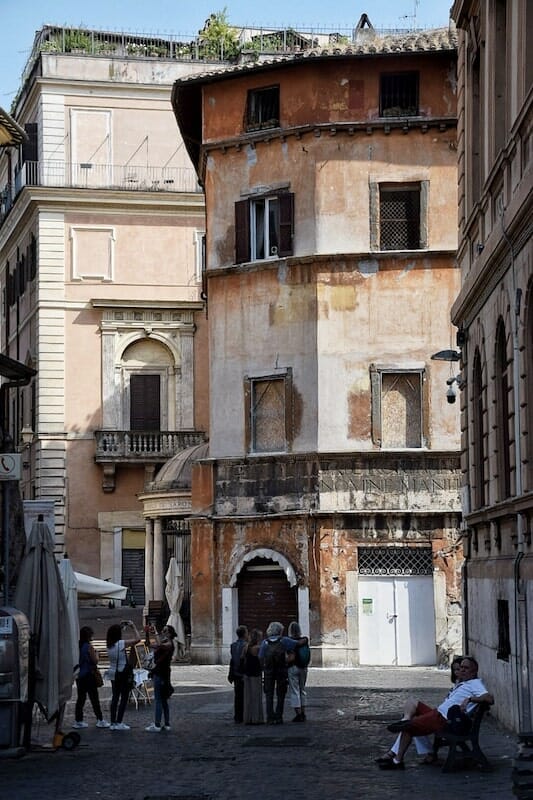
The crumbling facade, weathered by time, whispers tales of generations past. It’s right across from the Jewish school and has a small donation box outside that’s a Ghetto-era collection box for orphans.

Where To Stay Near Rome Jewish Ghetto
The Jewish Ghetto is actually in the city center, close to most of the main attractions. Therefore, staying in the city center, you should be relatively close to the small ex-Ghetto.
If you want to look for something specifically in this area, there are a handful of good options. Here are some of my top recommendations for hotels near the Jewish Ghetto.
Best Luxury Hotel: HT6 Hotel Roma
HT6 Hotel Roma is one of the most exclusive hotels within walking distance of the Jewish Quarter. It’s only about 50 meters (165 feet) from the Great Synagogue and near all the other main attractions.
The hotel is inside a very historic building but with new furniture and decor. It’s a lovely place to use as a starting point and couldn’t be more convenient and comfortable.
Best Mid-Range Hotel: Otivm Hotel
Otivm Hotel is a more affordable hotel within walking distance of the Jewish Ghetto. It’s about 500 meters (1,500 feet) from the center of the Jewish Ghetto. The hotel offers guests a delicious continental breakfast, spacious rooms, friendly staff, and a beautiful terrace with great views.
Best Budget-Friendly Hotel: Hotel Primavera
It’s a little more challenging to find budget-friendly accommodation in Rome’s city center. For obvious reasons (mostly convenience and accessibility), this area is more expensive than outside the tourist areas. That said, Hotel Primavera is a good budget-friendly option near the ghetto.
It’s a little further away, but still only about .6km (.3 miles) from the Jewish Ghetto and very close to Campo de Fiori and Piazza Navona. It does have an excellent breakfast buffet, and while the rooms are a little plain, they are clean and comfortable.
Conclusions On Visiting Rome’s Jewish Quarter
Rome’s Jewish Quarter is not overly touristy (it’s one of my favorite lesser known areas of Rome), so it can be a nice way to experience something unique and a bit more off-the-beaten-path while traveling Italy. It’s also one of the most historically important neighborhoods in Rome.
Despite its small size, the area is packed full of tragic history, empowering messages of freedom, and, of course, excellent food.
You can easily spend a few hours exploring every nook and cranny in the Jewish Ghetto and leave a much more enlightened person (with a full belly). I recommend visiting and paying tribute to the lives lost and those who suffered in the neighborhood.
PIN IT!



Buongiorno Claudia come stai? Sono roberto e mia moglie helen are travelling on a cruise in September for our cinquantunesimo wedding anniversary. Two ports we’re visiting are your home town Cagliari and Civetavecchia (Rome). We visited last year sadly helen had a foot issue so she couldn’t do anything in Cagliari so returned to ship I walked around. Can you recommend anything for us Claudia? In Rome we ended up getting a taxi to our hotel for arranged lunch. This year thought about tuk tuk in Cagliari and taxi in Rome. We have never visited the Jewish quarter in Roma. Have you been there? It really looks like somewhere we should visit. Out of all stops Italy is our favourite. So as I say your home Cagliari, Firenze and Roma. You have returned to a lovely part of Italy . Ciao roberto e helen
Hi Roberto! Lovely to hear from you, and congratulations on your upcoming wedding anniversary!
I’m sorry Helen wasn’t get to enjoy Cagliari last time. Hopefully she’ll be feeling much better this September.
As for the Jewish Ghetto… yes, I’ve been there! In fact, seeing as you’ve commented on my article about it, I rather had to visit it first—I only write about places I’ve actually been to.
Regarding Cagliari, you may not know that I also run a website dedicated entirely to Sardinia called Strictly Sardinia. Since you’re coming back, I’d definitely recommend having a look at my guide to Cagliari: https://strictlysardinia.com/things-to-do-in-cagliari-sardinia/
Have a wonderful anniversary trip, and I hope this time you both get to enjoy my hometown!