

There are many interesting things to do in Perugia. The city is the best starting point for visiting Umbria. It is also a wonderful destination for a weekend of art, history and good food, (beginning with chocolate).
A truly underrated city, Perugia struck me for its vitality. The city streets are busy with locals, students and (a few) tourists at any time of day and night.
Perugia is home to three important universities: the University of Perugia (one of the oldest in Italy); the Pietro Vannucci Academy of Fine Arts; and the International University, the most prestigious international university in Italy. That’s where foreign students learn about Italian culture and language.
The capital of Umbria also has a strong connection to chocolate. Its streets are packed with handmade chocolate and the city hosts the Eurochocolate Festival every autumn. But this is not the only festival it hosts.
My sister and I visited Perugia last September during a trip to Umbria. So I thought I’d help you plan your visit selecting its best attractions and activities.
Are you traveling to Perugia soon? These are some recommended tours you can book online:
If you are planning a longer Umbria trip, make sure to also read my post What To See And Do In Umbria.
Finally, continue reading to discover my favorite things to do in Perugia Italy – the ones you are likely to enjoy too.

15 Unmissable Things To Do In Perugia
Visit the Palazzo dei Priori
The Palazzo dei Priori is one of Perugia’s must-see. Between Piazza IV Novembre and Corso Vannucci, opposite the Cathedral, this is the seat of the City Council.
The third floor houses the National Gallery. The palace also houses two of the major medieval guilds: the Noble Collegio della Mercanzia and the Noble Collegio del Cambio.
Construction of the Palace took place in several stages, starting from 1293. It’s a series of overlapping buildings from different periods, so the palace has an irregular structure and asymmetrical facades.
You can’t miss the fan-shaped staircase by Ambrogio Maitani. It leads to the portal surmounted by bronze statues of the Perugian Griffin and Guelph Lion, symbols of the city.
The wide portal opens onto the Sala dei Notari, known until 1582 as People Hall. This is where assemblies used to take place in the past. It is now used for weddings and public functions. It is decorated with frescoes dating from the end of the 13th century.
I also recommend visiting the Sala del Consiglio Comunale to admire the frescoes by Pinturicchio; and the Sala dell’Udienza inside the Collegio del Cambio to see the frescoes from 1498 to 1500 by Perugino, which was helped by his pupil Raphael.

Enjoy art at the Galleria Nazionale dell’Umbria
Along Corso Vannucci, on the top floors of Palazzo dei Priori, you will find the National Gallery of Umbria. This was established in 1878 and houses an extraordinary collection of works of art, spanning from 1200 to 1900.
This is one of the places to visit in Perugia for art lovers. The gallery itself is a masterpiece of Gothic architecture, and it’s a fantastic place to get views of the city.
The collection includes works by some of Italy’s most celebrated painters – Duccio da Buoninsegna, Piero della Francesca, Beato Angelico, Pinturicchio and, last but not least, Perugino.
The exhibit consists of wall frescoes, paintings on panel and canvas, sculptures, jewels and textiles.

Admire Fontana Maggiore
Right in the center of Piazza IV Novembre, surrounded by the city’s most beautiful historic buildings, you will find Fontana Maggiore. This was built between 1275 and 1278 by Nicola and Giovanni Pisano to celebrate the new Aqueduct inauguration and the arrival of water from Mount Pacciano to the upper part of the city.
The fountain began to function only with the arrival of modern hydraulic pumps. Before, despite all the various attempts, the pressure was never strong enough to create a powerful jet.
Fontana Maggiore is thought to be one of the most beautiful fountains in Italy. It is made of white and pink stone, circular and has a small flight of steps with two concentric basins, on top of which there’s a bronze basin. Here, three nymphs hold an amphora from which water flows.
In the upper basin, statues depict characters related to the mythical foundation of the city. The lower basin is decorated with fifty tiles representing the calendar of agricultural work.
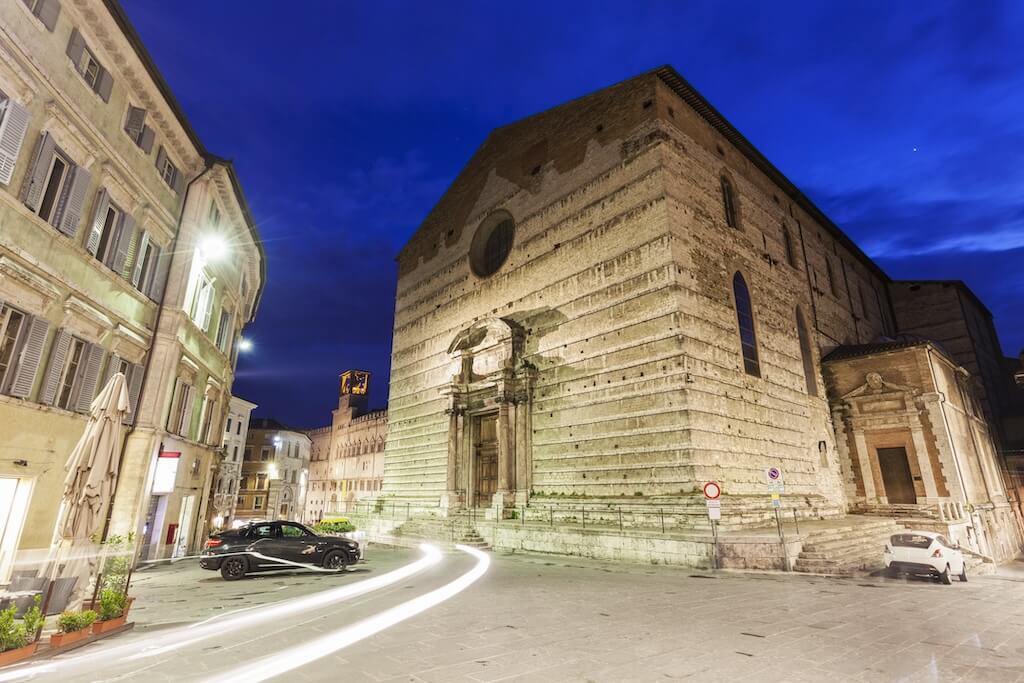
Check out Perugia Cathedral
San Lorenzo Cathedral overlooks two squares: the side wall faces Piazza IV Novembre, while the main facade faces Piazza Danti. It is so central that the stairs are now a gathering place for university students on a night out.
Construction of the Church began in 1345 and ended in 1490, although at that point the church was still unfinished. That’s why the facade is bare and austere.
Due to the long period of construction, the Cathedral sees an interesting mix of architectural styles (Gothic, Baroque and Renaissance).
The church has been a place of pilgrimage for centuries thanks to a relic preserved in the Holy Ring Chapel. That’s a ring with a precious green stone that, according to legend, St. Joseph gave to the Virgin Mary on their wedding day. Unfortunately, it is possible to admire the ring only twice a year in July and September.
The Sacristy is decorated with a pictorial cycle by Pandolfi. Make sure to also visit the annexed Capitular Museum. There you can see a collection of paintings, sculptures, jewels, liturgical vestments and ancient codices.
This Private City Tour with Rocca Paolina and Cathedral takes you to two of the most important places to visit in the city. Your local guide will share insightful information to help you get a better understanding of the city’s history and culture.

Visit Perugia Underground
The Perugia Underground tour is one of the best things to do in Perugia. From the Capitular Museum you can get into the archaeological area under the Cathedral. There you can see different stratifications of the Etruscan, Roman, and Medieval city.
The archaeological excavations have unearthed the ancient acropolis of the city that was first Etruscan and then Roman.
You will walk on a the perfectly preserved Roman road, where signs left by chariot wheels are still visible.Then you will see a Roman domus with an inner courtyard with the basin for collecting rainwater.
You will also find the foundation walls of two temples located exactly under the altar area of the Cathedral. One, probably dedicated to the goddess Uni, the Roman Juno, dates back to the 6th century, while the other to the 2nd century BC.
If you are in Perugia in summer, the Perugia Underground tour is a great activity in the central afternoon hours, when you can have some respite from the heat. I was there in fall and I took the tour during a rainfall.
Another unique underground attraction you may want to visit is the Volumni Hypogeum, Perugia’s oldest Etruscan funerary monument. It dates from the 3rd century BC but was discovered in 1840. It’s part of a vast necropolis that includes more than 200 tombs.

Spot the Etruscan Well
Located in Piazza Danti, the Etruscan Well is a great hydraulic work that testifies how ingenious local inhabitants already where in the 3rd century BC.
The well is 37 meters (about 121.4 feet) deep, has a diameter of 5 meters (16.4 feet) and a capacity of 424,000 liters of water. It was used as a water reservoir.
Descending the steps into the well, you will get into the heart of the Etruscan civilization. The bottom of the well is partly covered with travertine blocks.
The well was property of the Corbello family, but hasn’t been used for a long time now. The outside of the well, unfortunately, is completely choked by a parking lot. But I still think it’s a nice spot to stop for a few moments.
There’s a small fee to pay to visit, and you can get a combined ticket to also visit Palazzo Sorbello.
Then go to Palazzo Sorbello
Just a few steps away from the Cathedral, Palazzo Sorbello is located above the Etruscan Well. The Palace dates back to the 16th century. It houses a precious collection of paintings, porcelain, printed works, manuscripts and embroidered fabrics.
Throught the years, it has belonged to various aristocratic families. In 1780 it was purchased by the Bourbon Marquises of Sorbello to make it their residence.
You can explore the ground floor and the piano nobile of this palace, where descendants of the Sorbello Marquis still live, on a guided tour (which is best booked in advance).
It’s one of the most interesting things to do in Perugia. You’ll learn about the palace, its construction, the family that still owns it. During the tour you can see the historic library of Ranieri di Sorbello, original furnishings, beautiful chandeliers, a rich collection of 18th century porcelain, and embroidered fabrics created by the Ranieri di Sorbello Embroidery School.
The cherry on the cake is getting to the large panoramic terrace from where you can get stunning views of the city and the hills.

Walk along Via dell’Acquedotto di Perugia
One of the most picturesque walks in Perugia is along the aqueduct with the staircase that starts from Via Appia. This is one of the top free things to do in Perugia, too.
The construction of the aqueduct began in 1254 and ended in 1280. It was roughly 4 km (around 2.5 miles) long. It brought water from the springs of Mount Pacciano into the city. No pumps or other tools were used, but a system of communicating vessels was created to give water enough pressure to move.
To celebrate this masterpiece of hydraulic engineering, the Fontana Maggiore was built. Its water came from this aqueduct.
The aqueduct was decommissioned in 1835 because maintenance was too costly. When its original function ceased, the last section was transformed into a trail to easily connect the Porta S. Angelo district to the historic center.
A bridge supported by a large round arches, a long flight of steps and a walkway in the heart of the town, among colorful houses and balconies decorated with flowers make this walkway a must-do in Perugia.
If you have enough time, visit the aqueduct ruins in the Monte Pacciano area, where arches rebuilt over the centuries and the “conservoni,” cisterns for storing water, are still visible.

Climb the Sciri Tower
Climbing the Sciri Tower is what to do in Perugia to get breathtaking views of the city. Don’t be put off by the 232 steps. Once you get to the top you will be rewarded with magnificent views.
The Sciri Tower (Torre degli Sciri in Italian) is the only survivor of hundreds of towers that characterized Perugia’s skyline during the Middle Ages.
Towers were a key architectural element in aristocratic houses. They had both a military and a symbolic function, representing the prestige of the family.
The tower, which is 42 meters (almost 138 feet) tall, was built around the end of the 13th century. It belonged to the Oddi family until 1483, when, forced into exile, they sold it to the Sciri family. You can still see their name carved on the coat of arms above the front door.
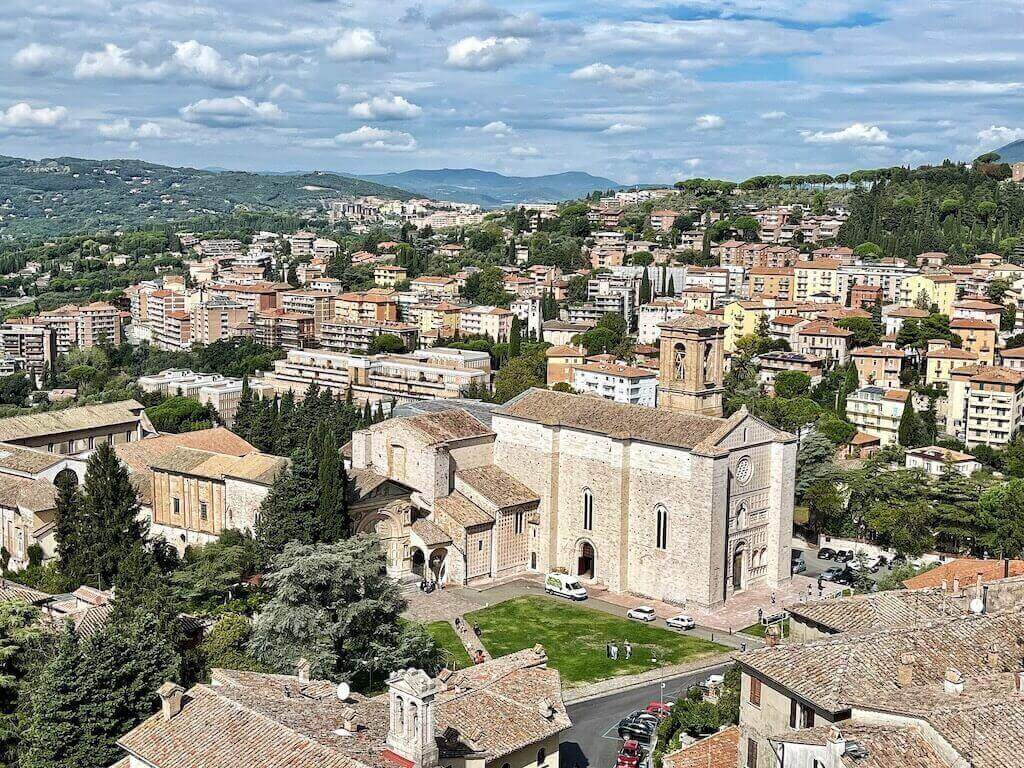
Explore the Oratorio di San Bernardino
Just a few minutes’ walk from the Sciri Tower there’s the San Bernardino Oratory. It’s a fine example of Renaissance art in Perugia. It was built in 1452 by Franciscan friars in honor of St. Bernardine of Siena, who was a regular visitor of Perugia.
Make sure to observe the facade, a masterpiece by Agostino di Duccio. The three-bay Gothic vaulted interior is equally beautiful with several works of art, including the main altar carved from an early Christian sarcophagus in which Blessed Egidio was buried from the late 13th century to 1887.
Behind the altar, two doors lead to the oratory, which has a beautifully carved ceiling and works by various artists.
During the Umbria Jazz Festival, the grass in front of the oratory is a spot where many find a relaxing moment in-between concerts.
Right next to the Oratorio you’ll find the former Church of St. Francis al Prato, now an auditorium. When I passed by there were rehearsals for a piano concert.

Explore the Rocca Paolina
Taking the escalators from Piazza Italia, you can descend into the underground city and step back in time into the heart of medieval Perugia. Other entrances are from Piazza Partigiani and Porta Marzia, an ancient Etruscan gate.
The Rocca Paolina, built between 1540 and 1543, was an ancient fortress commissioned by Pope Paul III as a symbol of papal power over Perugia.
In an effort to secure the city and create an efficient refuge as Castel Sant’Angelo had been during the Sack of Rome, hundreds of houses, monasteries and churches (basically almost an entire district of the city) were demolished to build the fortress. With this move, the Pope earned the locals hatred.
In 1860, with the annexation of Perugia to the Kingdom of Italy, the Rocca was demolished. Today only a section of the retaining walls remains, visible along Viale Indipendenza, and the bastion with Porta Marzia.
The most interesting bits are the underground areas that host exhibition spaces, cultural events, stores and a craft market during the Christmas season.
I recommend this Private City Tour with Rocca Paolina and Cathedral. It’s a great way of learning more about an important part of the history of the city.
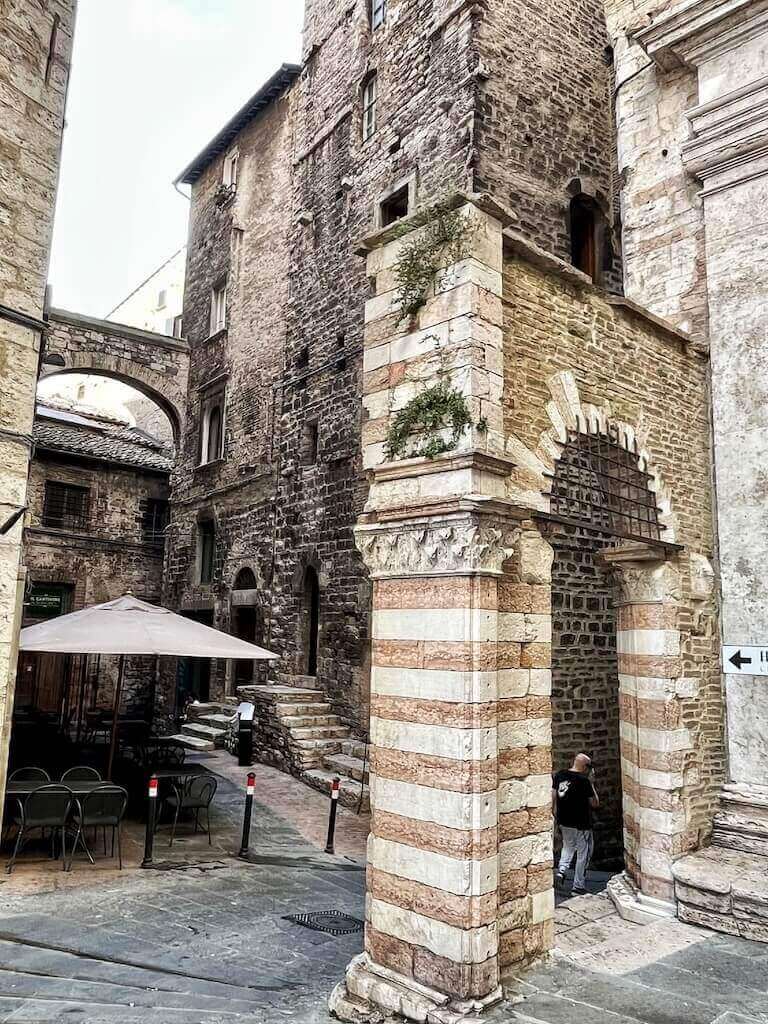
Attend Umbria Jazz
If you love listening to live music, I strongly suggest visiting Perugia during Umbria Jazz.
Umbria Jazz (commonly shortened to UJ) is the most important Italian jazz music festival and one of the most renowned in the world. Founded in 1973 by Carlo Pagnotta, it takes place every year around the middle of July.
On those days Perugia turns into an open-air music hall. In Santa Giuliana Arena, Pavone Theater, Santa Cecilia Oratory, Piazza IV Novembre and Carducci Gardens you can enjoy live performances by some of the world’s most famous musicians.
Over the years the festival has hosted the likes of George Coleman, Dizzy Gillespie, Chat Baker. If you wish to attend, I recommend you buy your tickets in advance.
The scenic afternoon parade along Corso Vannucci is one of the most thrilling shows.

Visit Perugina Chocolate House
Chocolate lovers can’t go to Perugia without visiting the Casa del Cioccolato Perugina. It’s located just outside the center, in the San Sisto district.
The visit lasts about an hour and takes you inside the production plant. Here some of the world’s most delicious chocolate pralines are made.
The tour begins with the Perugina Historical Museum. You will learn about its history since its founding in 1907, and Luisa Spagnoli’s genius intuition creating the praline, Bacio Perugina.
The next stop is the Historical Archives. There you’ll see images, wrappers, packaging and films including advertising carousels though the years. You will then see the production line in operation thanks to an elevated walkway.
Of course, there’s a tasting session too. At the end of the visit, you can access the Perugina shop or attend a chocolate-making class.
Every fall, Perugia hosts the Eurochocolate, the largest fair in Europe dedicated to chocolate.
Tempio di San Michele Arcangelo
St. Michael the Archangel Church, better known as St. Angelo Temple, is one of the earliest Paleo Christian churches in Italy that also shows additions from the Gothic period. It was probably built on the remains of a Roman temple that, in turn, stood on an Etruscan temple.
It is a circular building. The interior consists of two concentric compartments, separated by sixteen Roman columns with Corinthian capitals and four chapels arranged in the shape of a Greek cross.
It’s so scenic that it’s now a popular wedding venue in Perugia.
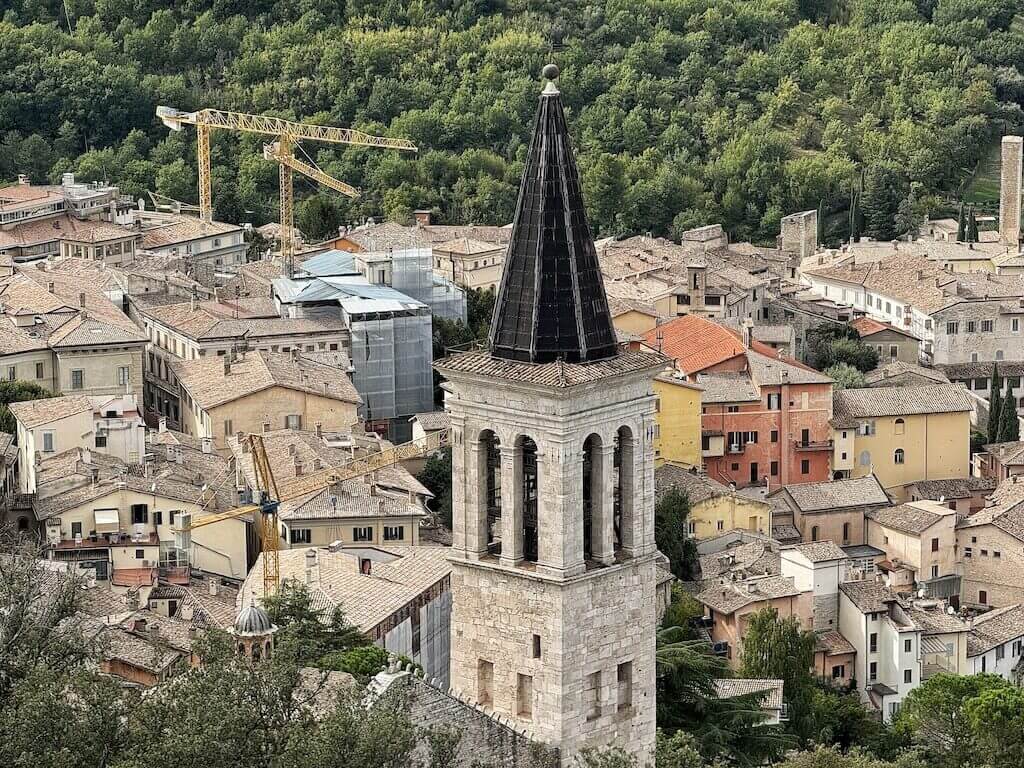
Take a day trip out of the city
Perugia is very centrally located in Umbria and an excellent starting point to explore the region. There are many interesting places you can visit on a day trip.
The most popular day trip from Perugia is by far Assisi. It’s only about 30 minutes by car, and you can get there by public transportation. Once there, the most impressive place to visit is St. Francis’ Basilica. But of course there’s much more to see.
Take your time to admire the Santa Chiara Basilica and the San Rufino Cathedral. Walk around the old town and then all the way to San Rocca Maggiore from where you can enjoy breathtaking views.
My guide The Best Places To Visit In Assisi shares more tips on what to see and do.
Another small town that’s perfect for a day trip (though we felt it deserved more than a day) is Spoleto. It takes about 50 minutes by car, and there’s a direct train from Perugia that gets you there in just one hour.
Don’t miss the magnificent Duomo di Spoleto, the Rocca Albornoziana (from where you can see the Ponte delle Torri), the Roman Theater and the Casa Romana. Take your time to wander around the narrow alleys and take in the lovely atmosphere.
Head over to my post A Useful Guide To Spoleto for more ideas on things to do.
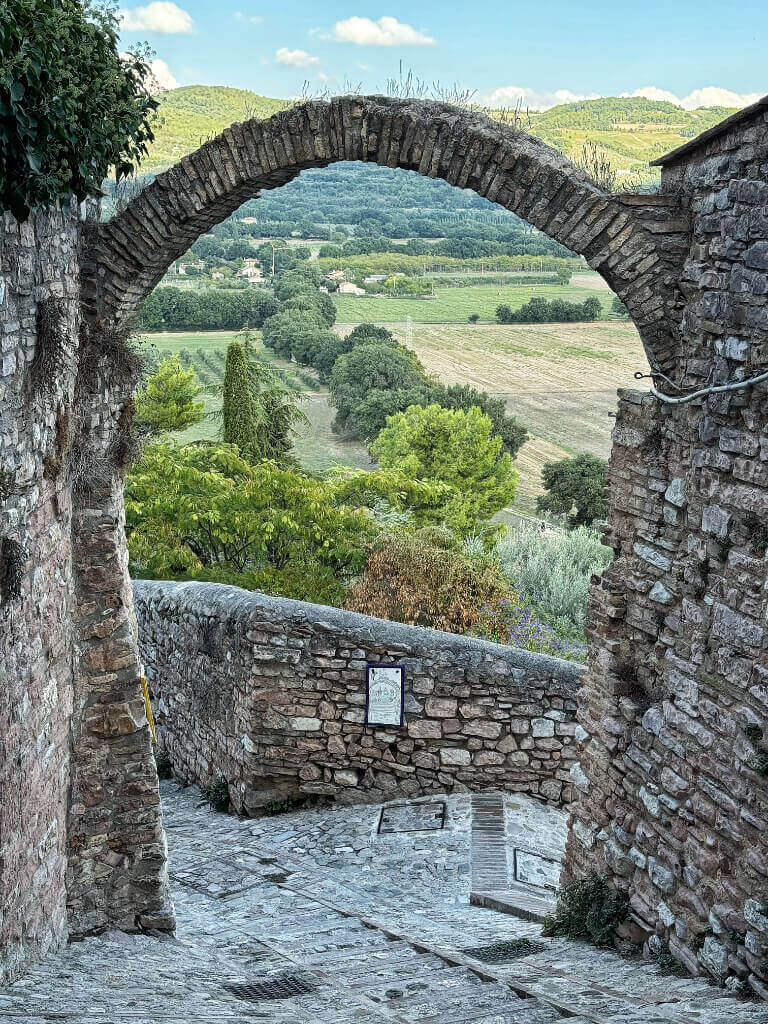
Spello is so easy to reach from Perugia (30 minutes by car, and 30 minutes by train) that it’d be a pity to miss it. Pass by the Porta di Venere and the other city gates, and spend time wandering around the small town streets. It’s also a great starting point for a bike tour around the olive groves.
Make sure to read my post An Easy Guide To Spello for more tips on what to see once there.
If you don’t mind driving a bit longer (one hour and 15 minutes), to Orvieto. It’s one of the nicest towns of the Tuscia region. The main attraction here is the Duomo, but there’s much more to see.
One of our favorite places when we visited was St. Patrick’s Well, and we also enjoyed exploring Orvieto Underground. The Giardini Comunali is another nice place to spend some relaxing moments.
Other than that, you can enjoy a wine tasting session or visit the Claudio Faina Museum. You can also simply spend time wandering around this gorgeous small town.
My Orvieto Guide shares more information on this delightful city.
I also have a post on the Best Day Trips From Perugia for more inspiration.

Conclusions: Is Perugia Worth Visiting?
Perugia is a beautiful city, very much alive and with many attractions to see. You can combine your love for history and art with that of good local food (so different from food in other parts of Italy). I recommend trying truffle, as it’s a local specialty, and of course chocolate.
I recommend using Perugia as a starting point for your itinerary around Umbria. I’d actually say it’s where to stay in Umbria to explore the region.
And if you ask me when is the best time to visit Perugia, I’d say that Perugia is beautiful to visit all year round. We visited at the end of September and loved it!
PIN IT!


Claudia Tavani
Claudia Tavani was born and raised in Sardinia, and after moving between the United States and the United Kingdom, she's now back living in her hometown, Cagliari. She's a travel blogger and certified travel designer who loves planning trips and publishing guides, travel tips, and packing lists so that you don't have to. Owner of Strictly Italy, cat mom to Minnie. Loves pizza, hiking, archeology, cities, beaches, swimming, and running. Hates peppers.