

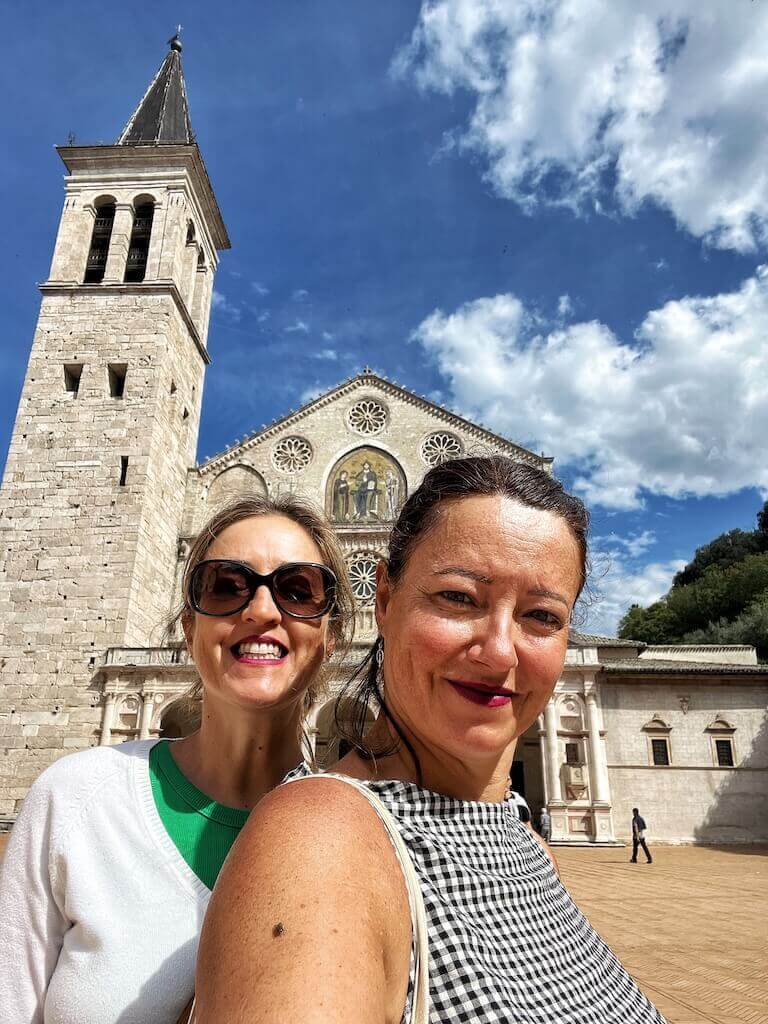
My sister and I visited Spoleto last September during a road trip around Umbria and didn’t expect to find a town that, albeit fairly small, is so steeped in history and rich in attractions.
The location of Spoleto Italy is enough to wow you: on Sant’Elia hill, at the foot of the Monteluco Forest, surrounded by mountains and hills covered with olive groves, crossed by several rivers and streams. You can see why it was chosen as the setting of a very famous Italian series – Don Matteo.
This city is rich in history: there’s a Roman Theater, medieval city walls, and a gorgeous Cathedral. There are towers and a fortress perched on the hills that stand out and provide incredible photo opportunities.
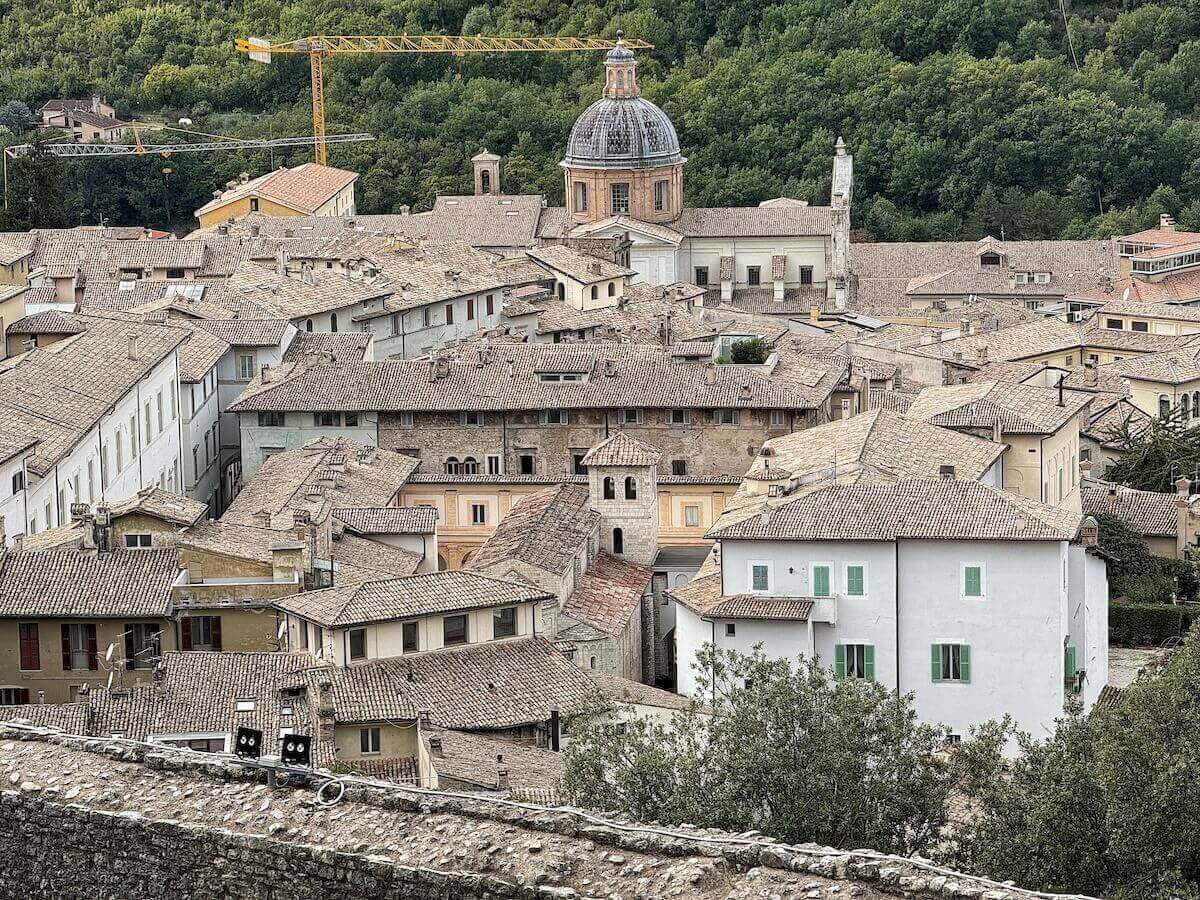
My sister and I only spent one day in Spoleto Umbria, but if you have the chance, you should stay at least two, three days to enjoy all the things to do in Spoleto and explore the beautiful surroundings. The best time to visit Spoleto is during spring and fall – as I said before, we went towards the end of September and enjoyed gorgeous weather and no tourist crowds.
For those of you traveling to Spoleto, I have put together a selection of what to see in Spoleto.
Are you going to Umbria soon? My post Where To Stay In Umbria will help you pick the best base for your trip, and my guide on 12 Best Things To Do In Umbria will guide you on the best activities.
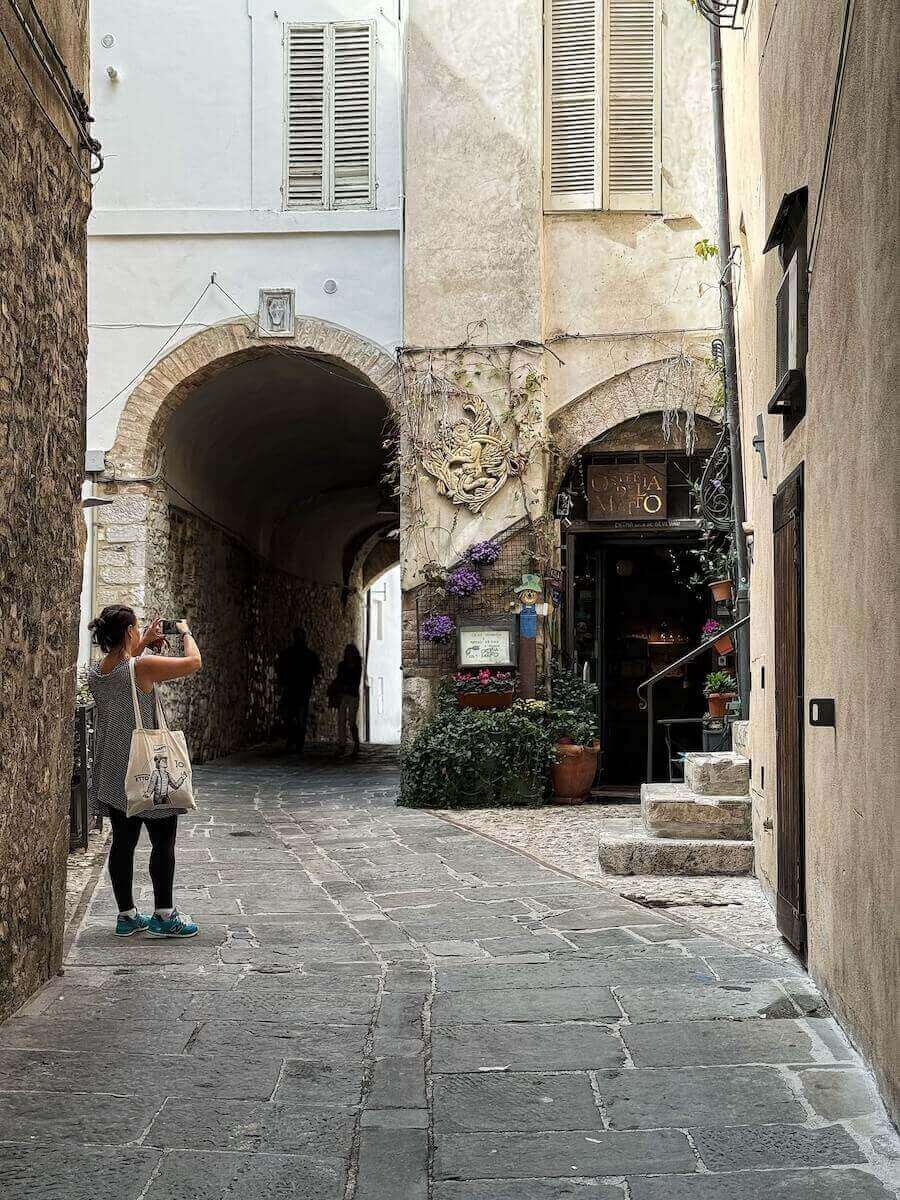
Best Things To Do In Spoleto Italy
Attend the Festival dei Due Mondi
One of the best things to do in Spoleto if you are visiting in June or July is attending the Festival dei Due Mondi (Festival of Two Worlds). It’s been taking place in Spoleto since 1958.
This is an international event of art, music, culture, and entertainment that, in recent years, has also committed itself to promoting sustainability, dealing with ESG (Environment, Social, Governance) issues.
The festival was founded by Gian Carlo Menotti, opera and artistic director, and composer of numerous contemporary musical works. He wanted to create an event that would be “a meeting place between two cultures and two artistic worlds, the American and the European.”

The festival focuses on music, dance, theater, and art and attracts thousands of visitors from all over the world.
In the past, celebrities such as Luciano Pavarotti, director Riccardo Muti, Italian classic ballet dancer Carla Fracci, Joaquin Cortes, actors Vittorio Gassmann and Al Pacino, have been guests of the festival.
Attending one of the performances, participating in the workshops, and meeting the artists is a good reason to visit Spoleto.

Visit the Duomo di Spoleto
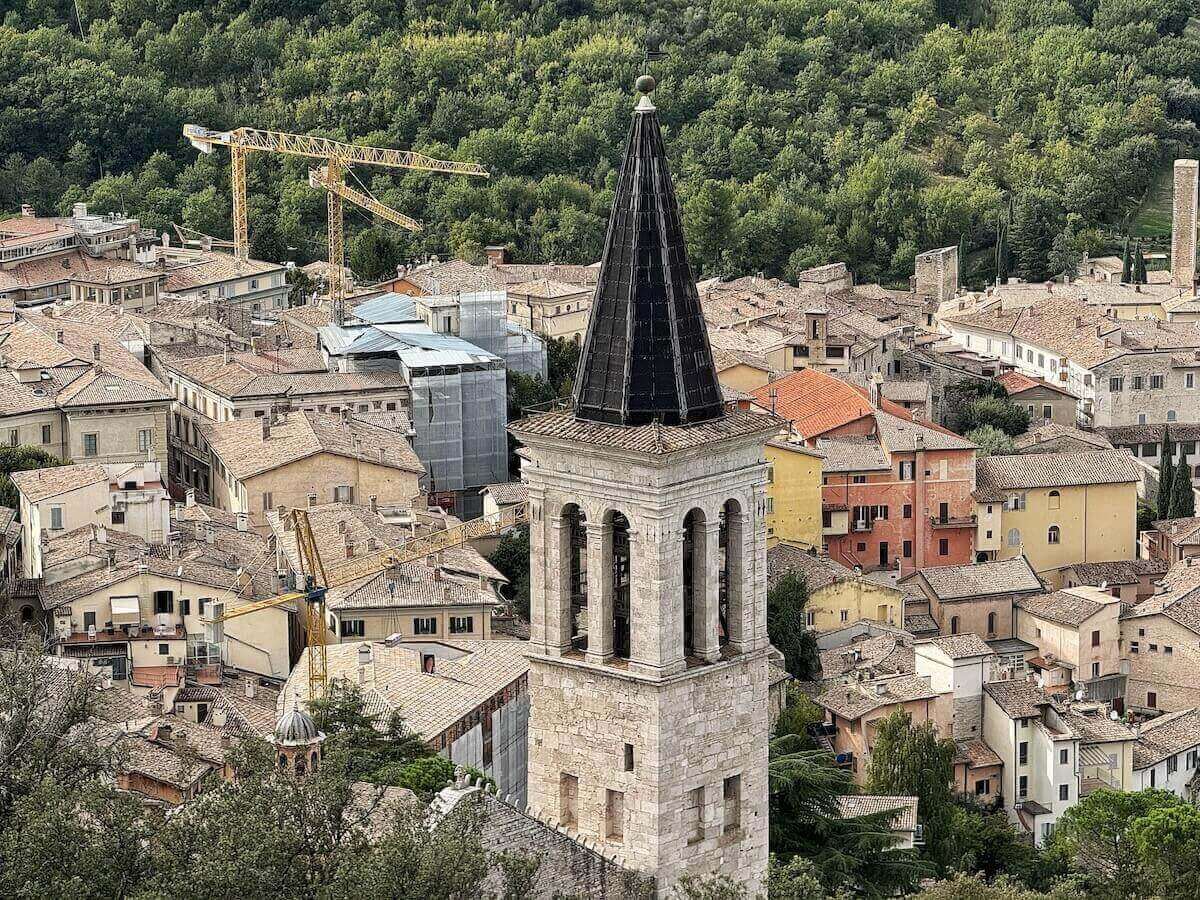
The Duomo is the most important building in the city. Construction of the church began at the end of Lombard rule, between the 8th and 9th centuries. Expanded over the following centuries, it was consecrated by Pope Innocent III in 1198.
Its beauty and grandeur can be seen from afar, when a long flight of steps opens among the narrow alleys of the center, leading to the square in front of the Duomo. I must admit my sister and I wowed a few times when we caught sight of it.
The square where the Duomo is located is well known to Italians as it’s where Italian TV series, Don Matteo is often filmed and, in the summer, its hosts many performances of the Festival of Two Worlds.
The Romanesque facade features eight rose windows, a large Byzantine-style mosaic depicting Christ between the Virgin and St. John, the bell tower to the side, and finally the Renaissance-style portico that precedes the three entrance portals.
The interior houses countless masterpieces, such as Bernini’s bronze bust of Urban VIII, the Crucifix by Alberto Sotio, and the nave floor porphyry, serpentine and stone tiles. The apse is decorated with frescoes by Filippo Lippi. Pinturicchio painted Bishop Eroli chapel.
And the Basilica di San Salvatore
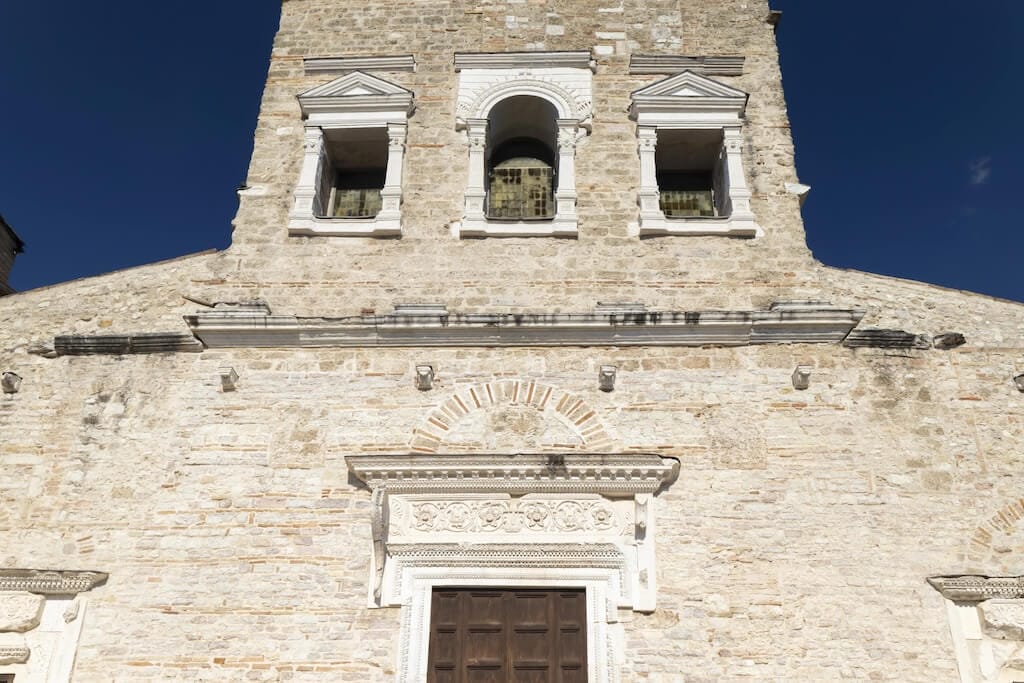
The Basilica of San Salvatore is the oldest church in Spoleto. Initially dedicated to the martyrs Concordius and Senzia, it was later named after San Salvatore because of the image of Christ placed above the high altar.
The church – which has been a UNESCO World Heritage Site since 2011 – is located at the foot of a hill, outside the historic center of Spoleto. It has undergone many restorations but it still retains its original features.
Inside, the church has three aisles separated by Doric columns that were actually taken from other ancient buildings; a square-shaped presbytery and, in the center of the apse, a fresco depicting gem-studded cross.
At the moment, the church is closed to the public due to post-earthquake restoration work. You can still admire the outside structure and follow the staircase to the Civic Cemetery, designed in 1836 by the architect Ireneo Aleandri: it’s a beautiful monumental cemetery that’s worth checking out.
Climb up to the Rocca Albornoziana
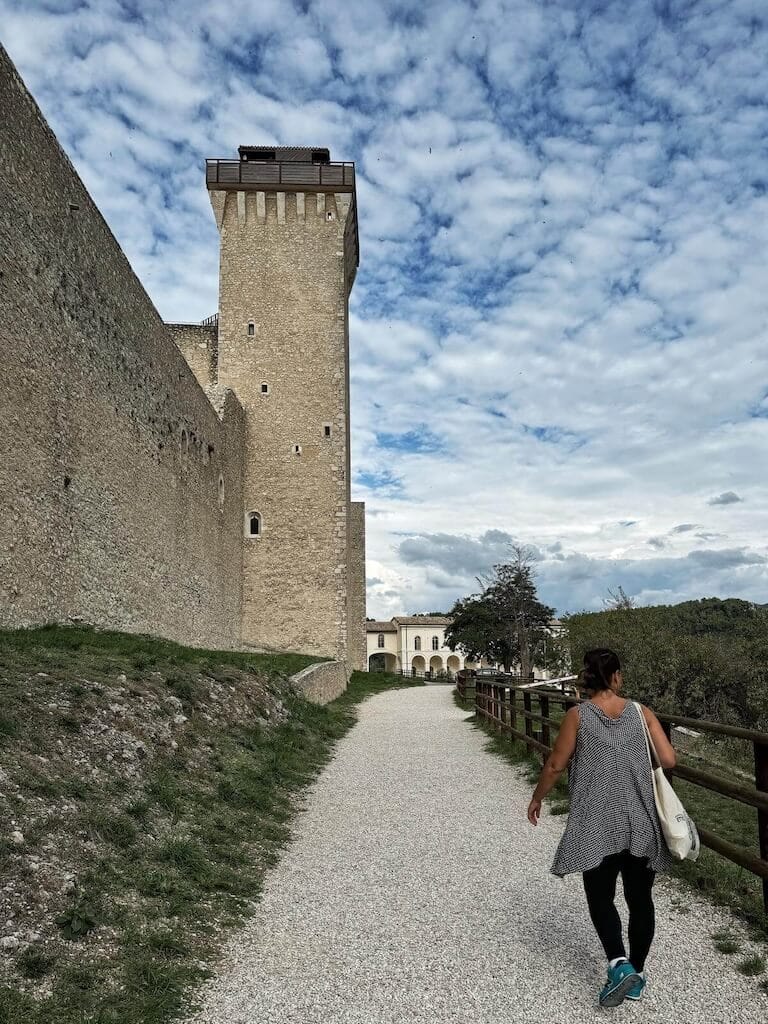
The Rocca Albornoziana is a fortress located on top of Sant’Elia hill, overlooking the Spoletana Valley. Walking up the Albornoz Fortress is what to do in Spoleto to catch stunning views.
The fortress was erected in the mid-14th century by Spanish Cardinal Egidio Albornoz (hence the name), upon request of Pope Innocent VI, who wanted to re-establish the authority of the Church and strengthen its defensive system in the region.
Throughout its history, the fortress became the residence of the rectors of the Duchy, the governors of the city, often chosen from among the closest relatives of the pontiffs. That’s when decorations and frescoes were added to the fortress, which would have otherwise been quite bare.

Among the most important residents there was Lucrezia Borgia, daughter of Pope Alexander VI: she became the regent of the Duchy of Spoleto when she was only 19.
In 1817, the fortress became a prison of the Papal State, and maintained this feature even after the Unification of Italy and until 1982. During that period, many decorations and frescoes were unfortunately lost, but restoration works have returned the many rooms of the fortress to their original beauty.
The Rocca Albornoziana has housed the National Museum of the Duchy of Spoleto since 2007. It’s an interesting museum to visit, and you can clearly distinguish the main rooms and courtyards that were once the beating heart of the fortress. The views of the city from up there are also impressive.
The fortress can be reached by elevator or through the walk of the Fortress, a loop trail of about 1 km (0.6 miles).
Admire the Ponte delle Torri
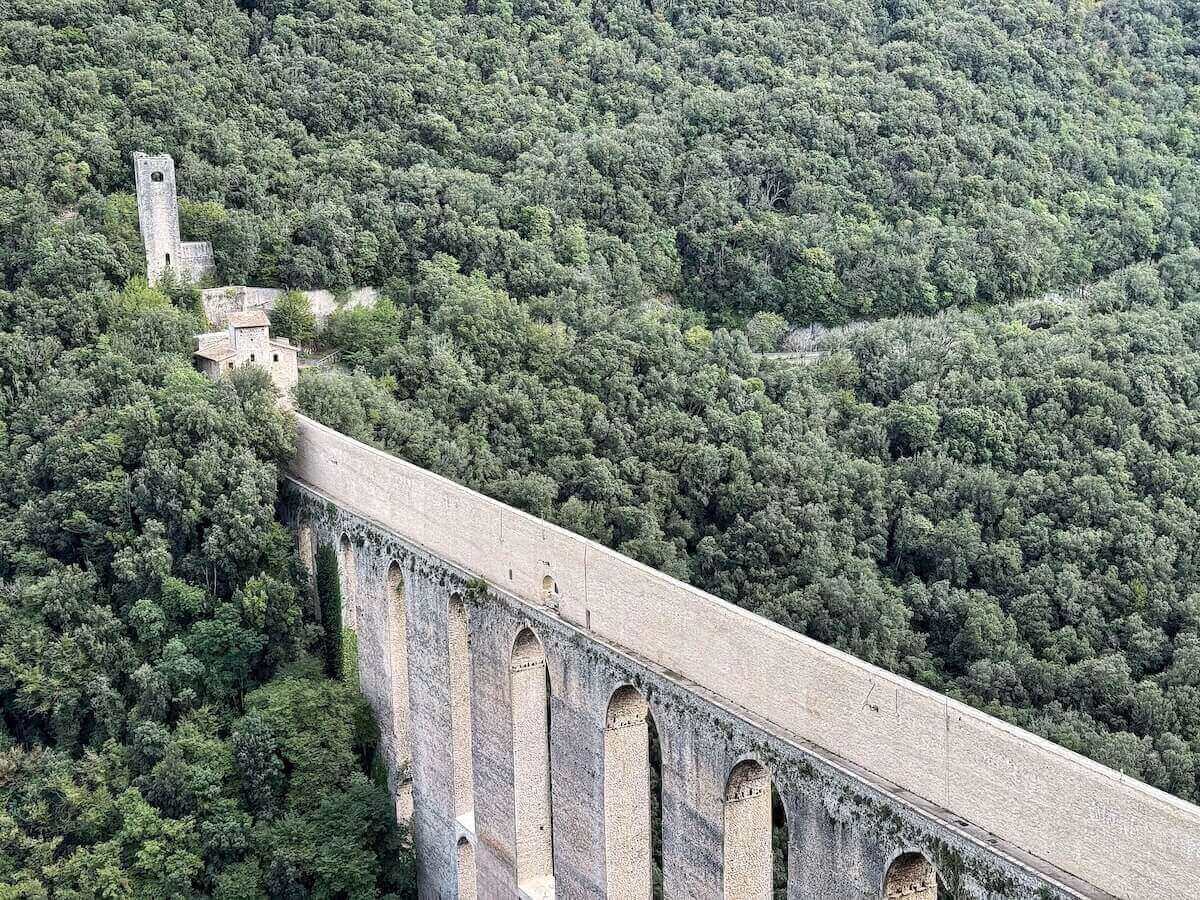
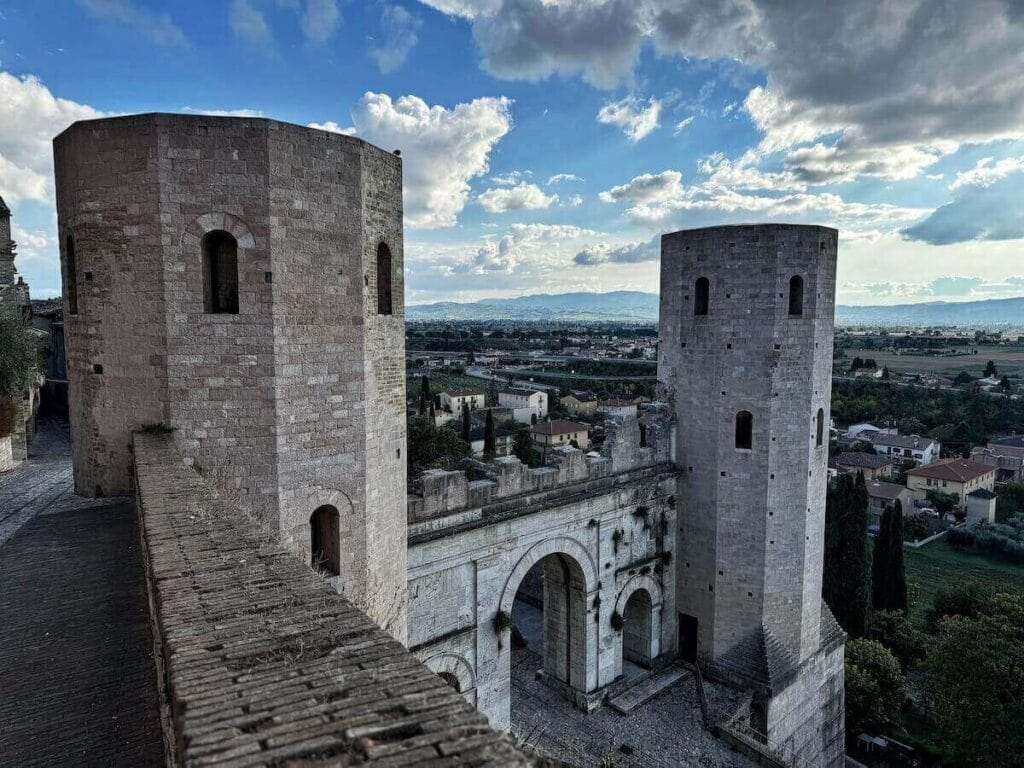
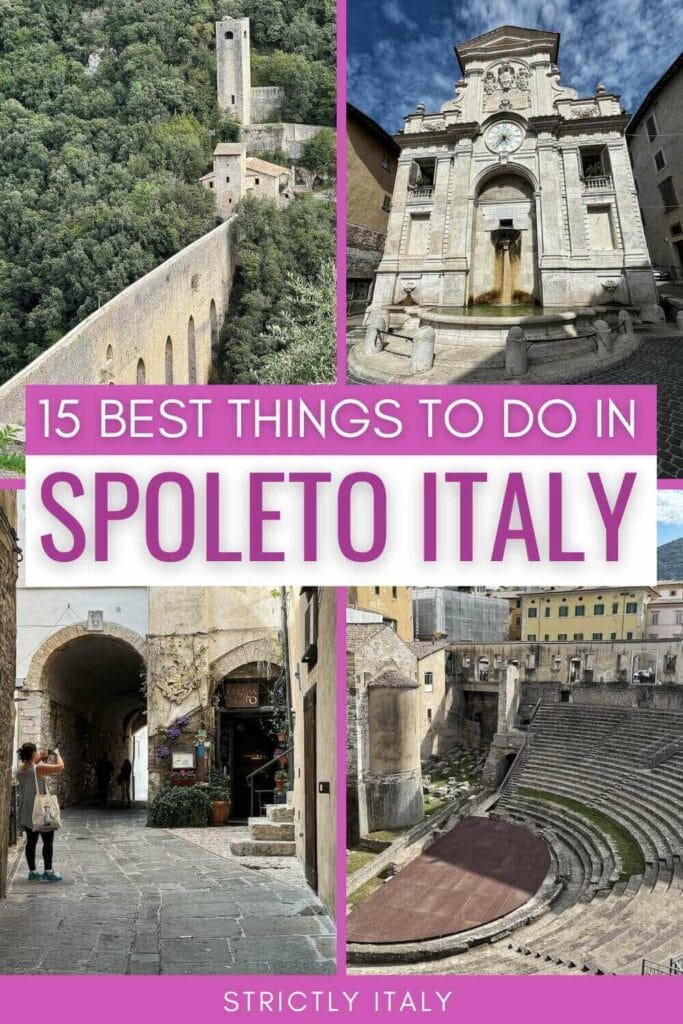
The Ponte delle Torri (Bridge of Towers) is an imposing bridge that connects Sant’Elia hill to Mount Monteluco, passing alongside the Rocca Albornoziana and ending in front of the Fortilizio dei Mulini.
The bridge – which is 80 meters/262.4 feet tall and 230 meters/754.5 feet long – worked both as an aqueduct, as it was meant to bring water from the mountain to the city, and connected the historic center of Spoleto to Monteluco.
Researchers suggest it was built in the mid-14th century, a time when the entire area underwent important changes promoted by Cardinal Albornoz and designed by architect Matteo Gattapone.
The bridge is divided into nine piers connected by ogival arches; the two highest piers were hollow and served as guard posts. The Fortilizio dei Mulini, located at the far end of the bridge in Monteluco, guarded the aqueduct where the waters fed two communal mills.
Numerous hiking trails that climb the Spoleto mountain start from here.
In December 2024, a ceremony was held to reopen the bridge, which can finally be crossed again: it remains one of the most popular things to do in Spoleto Italy.
Visit the Teatro Romano
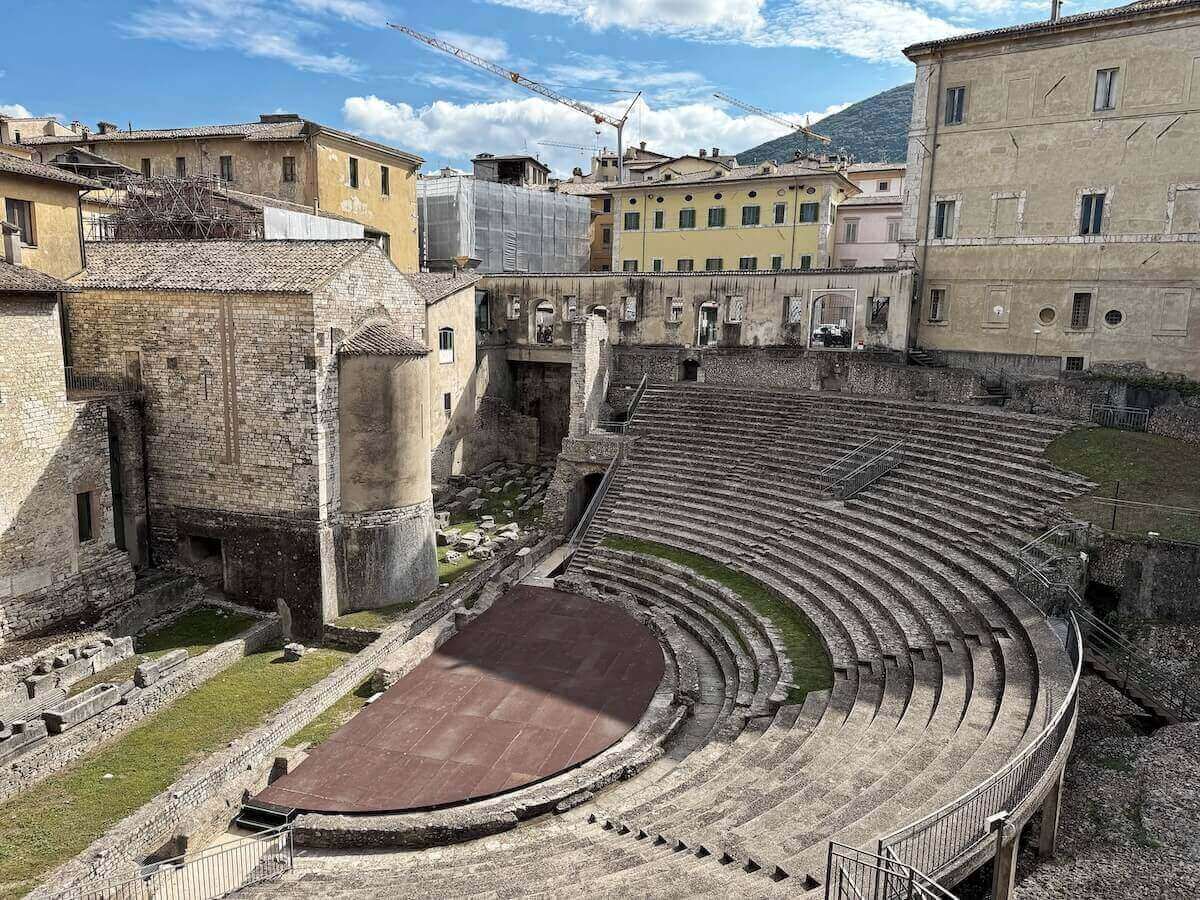
When my sister and I arrived in Spoleto, crossing Piazza della Libertà, we got a glimpse of the Roman Theater. We immediately decided to visit it.
The theater dates back to the second half of the 1st century BC and remained active until the 4th century. During the early Middle Ages, Corvi’s Palace (belonging to an important Spoleto family) and the Church of St. Agatha, where the Archaeological Museum is currently located, were built around it.
The theater was then used as a prison. When the Corvi building became a Benedictine monastery, the theater, which was then buried underground, became the cloister of the monastery.
In 1891, an archaeologist from Spoleto, Giuseppe Sordini, discovered the existence of the theater. The structure was then completely excavated and the building restored.

The lower floor is well preserved, but the stage was altered during the Middle Ages when St. Agatha Church was built.
Today, the theater has returned to its original function: during the Festival of Two Worlds, it hosts music and dance performances.
You will find several exhibits across the various floors. One is entirely dedicated to decorative sculptures, including a remarkable portrait of Augustus and Julius Caesar found during excavations to unearth the theater.
Tickets for the Roman Theater are included in the Spoleto Card and grant you access to the State Archaeological Museum, housed in the former Sant’Agata monastery.
Spot the Torre dell’Olio
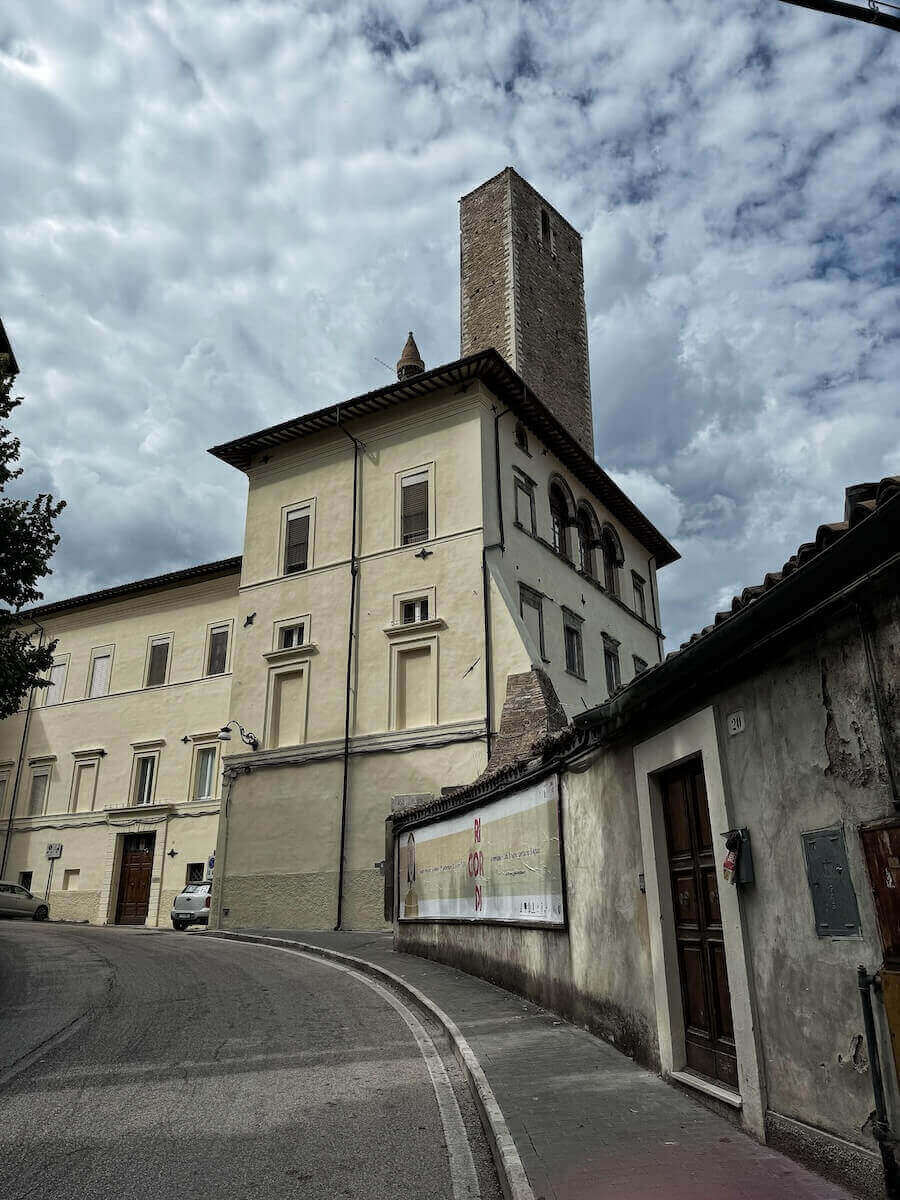
Walking through the historic center of Spoleto, you will spot the Torre dell’Olio, the tallest tower in town, with its 45.5 meters (about 150 feet).
Its name, Oil Tower, is due to the ancient medieval custom of throwing boiling oil from it to ward off enemies.
Legend says this system was used in 217 BC to halt the advance of Hannibal, a Punic general. To celebrate the event, the gate below the tower was named the Escape Gate.
The tower we see today, annexed to Palazzo Vigili, probably dates from the 13th century: in its place, there used to be another defensive structure. On its side, you can spot traces of the ancient consular road Via Flaminia.
Unfortunately, the tower is private property, so you can’t visit or climb it – you can just admire it from the outside.

Explore Piazza del Mercato
One of the liveliest squares in Spoleto is Piazza del Mercato. In the past, this was the center of public life, the site of ceremonies, town assemblies, and even executions.
This is where the forum stood in Roman times, though the square lost some of its width due to the construction of buildings in both medieval and modern times.
Between 1746 and 1748, the beautiful Fonte di Piazza was built by architect Costantino Fiaschetti. The lower part of the facade is composed of simple pilasters, while the upper part has a beautiful clock and a richly carved pediment with the four coats of arms of the Barberini family (that of Pope Urban VIII, whose name was Maffeo Barberini).
From the Square, it is easy to reach the main attractions and buildings of the city: the Roman House, the Town Hall, Campello Square, and the Duomo, so it is definitely a good starting point for sightseeing in Spoleto Italy.
Walk past the Arch of Drusus
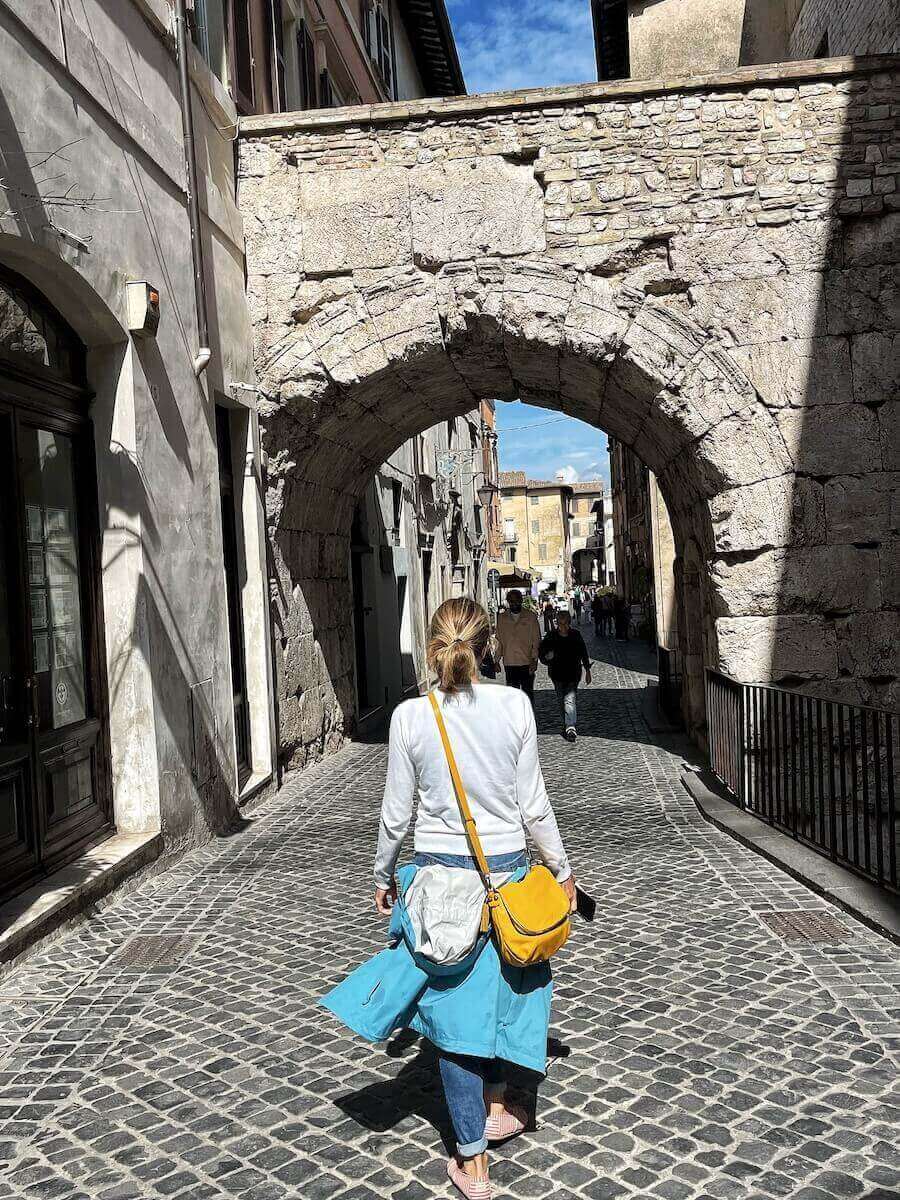
True to its Roman roots, Spoleto is home to the Arch of Drusus, a modest yet significant relic standing at the entrance of what was once the city’s forum. Built in 23 AD, the arch was dedicated to Drusus the Younger, son of Emperor Tiberius, and served as a gateway to the heart of Roman Spoleto.
The arch literally marked the entrance to Spoleto’s main square, where political, social, and commercial life thrived. Today, you really have to look for it as it sits tucked between later medieval buildings – but it’s close to the Piazza del Mercato, so you really can’t miss it.
For the best view, approach the arch from Via dell’Arco di Druso, where you can see how it connects with the older Roman street layout.
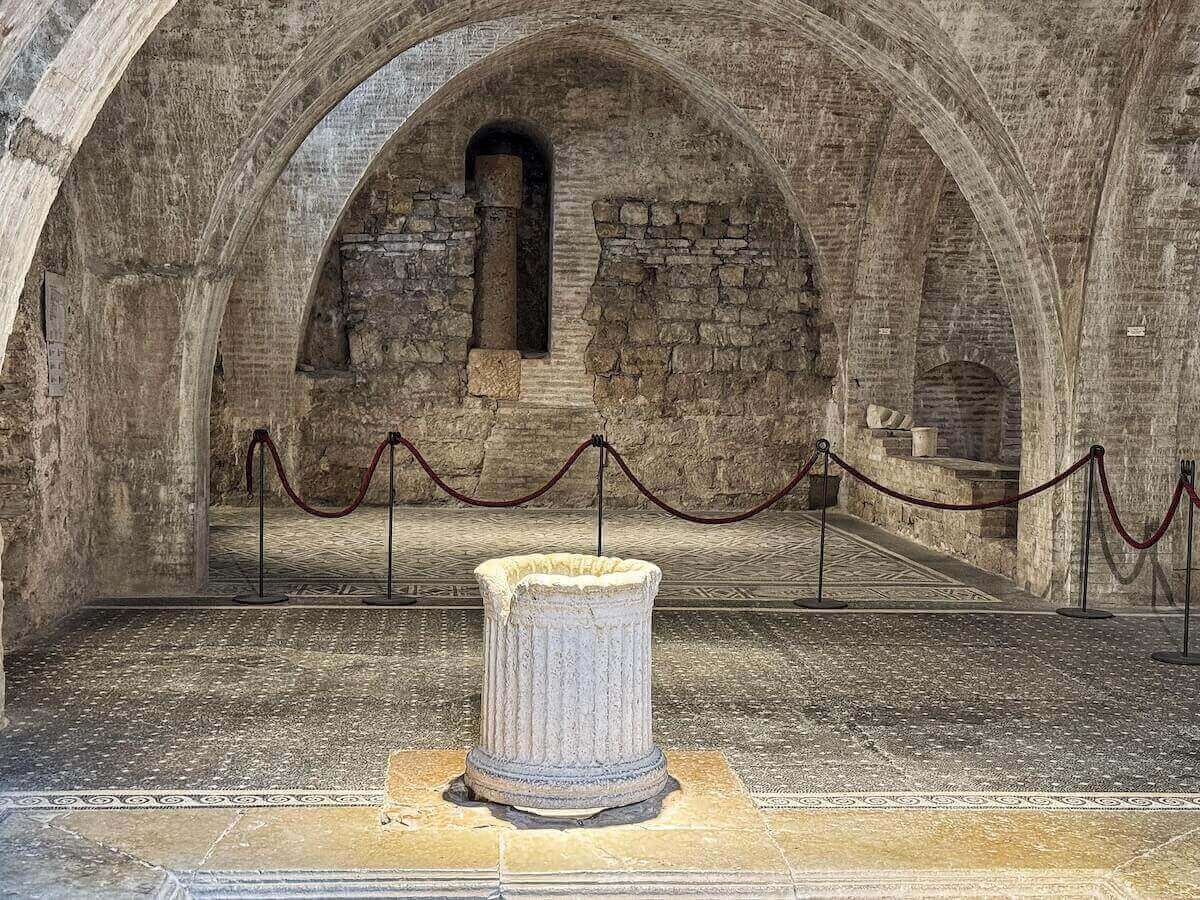
Visit the Casa Romana
Not far from Piazza del Mercato, or rather from what was once the Roman Forum, and precisely under the Palazzo Comunale, you can find a Roman House. Its location and decorations suggest that the owner was an important person.
Research shows the house belonged to Vespasia Polla, Emperor Vespasian’s mother, born in Norcia (nowadays Umbria) to a wealthy family and owner of many properties around Spoleto.
Archaeologist Giuseppe Sordini (the same one who uncovered the Roman Theater) carried out the first excavations to unearth the house in 1885.
The house dates from the 1st century AD, between the end of the Republican and the beginning of the Imperial age.
One of the most important features is the mosaic floor. Make sure to also spot the impluvium, the large quadrangular basin that collected rainwater coming in from the compluvium, a hole in the roof that served to collect rainwater and light the room.
You can also still see the bedrooms and the passage rooms and admire artifacts found during the excavations, such as ceramic pottery and amphorae, oil lamps, combs, and needles.
Admission is included in the Spoleto card.
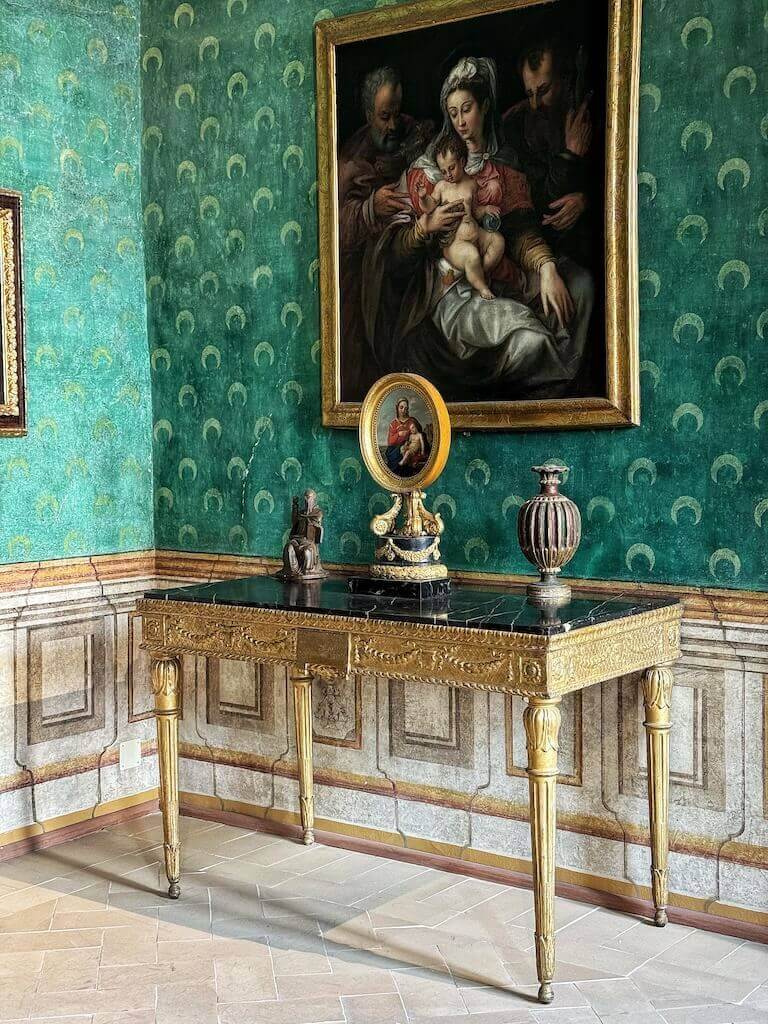
And Palazzo Collicola – Galleria d’Arte Moderna “G. Carandente”
Built between 1717 and 1730, Palazzo Collicola is one of the most important buildings in Spoleto.
During a period of economic and social fortune, Cardinal Francesco Collicola appointed architect Sebastiano Cipriani to design an imposing building of four floors, plus basement and attic, and 120 rooms and a beautiful Italian-style garden.
This splendid mansion hosted Charles of Bourbon, the future Charles III of Spain, in 1734.
The Palace now houses a modern art gallery. The ground floor is designated for temporary exhibitions.
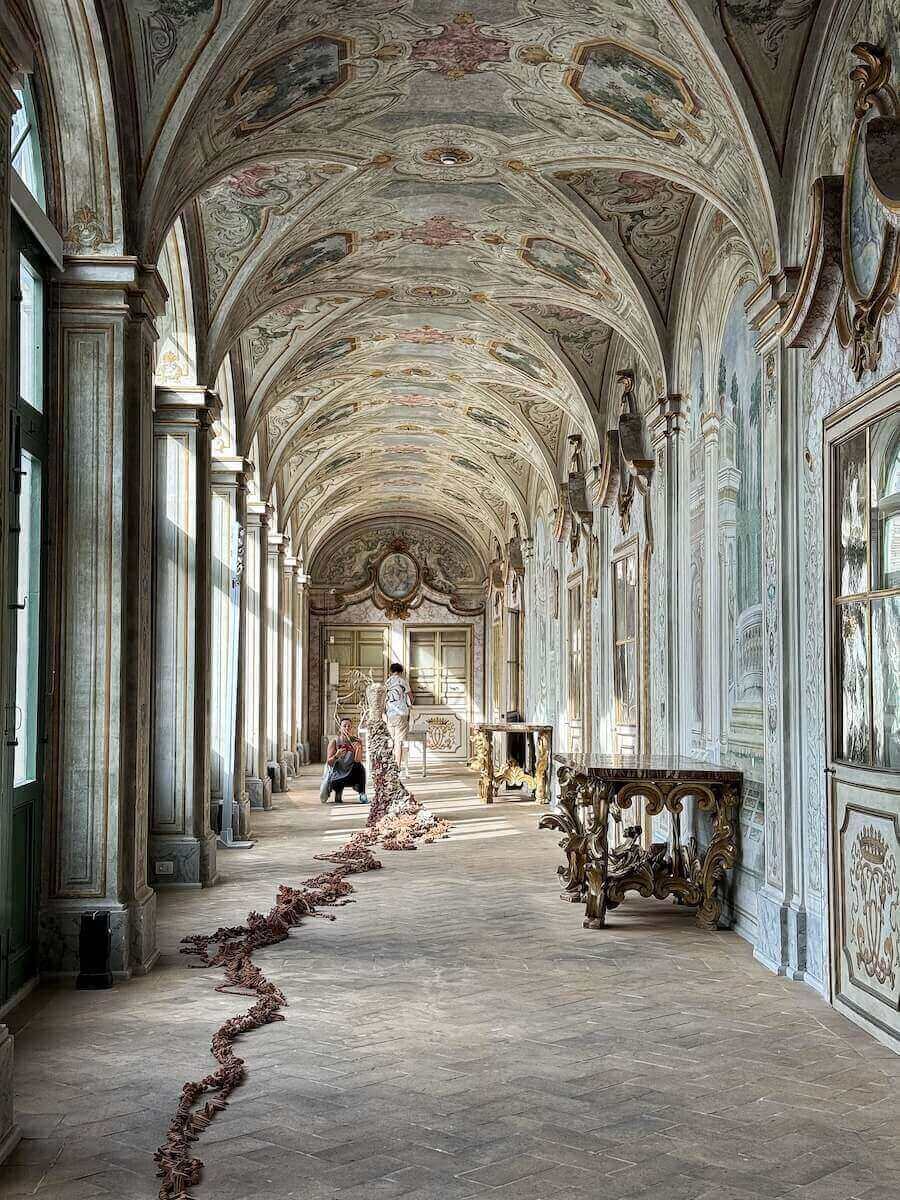
On the second floor, you can admire the wonderful 32-meter (105 feet) gallery, with one wall of stained glass and the others completely decorated in tempera, the salon, and many of the 18th-century furnishings and paintings.
On the first floor, there is also a library of more than 30000 volumes on modern art, donated by the art critic, collector, and historian, Giovanni Carandente.
The second floor houses paintings and sculptures by the most important Italian and international artists of the 20th century, such as Pomodoro, Burri, Consagra, Calder, Pepper, and Moore, just to mention a few.
Admission to the palace is included in the Spoleto Card.
Check out the Museo del Tessile e del Costume
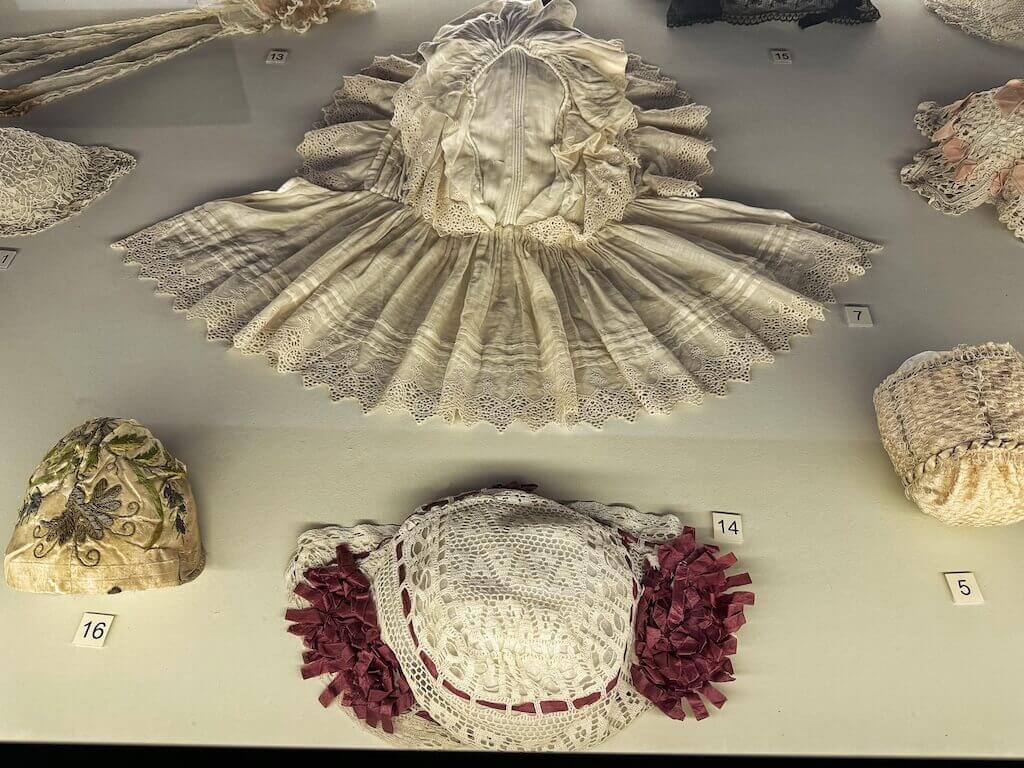
Located in the Palazzo Rosari-Spada, in the center of Spoleto, the Textile and Costume Museum displays a rich collection of fabrics, clothing, embroidery, and lace, dating from the 14th to the 20th century.
The first owner of the Palace, built between the 17th and 18th centuries, was the Rosari family: Virginio Rosari, who was elected cardinal in 1557. In 1664, the Palace became the property of the Marquis Spada of Rome – hence the name of the Palace.
The first room of the museum displays sacred vestments. You can admire the empire-style dress that belonged to Alexandrine Bonaparte, Napoleon’s granddaughter, and there’s an exhibit dedicated to accessories with a wide range of shoes and bags.
There’s also an exhibit dedicated to local textiles, among which the ancient “Perugian tablecloths” stand out.
Once again, admission to the museum is included in the Spoleto card.
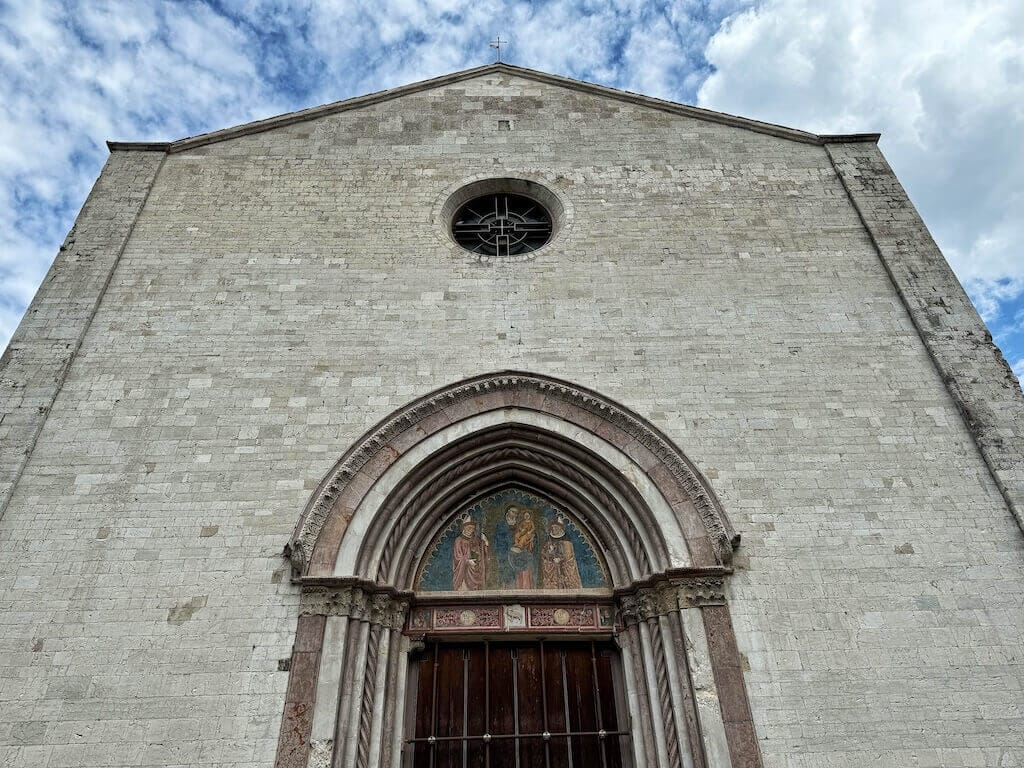
Explore the Complesso San Nicolò
Another attraction in Spoleto’s historic center that’s worth visiting is the San Nicolò Monumental Complex of 1304. It includes a church and a convent dedicated to San Nicolò, built on the area of two earlier religious buildings, as well as some private dwellings nearby.
Some suggest that even Martin Luther studied at the library of San Nicolò Complex.
In 1767, the monks abandoned the Church and the Convent after the damage caused by an earthquake. Over the years, the complex was used as a barn, a foundry, and a marketplace.
In the late 20th century, the complex was restored, and now it is a fantastic example of the early Gothic style.
The façade is rather simple, with a Gothic-style portal surmounted by a lunette with a fresco of the Madonna and Child between Saints Augustine and Nicholas.
The rose window above was unfortunately lost, while the two lions at the foot of the portal are preserved in the National Museum of the Duchy of Spoleto in the Rocca Albornoziana.
Inside, the walls are decorated with paintings, frescoes, and sculptures.
The former convent overlooks two cloisters: a 14th-century cloister with a splendid portico and a later, simpler cloister. The bell tower, which stood between the cloister and the church, was demolished in 1873 and replaced by a simple tower.
The Complex is now used as a conference and exhibition center, and it’s one of the settings of the Festival dei Due Mondi.

Eat gelato
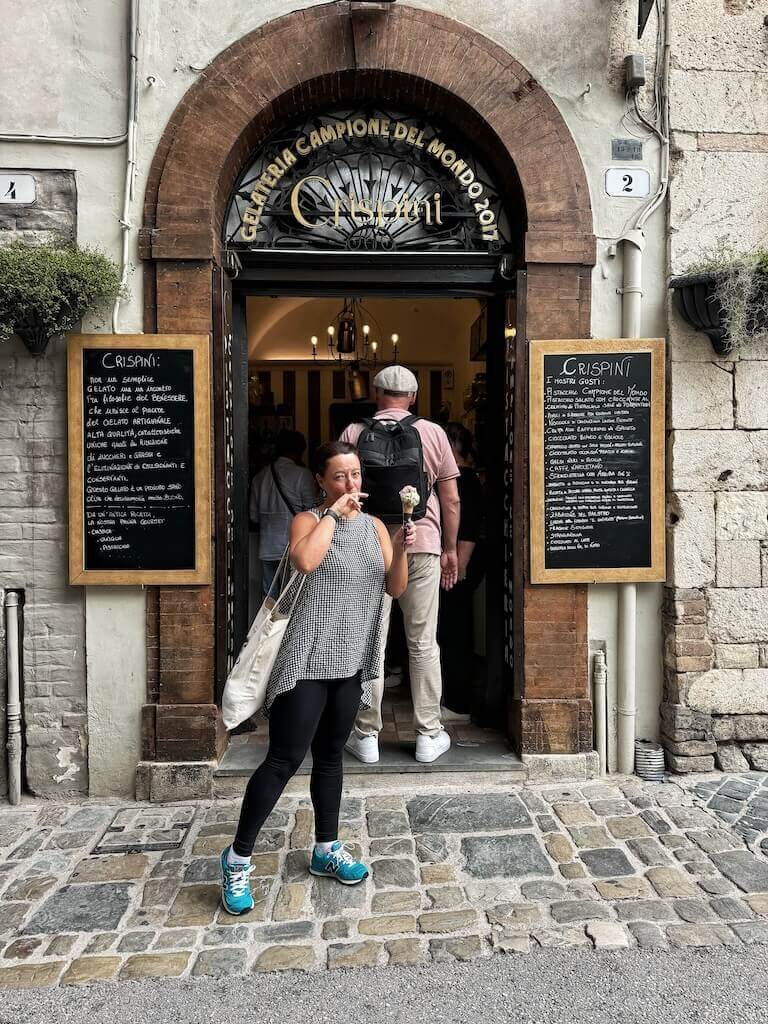
You don’t need any particular reason to eat gelato other than just wanting it. There are many good gelaterie in Spoleto. We tried Gelateria Crispini, next to Piazza del Mercato, and loved it.
In 2017, Alessandro Crispini’s pistachio was awarded the best flavor in the world during the Gelato World Tour Final. There are three varieties of Pistachio roasted for 24 hours, blanched with sugar and Madagascar vanilla. I tried it and it’s superlative.
Flavors vary depending on the season, as the products are fresh and of the highest quality. There are both regular gelato and fruit sorbets, and of course, vegan, lactose-free, and gluten-free flavors.
Tempietto del Clitunno
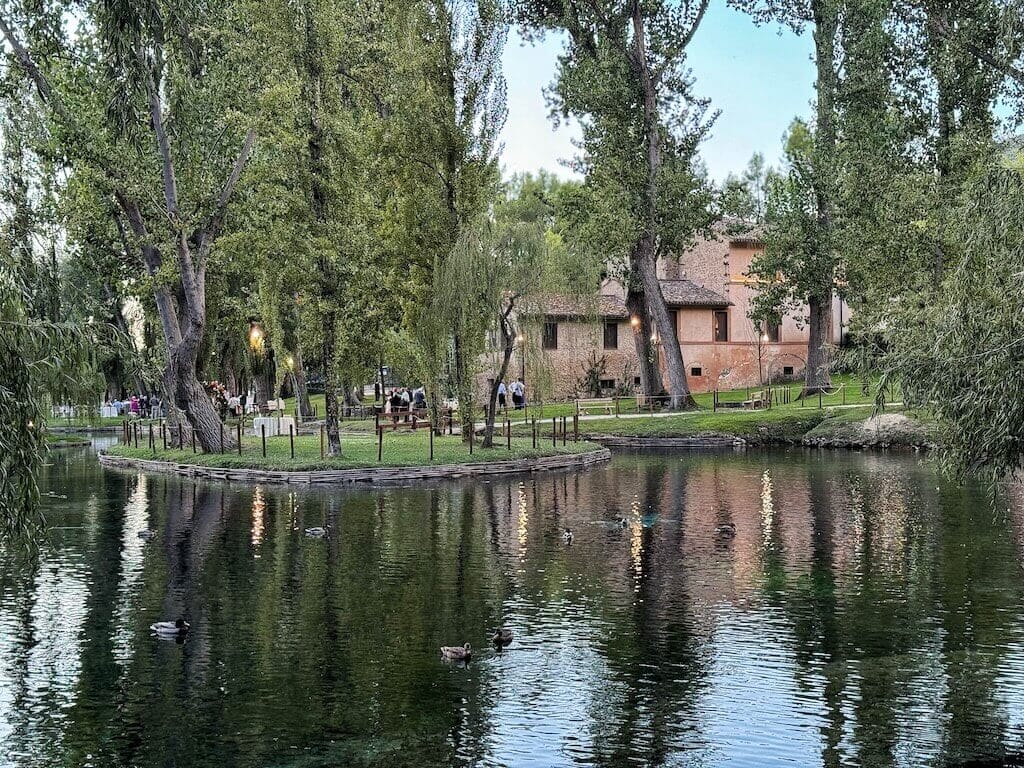
About half hour drive from Spoleto, in Campello sul Clitunno, you will find the Tempietto del Clitunno above one of the springs of Clitunno river.
Recent studies have dated this small temple to the early Middle Ages, between the early 7th and 8th century. It’s a UNESCO World Heritage Site since 2011.
Inside you will see frescoes depicting Christian themes. The apse has sculptural elements from the 1st century AD and carved slabs from the Lombard period.
Admission to the Tempietto is included in the Spoleto Card. Not far from the temple you can also visit the Fonti del Clitunno, a lovely park perfect for a relaxing walk.
Practical Guide
How to get to Spoleto Italy
Spoleto is one of the best places to visit on a day trip from Perugia. It’s just a 45-minute drive from Perugia, Umbria’s capital, so you can easily weave it in any Central Italy itinerary.
It’s also easy to visit on a day trip from Rome: there are direct trains from Rome Tiburtina that get you there in less than 1.5 hours.
Where to stay and eat in Spoleto
We stayed at the Domus Fontis Pescaia, which is a guest house in the historic center where rooms have views over the city. Rooms are clean, comfortable and spacious and there’s a fabulous breakfast waiting for you in the morning.
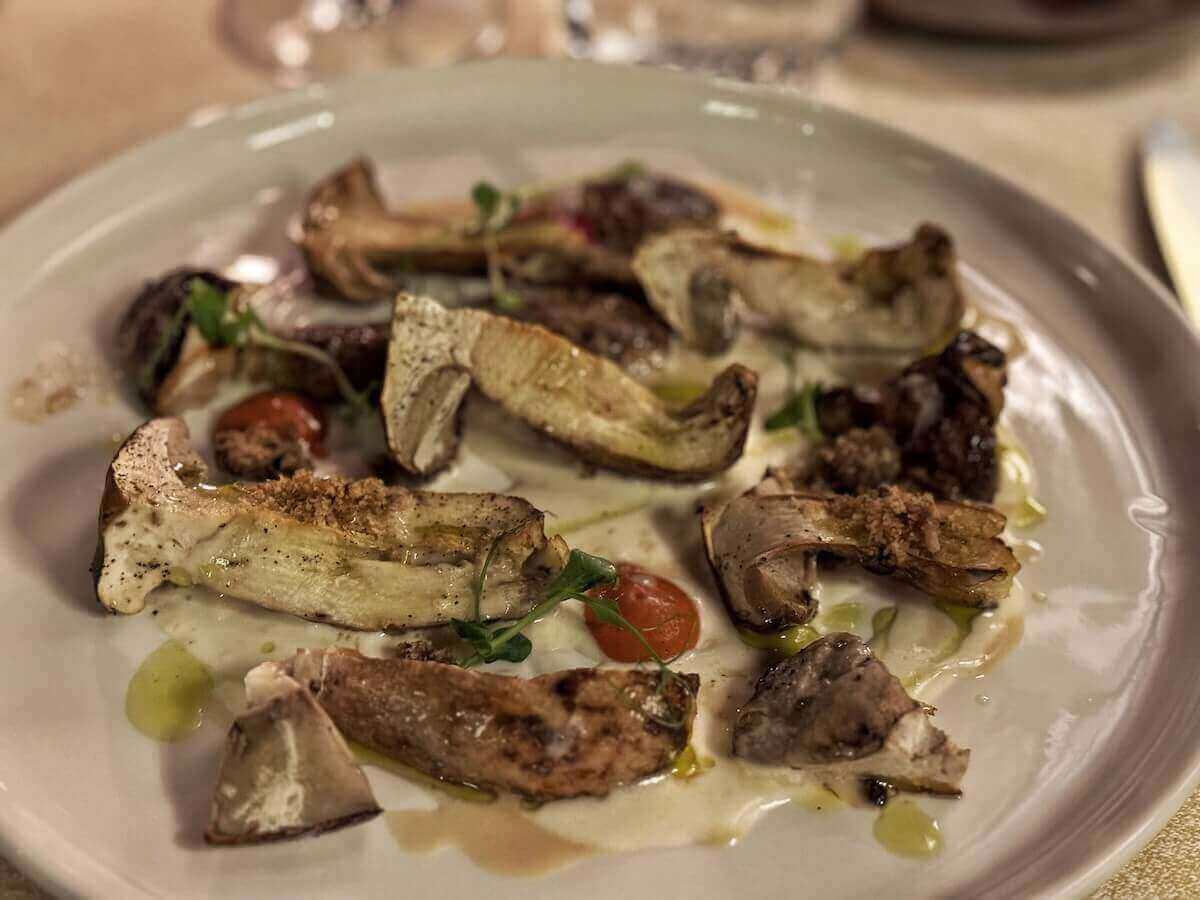
Other than gelato, we had lunch and dinner in Spoleto to take some of the best local specialties (remember that food in Italy is very regional), and we can wholeheartedly recommend these two places:
RISTORANTE APOLLINARE – Tucked in a quiet alley in the historic center, Apollinare features a classy and sophisticated location and offers dishes prepared with seasonal local ingredients. There’s an extensive wine list and service is spot on.
IL TEMPIO DEL GUSTO – Another lovely small restaurant in the historic center with a strong focus on local ingredients. Their revisited Carbonara is delicious.
FAQs on Spoleto Italy
Absolutely. Spoleto is easy to visit on day trips from Perugia (it’s just a 50-minute drive), and you can even visit it on day trips from Rome (there are direct trains from Rome Tiburtina station that will take you there in less than 1.5 hours).
Spoleto is a wonderful mix of Roman ruins and medieval architecture. Today, many visit Spoleto for its annual summer Festival dei Due Mondi (Festival of Two Worlds or Spoleto Festival), which has a strong focus on music, opera, theater, and dance.
I recommend renting a car for your Umbria trip – it’s the best way to get around this part of Italy, for sure. Having said that, Spoleto has a train station, so you can also get there by train.
When we visited, we drove to Spoleto and once there, we explored on foot. All in all, we found it to be a very walkable city. Just make sure you wear comfortable shoes.
Many will suggest that Spello is the prettiest town in Umbria, and I can’t disagree. This small town is packed with history, charming sights, and the historic center is incredibly pretty with its balconies adorned with colorful flowers.
Conclusions: Is Spoleto Worth Visiting?
I would say that Spoleto is one of the hidden gems of Italy. In the heart of the region of Umbria, it is significantly less known compared to places such as Orvieto and Assisi, which receive large crowds of visitors every year.
However, despite its size, Spoleto offers so much in the way of history, art, entertainment and good food. For many of the things to do in Spoleto mentioned in this post, you can take advantage of the Spoleto Card, which is valid for seven days.
We only spent one full day and one night in Spoleto, but one of my tips if you are planning a trip to Umbria is to consider spending a few days in this delightful small town – as you can surely appreciate after reading this post, there’s a lot to see and do to keep entertained.
If you enjoy nature, running, hiking and biking, you’ll find plenty of trails just outside the city. The most famous bike route is the Spoleto-Assisi, a long but entirely flat route, but you could also consider the Trasimeno ring road cycleway, or the Assisi Cycle Lane.
If you prefer hiking, the Giro dei Condotti is a hiking route of about three kilometers that starts from the Fortilizio dei Mulini and ends at the Church of San Ponziano, just outside the city walls of Spoleto, with beautiful views and surrounded by lush Mediterranean scrub.
Recommended Readings


Further Readings
Are you visiting Umbria soon? These other posts will help you plan your trip:
PIN IT!

Claudia Tavani
Claudia Tavani was born and raised in Sardinia, and after moving between the United States and the United Kingdom, she's now back living in her hometown, Cagliari. She's a travel blogger and certified travel designer who loves planning trips and publishing guides, travel tips, and packing lists so that you don't have to. Owner of Strictly Italy, cat mom to Minnie. Loves pizza, hiking, archeology, cities, beaches, swimming, and running. Hates peppers.