

Naples is less than an hour away from Rome by train, so a day trip from Rome to Naples is incredibly enticing.
You can get two birds with one stone and leave more room in your Italy itinerary for places of interest that are a little further away, like Florence, Milan, or Venice.
I’m usually not a fan of visiting such amazing Italian cities on a day trip, but Naples is easy to visit on day trips from Rome. Not only is it close to the capital, but many of the main attractions in Naples are within walking distance so you can see a lot in just a day.
Are you staying in Rome and looking for more places to visit nearby? My post The Best Day Trips From Rome is a must read.
Naples certainly deserves more than a day, but if you’re short on time and just want a taste of this incredible city, you shouldn’t miss out. Since I’ve spent a lot of time in Rome and the surrounding region, and I have also visited Naples in depth, I can share everything you need to know for an easy experience and have laid out an easy to follow itinerary.
Are you going on a day trip from Rome to Naples? These are the tickets and tours you need to book in advance to follow my itinerary:

Is A Day Trip To Naples From Rome Possible (And Is It Worth It)?
Absolutely, you can take a day trip from Rome to Naples, and it’s surprisingly simple to pull off. Thanks to Italy’s fast train system, it takes just over an hour to get from Rome to Naples by train.
This means you can spend a full day soaking up the sights, flavors, and energy of one of Italy’s most fascinating cities.
But is it worth it?
That depends on what you’re looking for. Naples is full of history, incredible food, and lively streets with their own charm. While there’s so much to see you would ideally need 5 days there, a single day still lets you dive into some of the city’s most famous spots.
If your schedule only allows for one day, don’t worry—you’ll leave with some amazing memories and maybe even a craving for more time in this unforgettable city. After all, you can always come back on another trip to Italy.
My post The Best Things To Do In Naples highlights the unmissable attractions and some lesser known ones too.

How much time you’ll need for a trip to Naples
Let me start by saying that a day isn’t enough to explore Naples. You can at most scratch the surface, get a feel for it and decide to visit again a bit more in depth another time.
An early start is key to making the most of a day trip to Naples from Rome. Plan to catch the first high-speed train from Rome, which departs around 7:00 am. This will get you to Naples just after 8:00 am, giving you a full day to explore.
If you’re wondering how much time you need, it depends on how much you want to pack into your day. Naples is a sprawling city with so much to see, so even with 8-10 hours, you’ll only be able to stick to the most famous attractions in the historic center.
But don’t let that discourage you. With careful planning, you can visit a mix of historic sites, enjoy a leisurely lunch, and take in the city’s vibrant energy.
If your day is tightly scheduled, aim to wrap up your activities by early evening so you can catch a return train to Rome. The last high-speed trains typically leave Naples around 8:30 pm, and there are slower intercity trains later, which means you have plenty of options for getting back.

Transportation options for a day trip from Rome to Naples
The two cities are about 225 kilometers (140 miles) apart, making it possible to get there and back in a single day.
By train
Taking the train is by far the fastest and most convenient way to travel in Italy. High-speed trains like the Frecciarossa or Italo connect Rome’s Termini station to Naples Centrale in just over an hour.
These trains run frequently throughout the day, but if you catch the first high-speed train at 7:00 am you can maximize your time in Naples.
Slower intercity or regional trains are cheaper but take up to three hours, which might not be ideal for a day trip to Naples.
By car
Renting a car and driving from Rome to Naples takes roughly two and a half hours, but navigating traffic in Naples can be difficult, and finding parking can be a real challenge.
Driving in Naples may be more stressful than convenient – lots of North American visitors find it hard to navigate the narrow streets of Italian cities, and feel overwhelmed by traffic.
Trains are faster and much easier for a short visit.

By bus
Buses are another affordable option for traveling from Rome to Naples – actually, it is the cheapest option. However, the journey takes around three hours, significantly longer than the high-speed train.
Buses typically depart from Rome’s Tiburtina or Anagnina stations and arrive at the city’s Naples Centrale or other central locations. While this option can save you money, it leaves less time to explore Naples, which can be a drawback for a day trip.
In other words: the bus is a viable option if you’re on a tight budget and don’t mind the extra travel time, but it’s not ideal if you want to maximize your time in the city.
Guided tours
Some companies offer day trips from Rome to Naples, often including additional stops like Pompeii or the Amalfi Coast. While these tours take care of logistics, they tend to feel rushed and leave little time to truly experience Naples.
If your priority is seeing Naples, it’s best to plan your trip independently. Otherwise, there are some options you may want to consider.
I recommend the From Rome: Pompeii and Naples Day Trip by High-Speed Train if you absolutely must visit Naples on a day trip. You won’t get the complete experience, but it’s about as good as it gets. The tour goes to Pompeii to explore its preserved ruins, followed by a visit to Naples to see landmarks like Piazza del Plebiscito and the Royal Palace. Along the way, you’ll enjoy authentic Neapolitan pizza and espresso, with some free time to soak in the city’s vibrant atmosphere.

The Perfect Day Trip To Naples Itinerary
Now, let’s look at my recommended itinerary for your Rome to Naples day tour.
Palace of Capodimonte
Start your day at the magnificent Palace of Capodimonte, a former royal hunting lodge turned art museum. Construction began in 1738 under King Charles VII, but it took over a century to complete due to the challenges of working with volcanic stone.
Today, the palace houses the Museum of Capodimonte, which boasts 124 galleries filled with masterpieces by artists such as Caravaggio, Titian, and Raphael.
Don’t miss the Farnese collection and the beautifully preserved period furnishings from the 1700s. To save time, take a taxi from Naples Central Station to the palace. Public transport is available but involves multiple changes, which can be a hassle.
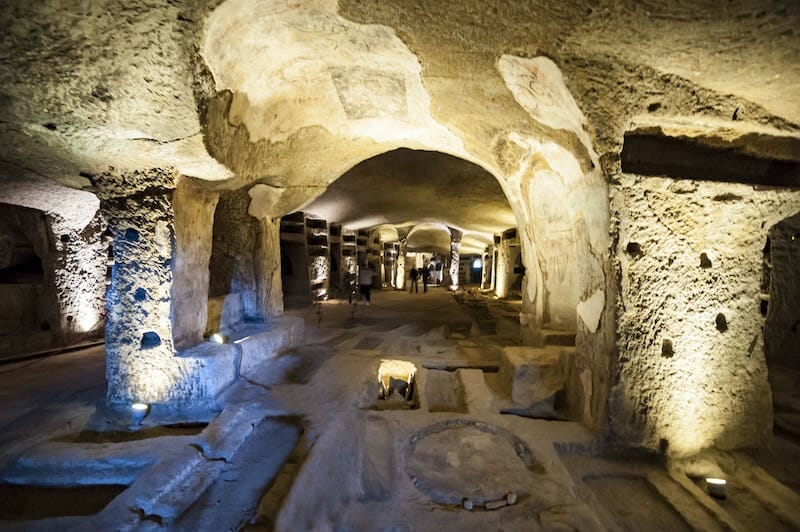
San Gennaro Catacombs
From the Palace of Capodimonte, it’s a short 15-minute walk to the Catacombs of San Gennaro.
These ancient burial sites, carved into volcanic rock, date back to the 2nd century AD. Expanded over centuries, the catacombs feature early Christian art, a basilica built in honor of Saint Agrippino, and a crypt where Naples’ patron saint, San Gennaro, was laid to rest.
Tours are required to visit and typically last around 45 minutes. It’s a cool 15°C (59°F) inside year-round, so bring a light layer if visiting in summer. Book your tickets in advance, as walk-ins are not allowed.
I recommend the Catacombs of San Gennaro Entry Ticket & Guided Tour. The tour takes you beneath the city to explore ancient burial sites, stunning frescoes, and some of the earliest Christian artwork in Italy. Along the way, your guide shares fascinating insights into 2,000 years of art and religious history, making this an unforgettable experience for history lovers. The tour departs every hour from 10:00 am so it’s easy to weave it into your itinerary.

Lunch at Sorbillo then walk to San Domenico Maggiore Church
After leaving the catacombs, head to the nearby Capodimonte bus stop and hop on bus 168. Get off after 8 stops at Pessina, then walk for about 10 minutes to reach Via dei Tribunali. You’ll find Sorbillo, one of Naples’ most famous pizzerie, here.
Sorbillo doesn’t take reservations, so you might have to wait, but the fresh, wood-fired pizza is worth it. After lunch, walk just a few minutes to the Basilica of San Domenico Maggiore.
This church, built on the site of a 10th-century structure, features a fascinating mix of Gothic and Baroque styles. You’ll find frescoes, ornate tombs, and the sacristy decorated with a stunning ceiling fresco by Francesco Solimena.
Allow 30–45 minutes to take in the details and the history tied to figures like Thomas Aquinas.
Museo Cappella Sansevero
From San Domenico Maggiore, it’s a quick 3-minute walk to the Museo Cappella Sansevero, a Baroque chapel turned museum that’s an absolute must-see.
This small but breathtaking site is home to intricate sculptures, including the famous Veiled Christ by Giuseppe Sanmartino. The detail of the marble veil draped over Christ’s figure is truly astonishing.
Other standout works include Disillusion by Francesco Queirolo and Modesty by Antonio Corradini. Each showcases delicate carvings of veils and textures that seem almost lifelike.
Photos aren’t allowed inside, so take time to soak in the incredible artistry. Visits typically last about 30 minutes, but you must book tickets beforehand.

Castel Nuovo
After visiting the chapel, walk about 8 minutes to the Museo subway station and take Line 1 toward Piazza Garibaldi. Get off at Municipio station, just a short distance from Castel Nuovo.
This iconic fortress, known as Maschio Angioino, was originally built in the late 13th century and later transformed by the Spanish rulers of Naples into a Renaissance-style stronghold.
Explore its massive fortified towers, the ornate marble triumphal arch at the entrance, and the Civic Museum inside. Highlights include the Palatine Chapel with its historic frescoes and a glass floor revealing ancient Roman ruins.
Guided tours of the castle’s terrace, dungeon, and ruins are available but must be booked in advance. Plan for about an hour here, depending on your interest in the exhibits.

San Carlo Theater and Galleria Umberto I
From Castel Nuovo, it’s a short 5-minute walk to the San Carlo Theater, the world’s oldest continuously operating opera house. Opened in 1737, its grandeur rivals that of La Scala in Milan.
Guided tours are available in Italian and English, providing access to its opulent interiors and fascinating history.
Galleria Umberto I is directly across from the theater. It is an elegant 19th-century shopping arcade with soaring glass domes and intricate ironwork. Built during Naples’ urban renewal efforts, the Galleria is a stunning blend of architecture and history.
Take a few minutes to admire the atrium – it’s magnificent.

Piazza del Plebiscito
Next, walk 5 minutes to Piazza del Plebiscito, Naples’ largest public square and the city’s heart. Lined with grand buildings like the Royal Palace and the Basilica of San Francesco di Paola, the piazza offers a chance to relax and take in the city’s history.
In the 1960s, this space was used as a parking lot, but today, it’s a beautiful gathering spot for concerts, events, or simply people-watching. Before continuing, consider stopping at the historic Caffè Gambrinus nearby for a pastry or espresso.
Castel dell’Ovo
From Piazza del Plebiscito, take a scenic 13-minute walk along the waterfront to Castel dell’Ovo, the oldest fortress in Naples. Its name, meaning “Egg Castle,” comes from a legend that the Roman poet Virgil placed a magical egg in its foundation, warning that if the egg were ever broken, disaster would strike the city.
Built in the 12th century by the Normans, this castle now serves as a cultural venue and offers panoramic views of the Gulf of Naples and Mount Vesuvius. While the interior is currently closed for renovations, walking around the exterior and medieval walls is still worthwhile.
Fountain of the Giant
Your final stop is the Fountain of the Giant, just a 5-minute stroll from Castel dell’Ovo. This ornate 17th-century fountain, originally located near the Royal Palace, was moved to its current location in the early 1900s.
Designed by Pietro Bernini and sculptor Michelangelo Naccherino, the fountain’s intricate marine motifs and triumphal arch design are a nod to ancient Roman influences.
Admire its craftsmanship and enjoy the peaceful setting by the waterfront. If time allows, this is a lovely spot to pause before returning to Naples Central Station in time to catch your train to Rome.
Tips For Planning The Perfect One-Day Trip To Naples From Rome
Book tickets and tours in advance
Naples is a popular destination, and many attractions—like the San Gennaro Catacombs and Museo Cappella Sansevero—require bookings. Securing your tickets beforehand saves valuable minutes and ensures you don’t miss out on key sites.
Online booking platforms like GetYourGuide or the official websites for each attraction (I have linked to them wherever relevant) are excellent options for hassle-free reservations.
There are so many great tours all around Naples. I’ve already recommended a few throughout this post, but here are some other of my favorites:
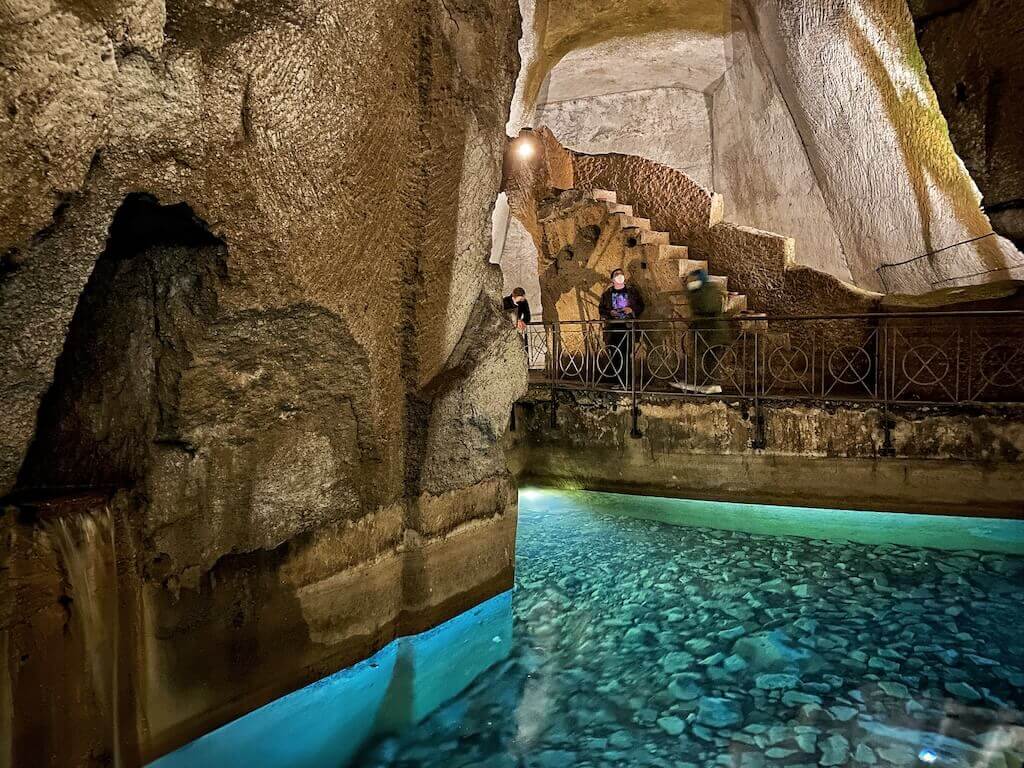
The Naples Underground Guided Tour is perfect for a unique journey beneath the city’s surface. This fascinating tour takes you through 2,400 years of history, including the Greek-Roman Aqueduct and the remains of the Roman Theater, while uncovering Naples’ hidden layers. You can add a pizza lunch or dinner for an extra treat to complete your experience.
The Street Food Walking Tour with Local Guide is perfect for food lovers looking to experience Naples through its vibrant culinary scene. This tour takes you through the historic center, sampling local specialties like pizza fritta and sfogliatelle while learning about the city’s rich culinary heritage. It’s a delicious way to combine sightseeing with authentic flavors.
Finally, the City Walking Tour with Underground Roman Ruins Ticket offers an in-depth look at Naples’ historic and modern treasures. It takes you from the lively streets of the city center to the fascinating underground Roman ruins of underground Naples. Along the way, you’ll visit landmarks like Castel Nuovo, the Royal Palace, and the bustling Spaccanapoli.

Consider timing and attraction schedule
Not all sites are open throughout the day, and some close on specific days of the week. For example, San Gennaro Catacombs are closed on Wednesdays. Double-check schedules while planning your itinerary to avoid surprises. To visit multiple attractions, consider time slots and plan your route accordingly.
Wear comfortable clothes and pack the essentials
Naples is best explored on foot, so comfortable shoes are essential. The city also has hills and cobblestone streets that can be tough to navigate in unsupportive footwear. If you’re visiting in the summer, breathable clothing and sunscreen are key to staying comfortable.
Bring a water bottle to stay hydrated, and pack a light layer for cooler spots like the catacombs. If you’re planning to visit churches, make sure your outfit covers your shoulders and knees—this is a standard dress code for religious sites.

Think about how you’ll get around Naples
While Naples is a walkable city, especially in the historic center, some attractions are a bit further apart and may require public transportation. I have given very detailed information on how to get from one place to another whenever using public transportation is needed, and you can use Google Maps whenever you are on foot.
When planning longer routes, like Naples Centrale to Capodimonte or Piazza del Plebiscito to Castel dell’Ovo, Google Maps can guide you to the nearest transport options.
The city’s metro system is reliable and easy to navigate. The cheapest option for a full day is to purchase a 24-hour transport pass: it covers unlimited rides on the metro, buses, and funiculars.
If you’re unsure about timing, Google Maps will show you when the next train or bus arrives and suggest the best transfer points. Type in your destination, choose “Transit,” and let it handle the details.

Use the Naples Pass
The Naples Pass gives you access to several important sites and includes public transportation for the day. I recommend it if you are staying in Naples for more than a day, but you may find use for it even for a shorter time.
With the pass, you can visit:
- Pompeii, where you’ll see the theater, ancient homes, and public baths preserved by the eruption of Mount Vesuvius (though keep in mind you don’t have time to visit if you are only in Naples for a day).
- The National Archaeological Museum holds mosaics, statues, and artifacts from Pompeii and other historical sites.
- Naples Underground features an aqueduct that supplied the city with water for centuries, Bourbon-era drainage tunnels, and even Emperor Nero’s private theater remains.
The pass also includes a 10% discount for places like Herculaneum and the Royal Palace of Caserta. Tickets are easy to book online, and everything is sent directly to your email, making it simple to plan your visits.
Final Considerations
A day trip from Rome to Naples is absolutely doable with some planning. Start your journey early to maximize your time, and use high-speed trains for quick and convenient travel.
Stick to a well-thought-out itinerary that balances iconic landmarks like the Palace of Capodimonte, San Gennaro Catacombs, and Castel dell’Ovo with moments to enjoy Naples’ vibrant streets and incredible food.
I’ll admit, I’m usually not a big fan of day trips—especially to a city like Naples that has so much to offer. It’s similar to visiting Milan in a single day: while you won’t see everything, it’s possible to cover the highlights if you’re well-organized. And, of course, you can always plan to return for a deeper dive into this unforgettable city.
PIN IT!


Claudia Tavani
Claudia Tavani was born and raised in Sardinia, and after moving between the United States and the United Kingdom, she's now back living in her hometown, Cagliari. She's a travel blogger and certified travel designer who loves planning trips and publishing guides, travel tips, and packing lists so that you don't have to. Owner of Strictly Italy, cat mom to Minnie. Loves pizza, hiking, archeology, cities, beaches, swimming, and running. Hates peppers.