
Toll roads in Italy, or autostrade italiane, are the major paid roads connecting the country. They cover Italy, connecting the north to the south and the east to the west.
They’re one of the best ways to travel in Italy if you’re renting a car and have the budget for them. The roads are well-maintained, smooth, and fast.
However, if you’re unfamiliar with Italy’s motorways, you might feel a bit lost at first. Things aren’t always marked and clear in English, so it can be daunting. Autostrade Italiane aren’t exactly the same as the highways in the United States or other parts of Europe (or at the least, they feel different if you aren’t from here).
And I’m speaking from experience. Even though I’m from Italy, there are no toll roads in my home region of Sardinia, so I wasn’t super familiar with them growing up. But as an adult, I’ve traveled all over my country, including on many of the main toll roads in the country.
So, in this guide, I’ll share everything you need to know about Italian toll roads, including how they work, where they are, roughly how much they cost, and other useful things to know.
Are you thinking of driving in Italy? I recommend using Discover Cars to book your car rental. It’s my favorite comparison site when it comes to looking for the best car rental deals. I have used them widely in many countries (including Italy of course) and highly recommend them.
My post A Complete Guide To Renting A Car In Italy will guide you through the process of picking the best rental car for your needs.

What Are Autostrade Italiane? Toll Roads In Italy
Italy toll roads, or highways in Italy, crisscross the country. In Italian, they are called autostrade (plural) or autostrada (singular).
They are owned and maintained by private companies that charge for their use. In return, the roads are maintained, secure, and easy to navigate.
There are usually two to four lanes in each direction and a higher speed limit than on a free motorway (called superstrada in Italian). While toll roads tend to be generally faster than regular motorways or provincial roads, there can be quite a bit of traffic, especially around the peak national holidays and during the weekend, and there can be a line at the exit.

Italian toll roads are marked by a green sign that says autostrada. The letter A is followed by a number (the official number of the marked toll road). For example, autostrada A3 connects Napoli to Salerno.
You might also encounter a raccordo, which is also marked by a green sign. A raccordo connects to the Italian motorway from another city, so it’s like an in-between road that will bring you to the autostrada.
Are you planning your road trip to Italy? If you’re looking for a rental car company, I recommend Discover Cars. It’s a great international rental car service that I’ve used many times in Italy abroad. You can compare cars and rates, get insurance information, and so much more.

Should You Use Italian Toll Roads?
Generally speaking, Italian toll roads are very convenient if you’re driving across Italy. They are efficient, safe, and, most of the time, very smooth sailing. So, they are a good option for traveling across Italy by car.
However, these motorways aren’t for everyone. Here are a few advantages and disadvantages of using these paid highways:
Advantages of using toll roads:
- Speed for long-distance travel: They are typically well-maintained from start to finish, so it’s easy to travel long distances across the country.
- Reduced traffic (for the most part): Italy’s toll roads have less congestion than local roads, and the journey is much more predictable. Beware that traffic and lines at the exit increase during peak holiday days and weekends in the summer.
- Safety: Toll roads are also known for their high safety standards, including frequent maintenance and monitoring for traffic/speed violations.
- Direct routes: They often offer more routes to major Italian cities and destinations, reducing travel time and complexity.
Disadvantages of using toll roads:
- Cost: Toll roads require payment, which can add up, especially for long-term travel, so it’s not the best option for ultra-budget travelers.
- Confusing ticket system: If you haven’t traveled on toll roads here before, the ticketing system might initially be confusing and intimidating (don’t worry, I will explain more in about it in a bit).
- Limited access across the country: The toll roads only connect the main places in Italy, not so much the lesser-known or smaller destinations, so they’re a little more limiting. It means you still have to drive on state roads, provincial roads and local roads at times.
To summarize, toll roads best fit those traveling long-distance in Italy between major destinations and are not on a super tight transportation budget.

How Do Toll Roads Work?
How to enter
Follow the autostrada signs onto the highway. Before you officially get on the motorway, you’ll have to go through a booth. Two lanes lead up to the ticket booth: Biglietto and Telepass, and you must be in the correct lane.
Biglietto is likely where you want to be. Biglietto means ticket. This is the lane where you’ll get a physical ticket from the toll booth.
Telepass are car passes that some people have in their cars. Only go in this lane if your rental car company specifically told you they have a Telepass – most car rental companies don’t provide one.
So, get in the biglietto lane, drive up to the toll booth where you’ll receive a small piece of paper, go through, and follow the signs (and Google Maps) to your desired destination. The road usually splits in two directions immediately after entering, so make sure you know which direction you’ll be going.
You need to keep the printed ticket you received, so make sure to put this in a safe place. You’ll return it upon exiting. It marks where you entered the motorway.

How to pay and exit
Toll roads exits are uscite in Italian. When you see your exit coming up, you’ll have to move into the furthest right lane and take a slight right to exit the motorway.
Upon exiting, you’ll come across another set of toll booths with three lanes to choose from: Telepass, Carte, and Cash (this is usually shown with a symbol of money).
Again, only get into the telepass lane if you have the toll box in your car. Most car rental companies do not have one, so you probably won’t.
Carte lane is for paying with a card. These are automated booths, so no one can help you, but it’s straightforward. The machine is on the driver’s side. You’ll first insert the ticket, check the amount owed, and then insert your card. Once the machine reads “Grazie,” you’re all set.
The cash lane is for paying with cash. There are usually two or three cash lanes, one or two automated lanes, and one staffed lane with a person working. They are labeled accordingly with an image.
It’s just as simple as with a card. If you’re in the automated lane, you’ll insert your ticket. The machine will tell you how much you owe, insert your bills, and retrieve your change. If you are in the staffed lane with someone, just hand them your ticket, pay them, and grab your change.

Useful Things To Know About Italy Toll Roads
Speed limit on Italian toll roads
The speed limit on most toll roads is 130 km/h (80 mph). When the weather is bad, it is 110 km/h (there’s usually a 20 km/h reduction during bad weather).
In Italy, toll roads usually have two or three lanes arranged in order of speed. The “slowest” lane is further right, where lower-speed vehicles travel. The middle lane is the middle speed, and the furthest left lane is for the fastest cars and the ones you are meant to use to overtake. Try to stick to the appropriate lane for your speed.
If you’re a speed demon, be careful of the autovelox. This is a machine that checks for speeding. If it catches a speeding vehicle, it takes a photo of your car and sends in a fine for speeding (and yes, you have to pay it even if you’re renting a car: the car rental company will notify if you get a ticket, and you are expected to pay).
There’s a 1km warning sign before the autovelox. However, police officers with radar guns can also check speeds without giving a 1km notice.
There’s also the Safety Tutor. This speed checkpoint measures your distance traveled and time spent between two points to determine whether you’re speeding.
The best thing to do is just not to speed.
Want to avoid traveling to Italy with bad weather, large tourist crowds (and lines at the exit of autostrade italiane) or simply want to know more about the seasons in Italy? Read my article, When Is The Best Time Of Year To Visit Italy?

Road signs on toll roads
One of the most confusing things about traveling to a foreign country with a different language is trying to get around without your home language. Fortunately, most signs on toll roads use images and symbols rather than words.
Here are some of the most important signs to recognize and what they look like:
Identifying the road: A green, rectangular sign with white text indicates that the road is an Italy toll road.
Signs upon entering: When you enter the toll road, you’ll see lanes labeled biglietto (ticket) or Telepass. You should be in the lane labeled biglietto, where you’ll get your ticket.

Signs upon exiting: White signs point to the cash lane, blue signs indicate payment via card, and yellow signs indicate Telepass. The white signs usually illustrate cash lanes where someone from staff is present (or not).
Speed limit and traps: The speed limit is usually easy to identify. It’s a circular, white sign with black numbers indicating the speed limit (in kilometers per hour). The autovelox is a white sign with a police officer figure in black (this is the sign that warns you of an upcoming speed sensor). The Safety Tutor speed sensors will also be labeled on a green sign with white and “Polizia Stradale” written on it.
The purpose of things like the Safety Tutor is to keep the roads safe, and they actually work with drastically reducing speeds and possibly accidents, so don’t get bitter about them. Italy is a safe place. Let’s keep our roads safe, too.
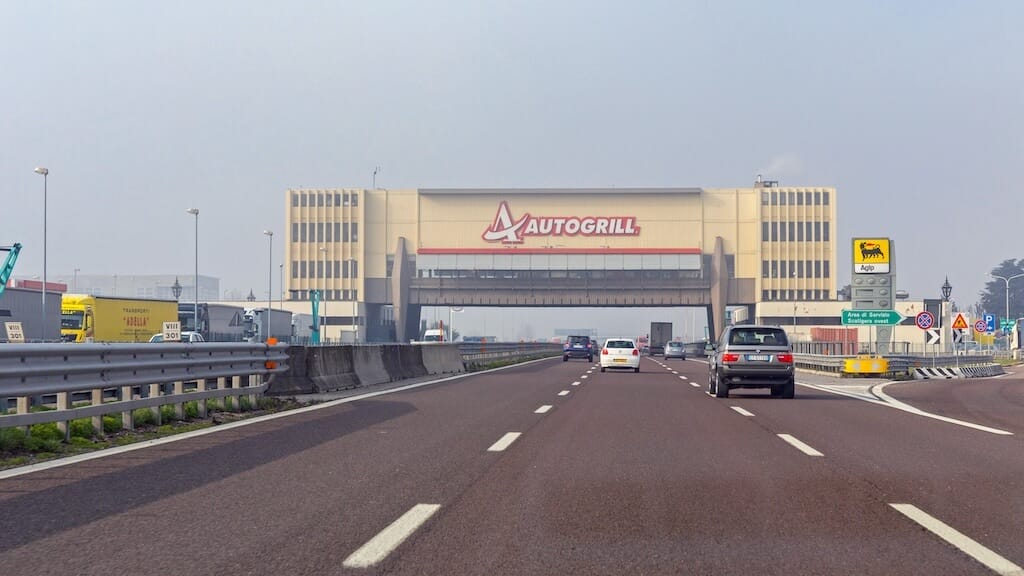
Where to eat on Italian toll roads
There are tons of restaurants and places for a quick bite right on all toll roads around Italy; you won’t even have to exit. Most service gas stations have a small restaurant, bathrooms, and sometimes even a grocery store, newsagent and souvenirs shop.
The most famous service station is the Autogrill, which is like an all-inclusive rest stop. There are a few different places to get food, a gas station, and clean bathrooms. You won’t find five-star restaurants with a variety of all the best regional cuisine, but there are usually decent sandwiches, a self-service restaurants with various options, and a few other snack-type foods.
Keep in mind that the food (gas and other amenities, too) will be more expensive on the autostrade. You’re paying for the convenience of not having to leave the toll road.
Read my article, Common Misconceptions about Italian Food, before trying the local cuisine in Italy for the first time. You don’t want to fall for the “food traps”, order the wrong thing, or arrive with wrong expectations.

Where to get gas on toll roads
The service areas, where you’ll find food, also have gas stations. Most of the time they are spaced nicely, so you shouldn’t worry about running out of gas.
You will see warning signs and other helpful information beforehand along the highway that tell you how far away the gas stations are. But if you’re super worried about missing one, you can head over to the official autostrade website for a list of all the service areas on the different motorways.
One thing I need to point out is that the gas on the autostrade is more expensive, so I recommend filling up before getting on the toll road.
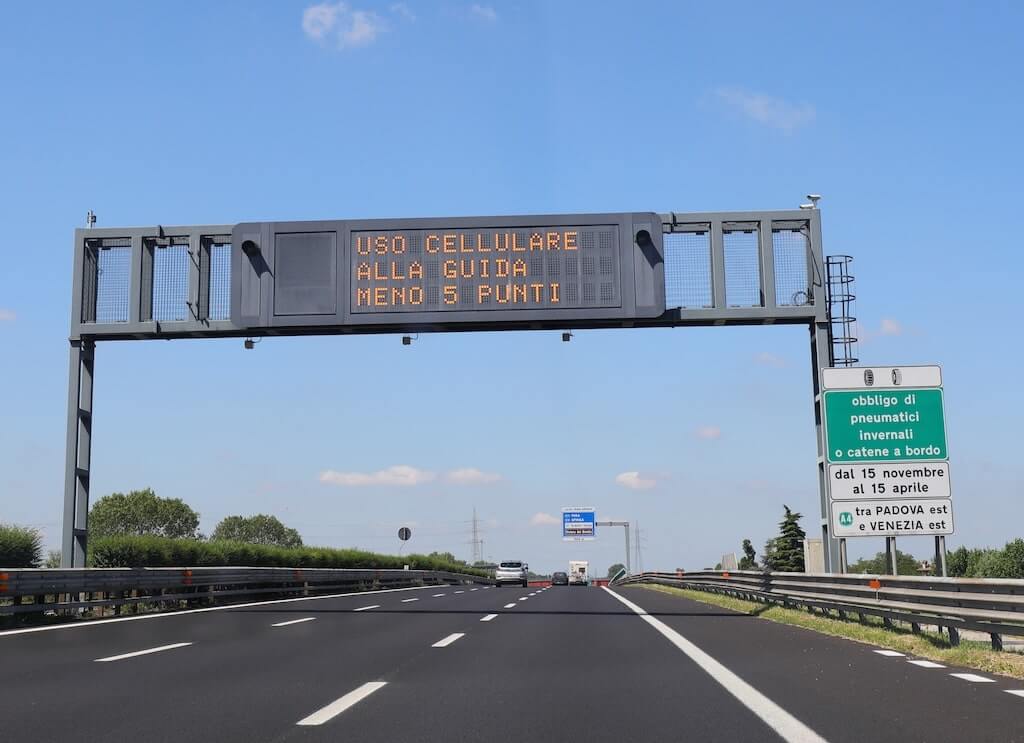
What if you have an electric car?
Electric vehicles are increasingly popular across Europe. Fortunately, most toll roads in Italy have scattered electric charging stations, and more are added each year.
There are much fewer charging stations at gas stations in the south, and sometimes, you might have to exit the highway to find the nearest station. However, if you’re lucky, you might stumble across one of the supercharging stations on some autostrade, which are fast and efficient.
If you’re renting an electric vehicle, the rental company will give you a list of all accessible charging stations, usually an app to check where the charging stations are and any other information you need before leaving the rental lot.
Many people in Italy use NextCharge, a popular charging app that allows you to manage payments. PlugShare is another really popular app that can help you track and find charging stations.
Get this information and plan around it. The last thing you want to do is spend an afternoon hunting for a charging station and feeling anxious if you can’t find one.

How much do Autostrade Italiane (Italian toll roads) cost?
The exact toll amount depends on how long you drive on the toll road. The longer you drive, the more it costs. There is a toll calculator on the official autostrade italiane website which is useful. All you have to do is enter your entry and exit points, and it will tell you how much your toll will cost. It also tells you about road closures, service areas along your route, and traffic conditions.
Here are a few examples of toll costs for popular routes in Italy:
- A1 Milano Sud-A1 Napoli Nord: A1 is Italy’s most trafficked toll road, connecting Milan to Naples and passing by several other popular Italian cities. If you drive from Milan to Naples (775 km/482 miles), the toll costs around €60.
- A1 Milano Sud-A14 Bologna Borgo Panigale: €16
- A12 Pisa Centro-Florence: €2.90
The A2 motorway in the south of Italy is the only toll-free highway. It connects Salerno and Reggio Calabria. If you’re uncertain about payments, just check the website and use their calculator.

Emergency numbers
If you have an emergency on an Italian toll road, you have many resources at your disposal. On the right side of the road, there are frequent emergency pullout sections with an emergency phone you can use to ask for help.
Here are some useful emergency numbers:
- 112: This is equivalent to 911 in Italy. It’s the go-to number for all big emergencies. The operator can connect you with the most appropriate authority for your emergency and location. There is English speaking staff on the phone.
- 113: Italian police.
- 118: Ambulance.
- 911: If you’ve forgotten all Italian emergency numbers, dial 911, and the phone operator will redirect you to 112.
- 803.116: This is Italy’s Automobile Club, which offers roadside assistance. Call them if you’ve broken down.
- Your rental car company: Make sure to write down the number of your rental car company (you should have it in the contract, which you should keep in the car anyways). If there are any problems with the car or you simply need a local to help you through some trouble, they’re a great resource to call.

Traffic information on toll roads in Italy
Toll roads are a little better than other roads in terms of traffic but aren’t perfect. They can get pretty congested, especially if there’s construction, you’re traveling during a holiday, rush hour, or something else is happening. A lot of trucks drive on the toll roads, which adds to the congestion.
Try to avoid driving during rush hour (in the morning and evenings when people are commuting to work) and at the beginning or end of the weekends around popular summer destinations. You can also save long-haul trips for a Sunday when trucks aren’t allowed on the toll road.
Your absolute best resource for checking traffic conditions is the autostrade website. There are live webcams, traffic updates, and up-to-date notices about road conditions.
For example, today, there are several notices. One of them reads: “A12 GENOVA-ROMA
LAVAGNA – road entry closed (at km 41.1 – Direction: Rosignano) road entry closed at Lavagna entrance towards Livorno, due to an accident.” As you can see, it tells you exactly where the entry is closed, why it’s closed, and the direction.
You can also use Google Maps to check road conditions. Their time estimation services are usually pretty accurate, and they tell you real-time traffic conditions.

Useful Italian words to know for the autostrade
Learning basic Italian is a useful tip before traveling to Italy, and it can come in handy if you’re driving on Italy’s toll roads. Here’s some Italian vocabulary that may come in handy:
- Autostrada/Autostrade: Italian toll road
- Casello: Toll station
- Biglietto: ticket
- Telepass: Telepass (automated entry)
- Contanti: Cash
- Monete: Coins
- Autogrill: Rest area with a gas station, food, and bathrooms
- Benzina: petrol, gas
- Piazzola di sosta: Emergency pullout
- Limite di velocità: Speed limit
- Multa: Fine (ticket)
- Entrata: Entrance
- Uscita: Exit
- Sinistra: Left
- Destra: Right
- Aiuto: Help
- Corsia: Lane
Here are some phrases if you’d like to talk to someone at the service station or toll booth:
- Scusi: Excuse me
- Grazie: Thank you
- Parla inglese? Do you speak English?
- Non parlo italiano: I don’t speak Italian
- Scusi, non ho capito: Sorry, I don’t understand
- Dov’è il bagno? Where’s the bathroom?
- Ho perso il biglietto: I lost the ticket
- Sono entrata a…: I entered at…
One of my biggest tips for those traveling to Italy for the first time is to learn some basic Italian. If you want to read all my other tips, check out my article, Must-Read Travel Tips For Italy. You’ll find tons of useful information before your upcoming trip.

List of Toll Roads In Italy
Here’s a complete list of all toll roads in the country, the official name and nickname, the starting and ending points, the distance from start to finish, and some other destinations near the route:
| Autostrade Name (And Alternative Name) | Start – End Points | Km (Miles) From Start to Finish | Destinations Near the Route |
| A1 (Autostrada del Sole) | Milan – Naples | 760 km (470 miles) | Bologna, Florence, Rome |
| A2 (Autostrada del Mediterraneo) | Salerno – Reggio Calabria | 432 km (268 miles) | Cosenza |
| A3 | Naples – Salerno | 53.6 km (33.3 miles) | Cosenza |
| A4 (Serenissima) | Turin – Trieste | 523.1 km (325 miles) | Milan, Vicenza, Verona, Venice |
| A5 (Autostrada del Monte Bianco) | Turin – Aosta | 143.4 km (89 miles) | Volpiano, Ivrea |
| A6 (Autostrada Verdemare) | Turin – Savona | 124.3 km (77.2 miles) | Alba, Astigiano |
| A7 (Autostrada dei Giova) | Milan – Genoa | 135.5 km (84.2 miles) | Ovada, Tortona |
| A8 (Autostrada dei Laghi) | Milan – Varese | 43.6 km (27.1 miles) | Lainate, Gallarate |
| A9 (Autstrada dei Laghi) | Lainate – Como | 31.5 km (19.5 miles) | Lomazzo |
| A10 (Autostrada dei Fiori) | Genoa – Ventimiglia | 158.1 km (98.2 miles) | Northern Liguria Italian Riviera |
| A11 (Autostrada Firenze Mare) | Florence – Pisa | 81.7 km (50.8 miles) | Prato, Pistoia, Lucca, Valdinievole |
| A12 (Autostrada Azzurra) | Genoa – Rosisnano, Civitavecchia – Rome | 275.4 km (171.1 miles) | Pisa, Lucca, Livorno |
| A13 | Bologna – Padova | 116.7 km (72.5 miles) | Ferrara, Rovigo |
| A14 (Autostrada Adriatica) | Bologna – Taranto | 743 km (462 miles) | Ravenna, Pescara, Rimini |
| A15 (Autocamionale della Cisa) | Parma – La Spezia | 108.5 km (67.4 miles) | Fornovo di Taro, Berceto, Pontremoli, Aulla |
| A16 (Autostrada dei Due Mari) | Naples – Canosa | 172.5 km (107.2 miles) | Afragola, Nola, Avellino |
| A18 | Messina – Catania | 77 km (48 miles) | Taormina |
| A19 | Palermo – Catania | 199.6 km (124 miles) | Enna, Bagheria |
| A20 | Messina – Palermo | 183 km (114 miles) | Termini Imerese |
| A21 (Autostrada dei Vini) | Turin – Brescia | 238.3 km (148.1 miles) | Alessandria, Piacenza |
| A22 (Autostrada del Brennero) | Brennero – Modena | 315 km (196 miles) | Brenner Pass, Trento, Verona |
| A23 (Autostrada Alpe-Adria) | Palmanova – Tarvisio | 120 km (75 miles) | Udine |
| A24 (Autostrada dei Parchi) | Rome – Teramo | 166 km (103 miles) | L’Aquila, Tivoli |
| A25 (Autostrada dei Parchi) | Torano – Pescara | 114 km (71 miles) | Apennine Mountains, Fucine Plain |
| A26 (Autostrada dei Trafori) | Genoa – Gravellona | 197.1 km (122.5 miles) | Po Valley, Lake Maggiore, Alessandria, Vercelli |
| A27 (Autostrada d’Alemagna) | Belluno – Venice | 82.5 km (51.3 miles) | Vedoia Plain |
| A28 | Portugruaro – Conegliano | 48.7 km (30.3 miles) | Pordenone |
| A29 (Autostrada del Sale) | Palermo – Mazara | 115.7 km (71.9 miles) | Trapani |
| A30 | Caserta – Salerno | 55 km (34 miles) | Nola, Avellino |
| A31 (Autostrada della Val d’Astico) | Vicenza – Thiene | 88.7 km (55.1 miles) | Vicenza |
| A32 (Autostrada del Fejus) | Turin – Bardonecchia | 73 km (45 miles) | Susa, Cesana Torinese |
| A33 (Autostrada del Tartufo) | Asti – Cuneo | 54.7 km (34 miles) | Alba, Canelli, Asti |
| A34 | Villesse – Gorizia | 17 km (11 miles) | Gradisca d’Isonzo |
| A35 (Autostrada BreBeMi) | Brescia – Milan | 54.8 km (34.1 miles) | Bergamo |
| A36 (Pedemontana Lombarda) | Cassano Magnago – Lentate sul Seveso | 22 km (14 miles) | Cislago |
Conclusions On Italy Toll Roads
If you’re going on a road trip in Italy, you’ll likely find yourself on one (or more) of the toll roads. But don’t be worried or overwhelmed; the toll roads are very easy to navigate and comfortable.
There are actually no toll roads in Sardinia, where I’m from. It’s one of the few regions in Italy with no paid toll roads. That said, I’ve traveled all over my country and have driven on many toll roads in other provinces. You pay for convenience, and convenience comes in many forms, including less traffic, higher-quality roads, and plenty of service stations.
PIN IT!



Hello Claudia Tavani,
I hope you are doing well and I thank you very much for your homepage to provide full information how to master the toll roads in Italy.
Well, I would like to consult you my case that I have family trip travelling in Italy with rental car from Eurocar. On 14 November 2024, I entered and exited the telepass lane without any ticket. So I would like to get your advice how to pay this toll charge before being fine. For me, I have only my rental car plate no. as reference.
Lastly, how much it costs to fine me at the end if I do nothing…
Thank you in advance for considering my case and your reply,
Weerapoj from Thailand
Hello! I am afraid I am unable to suggest what the fine would be. I’d call the car rental company and ask them about this, as they are bound to know more.